When I made the impulse decision to re-watch Ridley Scott's Alien for the first time in a long time, I thought I'd be able to admire a few shots, see some cool aliens, and just generally enjoy a nice, classic horror film before Halloween.
Ha. Nope.
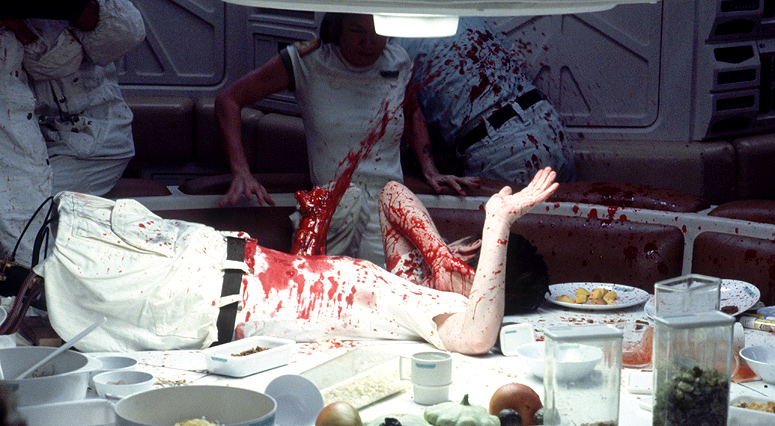
The scene that haunted my childhood
Somehow, I found some theories that claim that Alien is about feminist views, anti-feminist views, rape, Freud, parasitism, and how the facehugger acts as "payback for the many horror films in which sexually vulnerable women are attacked by male monsters. Wow. Scott, however, has a much more simple view on the matter: "...It's only point is terror, and more terror. It has absolutely no message." So, what's one to make of this weird, scary, possibly hyper-sexualized film? In my opinion... not a whole lot. Call it a cop-out, but I'm going to go ahead and say - others may disagree, but whatever - that we can take a lot of things away from Alien, but deep meanings and hidden messages are not a major part of this film.
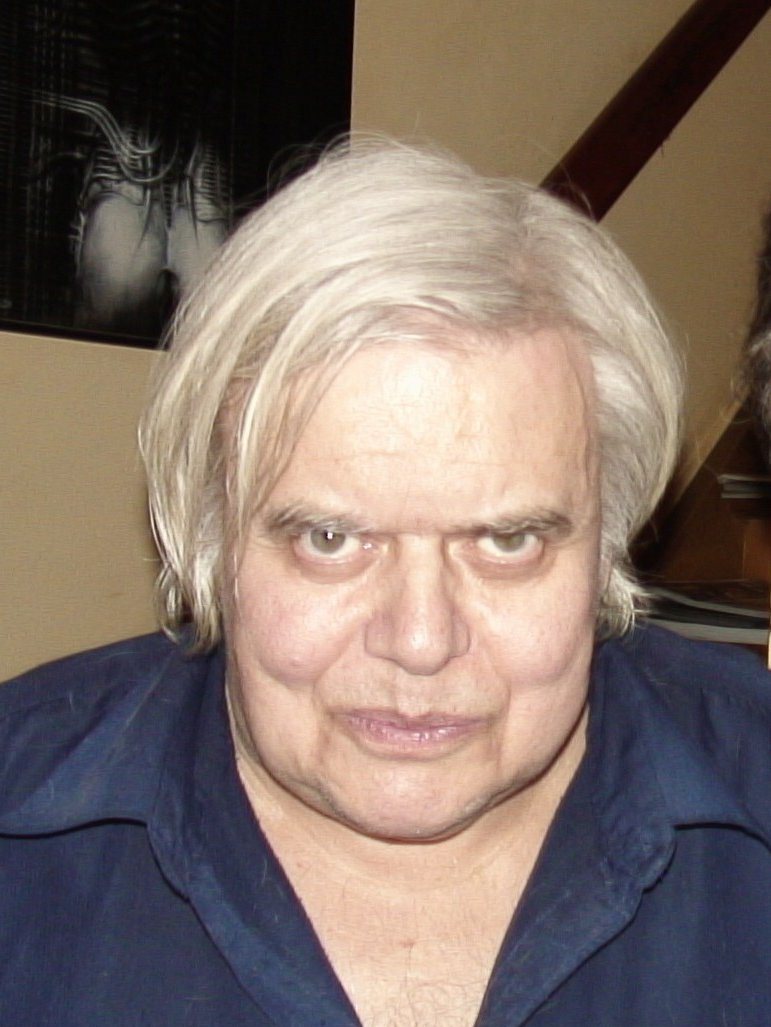
This is H.R. Giger, the guy who made the alien costume. I don't want to talk about him, just point out how creepy he is.
Alien has a lot good things going on: minimal dialogue, a convincing cast, and special effects that - for the most part - really stand the test of time. Seeing that little baby alien squirm around inside it's egg was getting me grossed out like no other, and some of the alien-planet shots, with Kane and the other members donning their spacesuit/headlamp combo, were almost indistinguishable from the same type of shots done in Prometheus (Scott's 2012 sequel/prequel that I think is unjustifiably underrated). The film is beautifully shot, and I can honestly say it's been one of the first movies I've seen where I could really say "ok, yeah, now I understand how important and badass set design can be." The combination of the close camera angles, long takes, and general claustrophobic atmosphere of the spaceship Nostromos really gives the whole film a sense of immediacy and tension, which only gets worse when a freaking alien is let loose on board.
The Alien itself is - ok, here's one of the only places I'll give in to the theory; his head looks like a dick - iconic. Scott crafted the film so that you would never see the full alien until the very end of the movie. Instead, he reveals it in different stages (egg, facehugger, coming out of John Hurt's chest) before slowly showing different bits and pieces of the fully grown thing. There were no special effects involved in the making of the alien, apart from the obvious practical effects, and there was actually an actor inside the costume of the full-grown adult. Now that I mention it, there was only ever one shot done on a bluescreen; the rest of the film - including many of the space scenes, were done with scaled-down models of the spaceships "flying' over a purely black background. Stars were later added in with double exposure.
All of the cinematography and effects aside, however, the thing that stood out the most to me was the combination of the dialogue and the lack thereof. I had never realized how profoundly quiet the whole movie really was. There's practically no dialogue at all for the last 20-30 minutes of the film, but unless you're really stopping to think about it (as I was. Thanks Arturo, you've ruined movies for me) it's not something that would ever stand out to you since so much else is going on. According to somewhere in this Wikipedia article, Scott encouraged his actors to improvise their lines, and he liked their improvisations so much that he decided to keep them in the film. As a result, the film feels much more gritty and realistic, without any unnecessary rants or monologuing that this type of movie might fall victim to. For a science-fiction/horror movie, I think it's the perfect balance of giving exposition through dialogue and simultaneously telling a very visual story.
FOREWORD: This is me being forward. I've been writing blogs for over a year now and I think that I'm ready to make what I call the "Miley Cyrus Transition." So far my blog posts have been family friendly-- the Hannah Montana of posts. Today I'm going to talk about something a wee bit sexier than hard drives-- this is my Wrecking Ball post. *You might not like it, but this is me now. The following content is NSFW.
*When I say now, I really mean like, this is me RIGHT NOW. Not in the future. I like talking about hard drives too much.
Everyone loves the sex scenes in television and cinema. It shows the characters’ passion for one another. It’s raw, instinctual, real. But it’s not really real. That’s why it’s awkward when your parents walk in during the sex scene in The Notebook and WORLD ENDING if they walk in on you watching porn. It’s fine if it’s in cinema because they just look like they’re having sex. But they aren’t. Right?
According to a Reddit user who claims to be an assistant director,
"There is absolutely no necessity for both actors to be naked and both have their ‘uglies’ bumping for real. If the director says “No, no they have to actually have sex,”– he’s not a real director." - Some guy on Reddit (you can see the whole post here)
Awh man. I wish someone had told me that earlier!
Hahaha just kidding. I knew he wasn't a real director.
Moving on, if the actors aren't actually having sex-- how come it looks so real on HBO?
Some movie magic on HBO's "Game of Thrones"
"HBO is sorta different in a lot of regards. For one they’ve made a name for themselves in how realistic they portray things, also they have some of the most highly professional crews in the field. Similar to the BBC nature documentaries, and Pixar for animation. Depending on the scene, the motivation, the cast, and other things regarding that they will make a call scene by scene basis. In a lot of instances I have to break some hearts by saying that it’s most likely a mixture of camera angles, body positioning, fantastic acting, and no doubt a bit of VFX wizardry. (They can now shadow out skin tone with relative ease, especially a show like Game of Thrones, that has their own VFX production crew.)" - Reddit Guy
Television and films have techniques for shooting these sorts of scenes in a safe, "comfortable" fashion for the actors. For example, during the more raunchy sex scenes the boy actors get to wear these super great things called, "*cock socks," and the girls wear "pasties."
*If there's another name for these I haven't found it
There's a "cock sock" made for every complexion
These go on nipples.
See? Now that's what I call a comfortable fashion. Click here to purchase your very own set of pasties!
Directors also place a special importance on the angles they shoot in during sex scenes in order to keep the actors as clothed as possible. For example, a director may have the woman drop her top and shoot her from behind. Or if they shoot from the front, they'll aim for the collar bone up. Many times directors will shoot a man thrusting waist up so that he can keep his pants on. It is very common to see deal terms in an actor’s contract such as, “You can show breast but no nipple; above-the-waist and side of buttock only; and artist has approval of body double, if used.” Body doubles (they are what they sound like) will be used in instances where a film requires more nudity than the actor is comfortable.
One of the story lines in Richard Curtis' film, Love Actually follows a plutonic pair that are body doubles for adult movies.
Regardless of all of the efforts to minimize on-set awkwardness, filming sex scenes is still always awkward. Fairly recently, director Joe Carnahan released a behind the (sex) scenes look from his most recent film, Stretch. This clip is revealing in more ways than one.
Disclaimer: There is no nudity in this video. (sorry)
Cool right? My favorite part was seeing the slate clap. My other favorite part was when Brooklyn Decker had to tell Patrick Wilson that she was just, "lifting... it."
Technically speaking, here's what I noticed:
Carnahan made sure that there was music playing in between each take. This helped ease the awkwardness of the situation and I'm sure helped the actors relax a bit. I can just imagine the "sound guy" anxiously awaiting his cues with a trembling finger on the play/pause button. They probably had a playlist made specifically for this.
And then there was the "sweat spray lady" who came in with an aerosol spray bottle to routinely re-moisten Wilson's back. Despite the absurdity of the job, the wet look makes the scene all the more realistic (and more aesthetically pleasing).
On a more subtle note, Carnahan encourages the actors by saying, "do another one like that and we got it." While encouragement is nice for the actors, Carnahan also understands that, unlike the real thing (by real thing I'm referring to the act of engaging in sexual intercourse), the faster you can wrap a sex scene the better the results. Not unlike the real thing, too much thought can cause the actors anxiety and their performances may come across rather “limp.”
In 2012 film producer Gavin Polone interviewed a few famous actors about what it's like to really like to act in a sex scene. He didn't include the names of the actors that he interviewed for privacy reasons but he assures the reader that, "...they have all appeared in many films and you have most likely seen each of them onscreen a number of times."
All of the following quotes void of a speaker comes from Polone's Article. Here's what I learned today about sex scenes told through the quotes of great actors:
Many actors who have sex scenes together are also romantically involved.
“Like all actors, I have had an on-set romance and have had a relationship with the actor with whom I was supposed to be in love with. If the producer and director have done their job well, they cast actors who have chemistry, so it makes it easy to fall for them.”
“I once did a sex scene with a girl I had just started to date on the film we worked on. But it ended up being really awkward, because it felt like we were letting strangers into the bedroom. It also was odd because I became aware of the notion that we were just cliché actors doing what was expected of us; and worse, the notion that both of us started the relationship — more her, I know I'm pointing fingers — in order to help our ‘performances.’”
“Actors become very professional and proficient about watching out for each other’s light and not stepping on each other’s lines. All of these things are artificial, and you have to strip that away if you’re going to achieve a sense of intimacy. In real life sex is messy…” -Ryan Gosling to Wmagazine
Many actors who have sex scenes together are NOT romantically involved.
“I have had to do sex scenes with people who on some chemical level I was repulsed by, and that was hard work.”
“Usually when there is nudity involved there is no arousal, people are too freaked out. You're more likely to get acorn syndrome than anything else. I’ve had instances when they've been clothed and got hard, but not while naked. And for me, I don't think there was an occasion when I was fully turned-on, but there have been instances where it was pleasant as opposed to me choking back my vomit.”
"Every set I have been on save two have had the actors(s) significant others there behind the monitor." - That Assistant Director Guy on Reddit
Sometimes the actors get REALLY into it.
“Not to mention any names, but one actor came on me during the take. I had to surreptitiously wipe myself off with the sheet. Fortunately, I liked the guy. I found it a little flattering and a little creepy. We never talked about it, so I can't tell you if it was Method acting on his part or if he just found me pretty, but I suspect I'm not the only actress who's had this experience. But I can tell you that twenty years later, when I run into him, my first thought is, There's the guy that had on-camera sex with my abdomen.”
“Arousal during a sex scene, ironically or not, is pretty much the only thing that can make it truly enjoyable. It's hard to categorize it as "work" if you're lucky enough to attain this kind of Nirvana on a set. And usually, let's be honest now, who is going to be offended if someone knows they turn you on?”
Amanda Seyfried talks about sex.
“Sex scenes are great. A lot of my co-stars have been sexy guys my age, and so, why not? I’m not going to pretend it’s not fun.” -Amanda Seyfried
Sometimes the actors REALLY don't get into it.
“Making love on camera is such hard work that there is no time for the libido to take over.” - Julie Christie
“You’d think it’d be hard not to get a boner, but it’s relatively easy not too. It’s a totally different situation when you’re being told how to lay, you’ve been on set 7 hours, lunch was an hour ago and it was chilly, the room you’re in is 100 degrees, there’s 10+ people all exhausted and expecting you to perform and get it right the first time so they can move on. It’s it’s all about the girl in the scene, and every time you miss a mark, you have to do it again. All this without taking into account multiple angles, you have to do the same thing at the same time every time, if you have any lines … remembering those lines. Also, you may have just performed a scene in which you were crying and thinking about your dead dog from 7th grade.” -Reddit Guy
“Everyone's got an ego: especially actresses. The offense for many actors, I'll bet my boots, is actually when the actor fails to get aroused — actors are already so insecure that for some, that's all the confirmation they need to realize the entire universe is pitted against them.”
Boys and Girls Have Different “Stuff”
“Men are sometimes as freaked having to go shirtless as women are getting naked altogether. For me, once I was down to my undies, or a string bikini, I might as well go for broke. What's a nipple or two between friends? Several times I'd be in some flesh-colored bodysuit or G-string, but they'd keep catching the edge of it on-camera, so I'd just take it off to expedite the filming process. Since I never did an X-rated movie, I trusted that whatever body parts they caught on film that they didn't want, they'd deal with in editing. Unfair? Probably, but there are so many unfair things about being a woman in film — and other industries — what's one more?”
This is a hot dog.
“Let's face it, for male nudity to be anything meaningful they have to show their dick. A woman doesn't have to go all the way for it to be a big deal. Guys have so much at stake: "Is it big enough, is it shaped well, is it all shrunk up?" It is harder for a guy to be aesthetically pleasing when naked, in my opinion.”
“I don't think it's unfair that women show more nudity in movies at all. As a dude, the truth is that a man's package is way more, well, visible. You're never going to see much more than a bit of muff from a woman in a scene, and that is really little more than the coming attraction for what really lies beneath. On the other hand, once you see an actor’s dong, you've got a pretty good idea of the kind of firepower he's packing.”
“Sex scenes can be quite awkward. As a guy, the first thing you want to do is make sure you’re not taking advantage,” he told PopSugar. “You don’t want the girl to feel like you’re getting a free feel or something. I try to make a fool of myself in one way or another to lighten the mood and then just go for it, because you don’t want to be doing take after take.” -Michael Fassbender
Welp, that's all I got. I hope you all learned something today. I know I did. Before I leave you, here's a word of advice for all of you inexperienced actor types courtesy of the infamous (but pretty helpful) Reddit Guy.
Art?
It’s not rude or inexperienced to request things from the crew… Make sure that everyone’s rights are protected. The footage goes to a lot of people, and if it’s an indie film … I doubt it’ll be like Hollywood where the rushes are kept under lock in key, most likely it’ll all be shot on digital. Due to this, anyone can end up with the footage, so make sure they are only shooting stuff relevant to the film. (Thus the shot list prior.) If an actor doesn’t feel comfortable showing their nether regions, they can shoot it without showing them. If an actress isn’t comfortable the guy being fully nude while she is full nude and simulating sex, they can shoot it to not show it. Film is all fake. Protect yourself from getting into getting into sketchy territory where you have to wonder whether this is all just a way for an artsy fartsy dillhole to get his rocks off while saying it’s for ‘art’.
I recently saw Frank, written by Jon Ronson and Peter Straughan, at Cinemapolis. Directed by Lenny Abrahamson, Michael Fassbender plays Frank, a rock star based loosely on Chris Sievey, an artist who performed in the '80s and '90s under the name Frank Sidebottom while wearing a fake head, and who Jon Ronson toured with at the time.
Chris Sievey (the inspiration) and Jon Ronson
I know what you're thinking, "Michael Fassbender wears a fake head the whole time? You mean, we don't get to see his beautiful face?" I thought it was crazy, too. But there is meaning behind it.
First of all, as I said, Frank is inspired by Frank Sidebottom, who did actually wear a fake head. Second of all, the character of Frank in the film has severe mental illnesses that cause him to want to wear this fake head and do other sad things. The dark comedic moments complement the serious undertones of this film. A lot of people don't understand mental illness or have a lot of misconceptions. It's a very taboo topic that people don't like to talk about. I think Frank touches on that and portrays mental illness in a very accurate and powerful way.
The Wire interviewed writer Jon Ronson to discuss this portrayal of mental illness and the parallels between fiction and reality. Here are a few great quotes from Ronson: "...It just interested me so much, that kind of beautiful naïveté when you’re young and see the tortured artist as being fabulous, and then when you’re faced with the reality of being with a tortured person and it’s not at all fabulous. It’s not fabulous to the person and it’s not fabulous to the people around the person." "It felt like it probably would have been irresponsible to make this film that says you should aspire towards torment and mental illness because that’s where the great art comes from, when usually it’s the opposite of that."
"People have kind of strange relationships with mental illness... We love nothing more than to declare other people insane. We always want to turn [mental illness] into something that it isn’t, so one thing I really wanted to do in the film was turn it into something that it is. The reality of what it’s like. Toward the end of the film Jon gets everything that he wants, he gets Frank to himself and it’s like What Ever Happened to Baby Jane? It’s really bad. He’s stuck with this damaged person and it’s not like the way he wants it to be at all."
There's a scene in the film in which Jon meets Frank's parents. Jon asks about Frank's upbringing and asks if something traumatic happened since he has mental problems. Frank's parents reply with something along the lines of, "No. He's had a normal life. It's just his brain doesn't work properly." Also, when Jon assumes his mental illness is the cause of his brilliant artistry, Frank's mother says, “the torment slows him down.”
NPR writer Tomas Hachard writes a great review of Frank, stating: "For most of Frank, Abrahamson walks this potentially offensive line largely by playing it as part of Jon's ignorance: At the cabin, Jon excitedly explains, "I have found my abusive childhood, my mental hospital, that which pushes me to my furthest corners." The film quite clearly means to deride the notion — heard particularly when discussing outsider art or musicians like Daniel Johnston, who Abrahamson has said also inspired the film — that mental illness can somehow be a path to boosted creativity...
Yet toward the end, there are suggestions of a lack of compassion for some of these characters. After letting the audience think it's OK, if not necessarily tasteful, to laugh at jokes about attempted suicide, the story shifts and we are left to question if there was ever any humor in it at all. Whether the film fully accomplishes this transition from comical (and almost sneering) to empathetic is its own open question. My vote says it does, but it's a fine line, one that Frank necessarily risks overstepping with its complex, but worthwhile, attempt at being facetious, satirical and emotionally bare all at once." I agree with Mr. Hachard whole-heartedly and highly suggest you see it to decide for yourself.