Showing posts with label narration. Show all posts

Monday, November 16, 2015

Clockwork Orange

This semester I've been trying to watch on the films that I've been chastised for not watching yet. It's been a great ride so far and a lot of the classics I thought were over hyped actually turned out to be pretty great! However every once and awhile there come a time when I flick on a film that really grips me. And this time dear friends and trusted readers, that film was Stanley Kubrick's a Clockwork Orange.
Spoilers Y'all
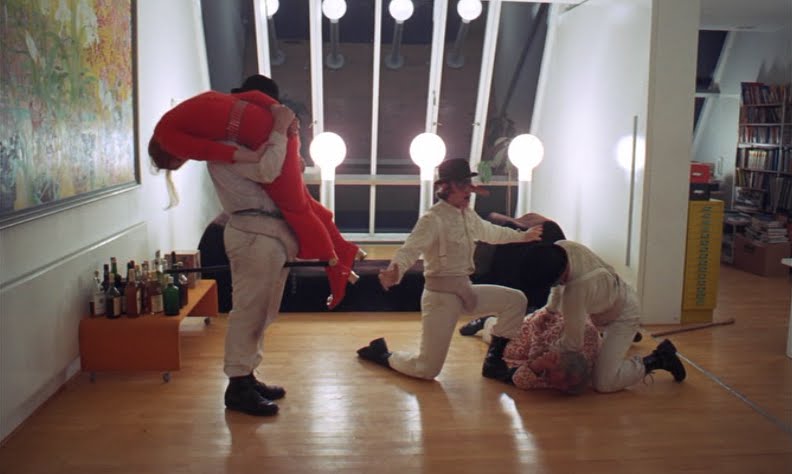
I really didn't know what I was expecting coming into the film. For years I'd heard that it set the bar for ruthless onscreen violence, and for the most part it lived up to the hype. Sure we may see more Ultraviolence nowadays, but I'm sure that back then this film really was a real horror show. Overall I loved the film, I loved the character of Alex as a self aggrandizing psychopathic narcissist, I loved the sets seen below:

And I loved how the change the main character goes through. I feel as though most of what I loved about this film can be summed up in the following clip, which I don't suggest you watch if you haven't seen the film. It's wacky, weird, and works wonderfully to frame the psychological instability of the main character.

Thursday, November 14, 2013

History of the Intertitle

           For this week's post I am branching off a topic I covered on my blog in the Motion Graphics & Animation course. Since I gave the evolution of the title sequence in cinema I thought it would only be fair to do a little segment on the intertitle also referred to as a title card. These filmed printed pieces of text generally conveyed dialogue or narrative on screen to the audience and were simply known as titles during the silent film era. The earliest known use of intertitles was in 1901 for the British film "Scrooge or Marley's Ghost." Here is a look at the silent film and also the intertitles toward the end.


In film today intertitles are still utilized every once in awhile to distinguish various acts of a film or provide a poem, quotation, phrase, etc... Although with the development of sound on film their are still traces of this technique as a modern day artistic device. For example even though intertitles aren't used to narrate the film anymore they are used in Frasier as a gimmick, in BBC's drama Threads and lastly in Law & Order to give date and location; sometimes even more information. Intertitle/title card may be a term of the past but is still apparent in our media world today. Here is some more examples of intertitles...

"The Birth of a Nation" (1915)

"The Cabinet of Dr. Caligari" (1920)
This is a slightly more stylistic intertitle/ title card.


Wednesday, October 24, 2012

The Chinese Wall

In my screenwriting class we watched a film titled "The Chinese Wall". The film is about a woman dining in a chinese restaurant alone on her birthday. The film is mainly told from the narration of her internal monologue. This is usually a big no-no when writing for the screen, but works really well for this film. I wasn't into the film at first, finding the subtitles tiring and the action on screen not very captivating. About half-way through the film, I began to get involved in the story. It is very interesting and relatable. The woman begins to people watch and make stories and assumptions about the people around her. It is later revealed that she was wrong about everyone, and the ending is heart warming. I found this film interesting because of it's successful use of narration. I also really liked the story and found it relatable since I often find myself people watching and wondering what their stories  are. It is human nature to try and figure out what people's personalities and stories are. This leads us to come to false conclusions when we don't have a sufficient amount of information about them. I posted the clip below if you are interested in watching this film.