Showing posts with label horror. Show all posts

Thursday, November 5, 2015

Cloverfield

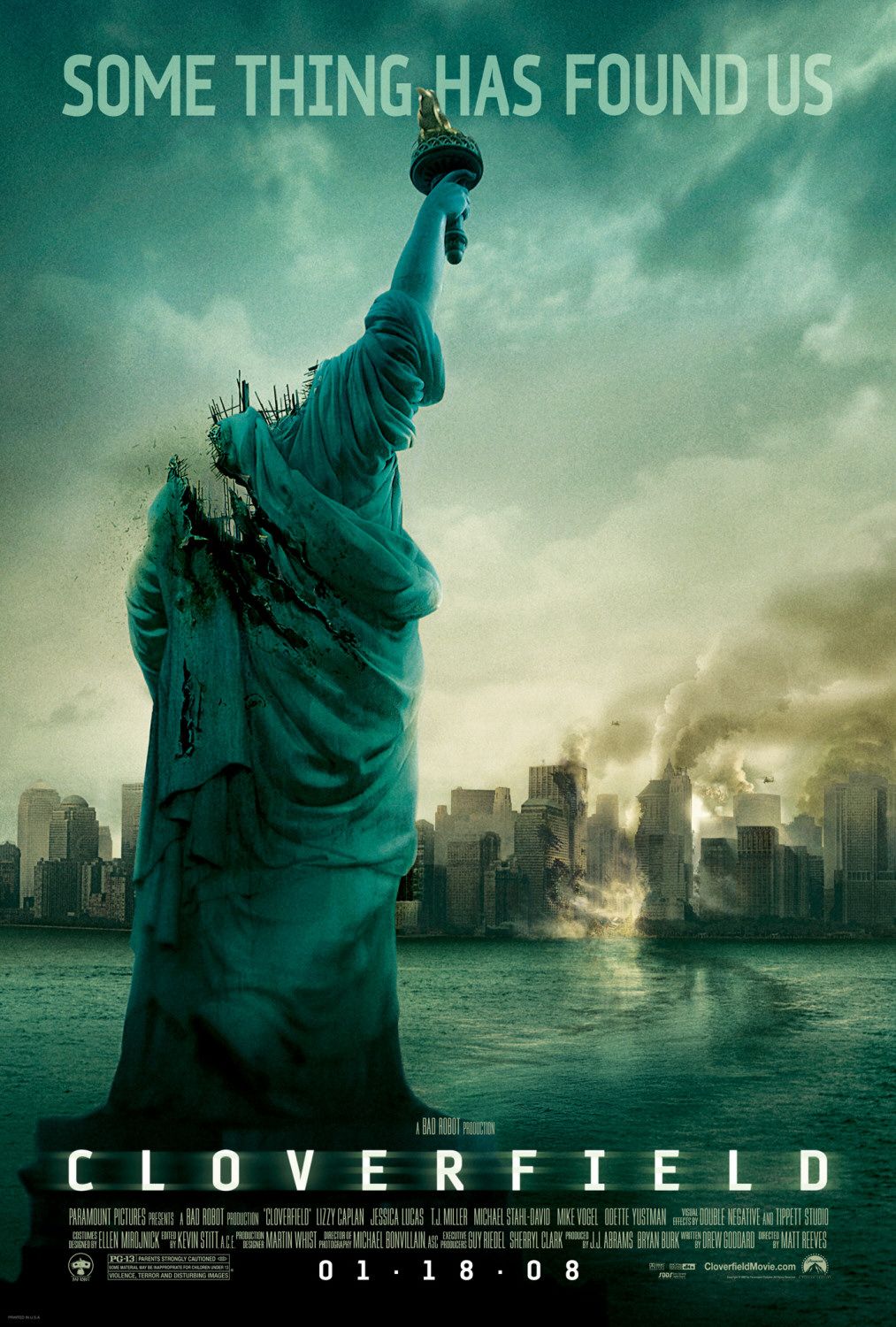
In the realm of novelty movie genres, found footage is probably one of the most famous, and also one of the most divisive. People are always kinda torn on whether or not they like this style. On one hand, it provides and interesting change of pace from typically movies and allows for some cool tricks. It also gives some better insight into the characters involved, seeing them from an up close personal space. On the other hand, found footage movies are typically shaky and can easily cause viewers to get motion sickness. The reason I bring this up is because these were some of the comments surrounding J.J. Abrams' 2008 sci-fi film, Cloverfield.
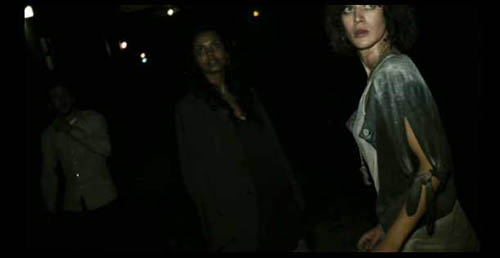
This movie revolves around the idea of a group of friends trying to escape New York as a giant monster starts wreaking havoc on the city. This style of filming was used before, in movies such as The Blair Witch Project, and has since been used many times, like in the Paranormal Activity series of movies. However, when this movie first came out, it kickstarted the trend. It was really interesting to see how the characters react in the situation and every little nuance of their personality that gets caught on camera. Another nice touch is how they used the effect of stopping recording, as periodically, seeing how the camera guy is recording over another characters video which gives some background to the movie, it switches between the present with the monster and the past with the boyfriend and girlfriend on their date. The main criticism is, of course, the shaky camera, as it made seeing what was going on difficult and did make some movie goers motion sick.
Overall it was a solid and enjoyable flick that gives a new perspective to the millions of people running from the monster instead of the heroes fighting it off.

Sunday, October 25, 2015

Rosemary's Mise-en-scene

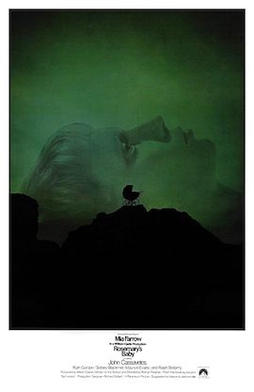
In preparation for shooting our film I've been going through my netflix que and watching every old horror movie I can find. Many horror films share similar thematic and cinematic tropes with one another, so it's been an incredible helpful exercise for me when I was writing the script. I've just finished the film "Rosmary's Baby"

One of the biggest hesitations our group has in shooting at 918 Danby is that many of the walls if not all of them are stark white. I've been told this will cause issues with lighting and wardrobe, and for the past few day's I've been really worried that our locations pure white walls would be the end of us. However after watching Rosemarie's Baby (a film shot in an apartment painted entirely mental asylum white) I found that I really like the way the white backgrounds interacted with the characters. 

First off our main characters are young newlyweds and are fairly new to the city of New York. This motif is reflected in many of the shots where we see them talking and interacting with each other.


The light background sort of blends together to highlight the drama surrounding the couples problems communicating to one another. The background also helps to give us an idea of how new their relationship is both to eachother and to their new city. We see evidence of this when the two young lovers go next door to visit their elderly neighbors. 


Herbert's study practically overflows with visual intrigue. Just from this one shot we can tell what kind of man he is and what kind of life he leads.

Rosemarie's baby is certainly a must see if you're interested in production design.

Monday, October 19, 2015

One Does Not Simply Record Nat Sound

Sound is important. Like really important. I think it is one of the most underrated fields in contemporary cinema, simply because if it is done well you shouldn't even notice it. That's sort of the point; no average viewer walks out of the theater complimenting the foley artist, they are the unsung heroes of a great film. If the sound design is believable and helps immerse the audience in the story world, then it has done its job. Sound design and foley has always really interested me, and after talking about it in class today it made me really excited to have some kick-ass sound in our horror short Dollhouse. But more on that later.

I wanted to focus more on some awesome sound design goodness. The Lord of the Rings trilogy has a really intense and creative sound design Led by David Farmer. The sound design has a lot of one-of-a-kind "original" sounds you would expect from a fantasy epic. Movies like LOTR pose a particular challenge because of the fantasy element in the story; it's hard to foley sounds for fictionalized,mythical creatures. It take a lot of creativity to be able to make these crazy, fantastical sounds from everyday objects and even human voices. Unfortunately, I was unable to find the video that I wanted to share that goes in depth about the sound design of LOTR (damn copyright laws), but here is the next best thing that still gives you an in depth look at the creativity behind the sound design. It also goes into a little bit about ADR and the challenges they faced with changing frame rates throughout the film, but that's all just bonus. It says that about 98% of LOTR Fellowship used ADR. Ouch. 

Here's the video:


 The creativity and skill that goes into the sound design of a film really blows my mind, especially on such an ambitious project like LOTR.  Not only are you responsible for every sound on screen (thats every footstep, every arrow shot, every armor clink), but to also be able to use everyday objects to produce fantasy sounds with limited digital manipulation is no easy task; it requires an in depth understand of the physics of sound as well as the overall "vision" of the sound in the film. For example, the voice for the tree character (specifically an "Ent"-thanks wikipedia) was created by building a resonant chamber with specifically calculated bends and turns to produce a very hollow, echoed sound when spoken into. With relatively little digital manipulation, the sound team was able to create a really cool, unique sound. 

As far as our sound design for Doll House, I see the potential for a lot of cool opportunities. I think when used effectively sound can be one of the scariest elements in a film because it forces the viewer to imagine what is/could be making that sound, resulting in a personalized mental image that hopefully scares the shit out of you. Unlike a visual image, it lets your sub-conscious make decisions, bringing out what each individual finds terrifying and bringing it to life. For most of our "spooky scenes" I think creaks and moans from the hardwood floor will really play well with our location, paired with an intense score to really bring out the tension and helplessness in the scene that will (hopefully) makes the audience squirm in their seats. That being said, I think silence also plays an important role in a horror film, helping to highlight the visual element and making your imagination run wild within the frame. I delicate balance is needed, and I am excited to help Sam with the sound design after we wrap production and my duties as AD are essentially over. 

Its going to be a challenge, but in the end I think sound design will really help set Doll House over the edge.


Friday, October 16, 2015

Grand Designs and Flat Characters

If you're at all interested in horror or thriller movies chances are you're aware of the brimming box office success of director Guillermo Del Toro's (spelled his name right first try) newest film "Crimson Peak". Crimson peaks follows the story of a wealthy american heiress, played by Mia Wasikowska, who finds herself wed to struggling English inventor, played by Tom Hiddleston.

Mia is whisked by her new lover from the comfort of the streets of buffalo New York to a grand and desolate mansion in the heart of  the English countryside. After a few nights it becomes both clear to Mia and the audience that something ghostly is a foot, but for the sake of spoilers I'll spare you all the details of the rest of the plot.

Overall the film is gorgeous, I really found myself being sucked into the frame by the wealth of period details. Perhaps the only fumble on the part of the production design was in layering on too many heavy handed metaphors throughout. Early on in the film is compared to a butterfly and from that point forward there is distinct insect iconography in almost every scene. 

On the topic of butterflies, it's strange to me that Mia's character is compared to one so often despite the fact that she undergoes no character metamorphosis what so ever. Her character lacks any sort of motivation ; even when she's hit over the head with plot details that would leave any other person paralyzed with fear, she doesn't bat so much as an eyelash.

The film as a whole just felt a little bit too fast, like someone cranked up the speed on the haunted mansion ride at disney. There are a few scary parts, but the film jumps to the next scene so fast that you never get to seep yourself in the horror of the protagonists situation. I'd definitely recommend it to those of you looking to go into production design, but if you're looking for a truly gripping thriller you could do a whole lot better than Crimson Peak.

Sunday, October 11, 2015

Success of the Silence of the Lambs

Over the weekend I rewatched one of my favorite films of all time, Silence of the Lambs. The film has be hailed by many a critic and it's easy to see why, simply stated it's a goddamn masterpiece.

It's writing, it's production design, the casting, it call comes together in such a harmonious way. Each scene is rich with subtext and detail, and it does such a fantastic job of showing rather than telling.

In trying to write the character of a maniacal psychopath it's hard not to take a few pages out of the good doctor Lecters book. I see so many movie villains now a days with traces of his marvelously malevolent personality. I love the way we're introduced to him as a character.
First off we're given snippets of his backstory, how he killed and ate his patients for seemingly no reason. Secondly we're informed by an orderly escorting Clarice to Lectors cell of the unbridled brutality that Lector inflicts on others, even while he's still incarcerated. We're told that we aren't allowed to get too close to his cell, and that we can't tell him anything other than the information that we've been cleared to disclose. Every shred of information that Lector learns about you is ammunition he can use against you. With that in mind it makes it all the more chilling when before engaging Clarice in conversation, Lector smells the air for a moment and tells her what skin lotion she uses, and the perfume she wore the night before. It's chilling, invasive, and remarkably thrilling. While I don't think I have the writing chops to crank out a character with the complexity of lector, it's still extremely interesting to watch the ways he unnerves us, and take that as inspiration. 

Wednesday, September 30, 2015

Prepping to Make a Horror Film: Insidious 2

Over the weekend, I mustered up the courage to watch Insidious: Chapter 2. I am not an avid horror fan. I'm not a fan of horror at all, actually. Usually I see a trailer and then make a snap decision which is, "Ha! I'm never watching that!"


I have not seen the first of the Insidious movies, but my roommate told me that I didn't have to. Insidious: Chapter 2 is very similar to the first movie and picks up right where the first one leaves off, so she gave me a brief summary.  The first two Insidious films are about the Lambert family, who are connected to the spirit world through one of the sons, Dalton, and his father, Josh. In the first film, Dalton  falls into a coma and is tormented by evil spirits in another realm called The Further. The family seeks the help of Elise Rainier to bring Dalton back to reality. At some point in the movie, Josh goes into The Further to bring Dalton back, but an evil spirit follows him out and continues to haunt the family throughout the second film.

There was a lot that was visually scary, but if I had watched the movie on mute, I'm sure I wouldn't have been as scared. The sound was so powerful. The score sounded like it had a lot of strings; I expected that. But I think what was most scary was the pairing of a quick, jarring sound with a striking or strange image.

This short scene is great for sound design analysis. Specs and Tucker, two ghost hunters, are in the house of Parker Crane, a man who died many years before that is connected to the Lambert family.


This scene is very short, but it's clear the sound sets up the audience to be spooked. The first line of dialogue, "Let's get out of here," is accompanied by silence. Then you hear the floor squeak for a second, until the sound grows and you realize it's coming from the rocking horses behind the guys. The rocking horses rock faster and faster until a little boy runs across the frame yelling "This is my room!" This is paired with a jarring, non-diegetic sound. These non-diegetic sounds inserted at key moments let the audience know what they should be scared of.


Another example of this is when Dalton recalls a dream he had the previous night. At 0:42, a strategic jump cut to a wider angle, coupled with the jarring sound and scary image of the woman in the white gown makes the audience jump. I hope to implement this strategic and classic horror ingredient in our film, Dollhouse.

Wednesday, September 2, 2015

To Grandmother's House We Go

I've recently taken an interest in the Horror genre, even more so now with my involvement in our class project, Fallen Angel. I have watched a lot of horror/thriller films and one thing that really sticks out to me about this genre is just how easy it is to make a terrible film. Horror can be a tricky beast. I would argue that horror is the most emotionally/psychologically involved of any genre in contemporary cinema. Striking fear and evoking a physiological reaction from the viewer is no easy task, as evidence by some of the horror 'flops' we have seen in the past. 


Some notable flops are: 


While these titles range from the bizarre to the down right ridiculous, they are but a small piece of the mountain of failed horror movies out there. 


A recent film coming to theaters soon that has caught my horror eye (and made me groan) is M. Night Shyamalan's The Visit, a horror (comedy?) centered around two children's first visit to their grandma's house. The grandparents are typical, sweet old people, until 9:30pm, when they become some mysterious, cult-driven type of insane. Yeah, that's right. M. Night Shyamalan is making a horror film about visiting your grandmother. At first, I thought this had to be a joke-until I saw good ol' M. Night's name in bold letters at the end of the trailer. Then I knew this was for real. The film comes out next week, and I am very tempted to go see it. 

As a horror fan, I'm not going to lie: my expectations are very low. With the kind of creepy tagline "Don't worry, its only Nana" I don't see this film getting my heart racing or getting me engaged in the narrative in any way. The best horror movies are the ones that not only scare you with jumps and make you squirm through intense long-take shots, but also (like any great film narrative) make you forget you are even watching a film- you become absorbed in the helpless world of the main characters. 


This film made me think long and hard about my own venture into horror with our project Fallen Angel. There is a tasteful way to produce a heart-pounding horror flick, and I hope that we as a group think long and hard about our limitations and capabilities both as students and filmmakers. To avoid this project becoming "hoaky" or missing its mark, careful attention to detail is needed. I think an intense focus on sound design will help push this project in the right direction, as well as stellar casting and editing to put it all together.

 Horror films are meant to mess with your minds and make you feel uncomfortable, a feat that isn't easy to accomplish on a two dimensional screen. We all know examples of horror movies that just simply missed the mark. The Visit may soon be added to that list- hopefully I am pleasantly horrified when I go see it in theaters. I may not have the recipe for the perfect horror movie, (yet-stay tuned) but I just hope that Fallen Angel can live up to expectation in this challenging genre of film.


Friday, October 31, 2014

Not Another Halloween Movie: The Rise of Slasher Films

Dun, dun, duuuuuun! Another conveniently holiday themed blog post! And every year when Halloween comes round, the first thing that comes to mind for us film buffs is usually the slasher film genre. So stick around... if you dare, and let's do this thing.


A Little Bit of History

The sub-genre known as "Slasher Films" dates back to the 19th century French theatre plays known as The Grand Guignol. It was a violent, shocking form of theatre that was a pioneer for horror films in general, but that's a whole other blog post's worth of information. Oh wait, I did do a blog post on it. Check it out here if you want more info, or wikipedia it or whatever. Anyway the real stuff started with Alfred Hitchcock's infamous film, Psycho (1960). Although the character Norman Bates wasn't technically a serial killer, he paved the way for the big stars like Michael Meyers, Freddy Krueger and Jason Voorhees. The subgenre itself was a hybrid of thriller and horror films from the 70s and 80s, starting with Black Christmas (1974) and Texas Chainsaw Massacre (1974). But, the movie Halloween (1978) really defined the genre. Close after came Friday the 13th (1980) and A Nightmare On Elm Street (1984), which solidified the famous trio of psycho killers (mentioned above) places in film history.


What's a Slasher Film?!

For those of you who grew up under a rock, the definition of a slasher film is a subgenre of horror and thriller, usually involving some kind of psycho who kills a lot of people. But, what sets it apart from splatter film or psychological thrillers is that most of the time, it follows a pretty recognizable formula:

1. Sexy Lookin' Teenagers: That's right folks, what's a slasher film without a bunch of beautiful, unsuspecting, high school/college kids? I guess it's less satisfying to watch ugly people get murdered in horrible, horrible ways.

2. Sex, Drugs and Alcohol: You know the drill. All the beautiful kids get together at a party and participate in risqué activities and drunken debauchery, until it's broken up by many of the guests' guts being spilled all over the place.

3. Psycho Killer: There's no slasher film without someone doing the slashing. The psycho killer is usually equipped with some kind of unconventional weapon (chainsaw, blade, axe, etc...) and may possess supernatural abilities, like never, ever, ever dying. Ever.

4. Teenagers Get Killed Off: One by one they fall. If you're sexually active, stupid, ridiculously heroic or a minority, then sorry, you're probably not going to make it. Which leads us into the final rule of a slasher film:


5. Final Girl (aka Survivor Girl)

The final girl of a slasher film is the last woman/girl alive to face the serial killer. To be a final girl, you usually have to have some of the following characteristics:
  • Sexually unavailable or virginal
  • Avoids alcohol/drugs
  • Have a unisex name (Laurie, Sidney, Teddy, Billie, Georgie, etc...)
  • Short hair
  • Spend half of the film terrorized, then overcome your fear through masculinity
  • Become masculinized through "phallic appropriation"
That last one refers to stabbing the psycho killer with some kind of long, pointy object (get it?). Typically, a final girl has quite a few masculine qualities (like the short hair, or the name) and steps into that role when they overcome their fear of the killer and fight back. There are many theories about whether or not slasher films are feminist or anti-feminist, but the best discussion about it that I've seen so far is Carol J. Clover's Men, Women, and Chain Saws: Gender in the Modern Horror Film (1992). Check it out if you have the time.


Examples of Slasher Films

And finally, here's some examples of slashers films:

  • He Knows You're Alone (1980)
  • Dressed to Kill (1980)
  • The Boogeyman (1980)
  • Hell Night (1981)
  • Jagged Edge (1985)
  • Halloween (1978)
  • Friday the 13th (1980) - which was notably the most successful horror franchise of the 80s.
And if you're like me and love a good satire, you should check out the film Behind the Mask: The Rise of Leslie Vernon (2006). It's shot mostly in documentary format and follows a film crew who interviews an alleged legendary psycho-killer, and how he keeps up the appearance of the supernatural aspects of the legend. It's a funny film, but also provides a really good insight to the sub-genre of slasher films.


Happy Halloween folks! And if you decide to drink tonight, remember that there's always a chance that you may be murdered by a psychopathic killer.

Wednesday, October 29, 2014

A tribute to horror films... just in time for Halloween!

It's that time of year again. Trick or treaters everywhere, candy by the boat loads and costumes from the elaborate and clever costumes to the put together at the last minute costumes. But to be honest my favorite part of Halloween is the movies. They can range anywhere from the family oriented movies like Hocus Pocus or the more horror style of movie like Nightmare on Elm Street.  I prefer the horror style of movie this time of year.


Now none of these films would be around if it weren't for the pioneer of horror films, Mr. Alfred Hitchcock. Many of his films are considered to have established the benchmark for horror films. Almost every horror film can have at least one of their cinematography techniques traced back to one of Hitchcock's films. During their time, movies such as Psycho and The Birds terrified audiences. With clever cinematography and editing techniques, Hitchcock was able to strike fear into the hearts of audiences all over the world. Never before has a movie been able to strike emotions into an audience quite like Hitchcock can.


But in recent years horror films have somewhat strayed away from Hitchcock's style of horror. There are still traces of the same kind of scare factor Hitchcock was known for but now horror films are aiming for what I like to call "Gross-factor." By that I mean they will do everything they can think of to absolutely disgust and shock an audience. Instead of making us jump out of our seats with fear, horror films now a days make us cringe in our seats. Some examples include, Ithaca College's own Dan Heffner's Saw series, The Hills Have Eyes series, and The Human Centipede series.  I believe that these films are redefining the horror genre. The Gross-Horror films strike fear into it's audiences by grossing them out beyond their wildest imaginations.


Lastly, scary movies have become a part of Halloween more than ever. Iconic horror film characters such as Freddy Krueger from Nightmare on Elm Street, Jason Voorhees from Friday the 13th , and Michael Myers from Halloween have all become regulars as Halloween costumes.
You can't deny the impact that horror films have on people when deciding on what they want to be for Halloween. Its amazing the influence a movie can have on people.
 

Enjoy your trick-or-treating and watch a good horror film or two with your candy this Halloween. Happy Halloween everyone! 

Monday, October 28, 2013

The Remake Of Carrie


I'm not a fan of scary movies nor was I a fan of the old Carrie but I absolutely hate remakes! First of all remakes of the originals never come out as well. It always seems like the director is trying to keep the important scenes and similar lines but it always looks cheesy like a really bad knock off. Carrie is a 2013 American supernatural horror film. It is the third film adaptation of Stephen King's 1974 novel of the same name, though MGM and Screen Gems, who are producing the film, employed a script that reportedly more faithful to King's original novel.

In the first movie the mother was creepy and terrifyingly religious! I was afraid to be Carrie but in the new version the mother from the beginning always seemed weaker then her. Carrie's powers were more evident in the remake from early on. In the original she doesn't realize her abilities until later on in the movie. They changed a lot of the scenes that made the original creepy movie creepy. Chloe Moretz did an excellent job trying to live up to Sissy Spacek's original performance in the 1976 version directed by Brian De Palma. I will say the new Carrie has great visual effects and explosions that make Carrie's powers seem more real and believable.

It's the same movie just not as good I think. Some people enjoyed it like modern scary movies they have a good finish a big bang and the audiences tolerate them. For me the entire story needs to be good from start to finish.

Friday, October 25, 2013

You Don't Need Money to Scare the S*** Out of People

As a college student looking pursue a career in the movie industry, I have heard the same advice on countless occasions: 

"Movies? Yikes...You should probably study something more stable; like psychology, or art history." 

However, upon realizing that I'm pretty set in my decision to make films, people in the industry give me another piece of advice: 

"Start by producing horror. They're relatively cheap to make, and they have a built in audience." 

I decided to do my own research on the topic. How small of a budget can horror films have and still make a profit? Does a bigger budget necessarily guarantee a better movie? I started by comparing two horror films with very different budgets.

This is the trailer for the 2010 thriller, The Wolfman directed by Joe Johnston. It cost $150,000,000 to produce.


This is the trailer for the 1978 horror film, Halloween, directed by John Carpenter. The independent film had the minuscule budget of $325,000.


When looking exclusively at box office sales, The Wolfman outperformed Halloween; grossing a whopping $139,789,765 as opposed to Halloween's $70,000,000. Despite this, in the end, The Wolfman lost $10,210,235 while Carpenter's Halloween made $69,675,000. This comparison isn't the only example of low budget horror films ultimately earning more money than bigger budget productions.

Director Tobe Hooper's 1974 film, The Texas Chain Saw Massacre is my all-time favorite example of the little budget guys coming out on top. The thriller cost under $140,000 to produce and ended up grossing $26,000,000. Not bad Tobe. Not bad. 

For those who haven't seen it:


Horror movies will *almost always sell tickets.

 ( *I use the word "almost" due to the failure of the horror film Playback which earned exactly $265 at the box office in 2012.)

Horror films will always sell tickets, but they'll never be blockbusters. Some people just don't like scary movies. They never will. Luckily, there will always be those high school couples and adrenaline junkies that will go out and see anything classified as a horror film. Keeping this in mind, it doesn't economically make sense to spend millions upon millions of dollars to produce a genre of movie that targets a relatively small (although stable) population.

So in the end, the second piece of advice is correct. Scary movies are a great place to start when you want to break into the industry but don't have any money. Still, if horror isn't your thing, there's always porn.


The Cabin in the Woods - Purposefully Cliche

I recently watched The Cabin in the Woods (2012), directed by Drew Goddard, to prepare myself for Halloween. (I normally don't like too many "horror" movies because of how cheesy they can be, but this one was slightly different.) A jock, a nerd, a stoner, a dumb blonde, and a virgin decide to get away for the weekend by going to a desolate cabin in the middle of nowhere. Before which, they were warned by a creepy old man not to go there. Sound familiar?

That's because you've seen it a thousand times in every other scary movie.

However, The Cabin in the Woods played off of these normal cliches in a clever way. I won't explain in detail as to not give it away, but this movie is about ritual sacrifice. It's sort of The Hunger Games with a ritual sacrifice twist combined with every scary movie... If that makes sense.

The plot and writing (Joss Whedon and Drew Goddard, who worked together on Buffy the Vampire Slayer) are what really make this movie worth watching. They play upon the stereotypes of scary movies, referencing many things that have been done over and over again. For example, there are spirits, zombies, killer mermen, giant snakes, flying beasts, and many other horrible creatures. All these typical monsters come out all at once in an exciting, gruesome climax.

To be able to play off the irony of the stereotypical characters, they need to be very well cast. Chris Hemsworth plays the role of the alpha male, thick-headed jock well. Fran Kranz is superb as the "fool" pothead, who's theories turn out to be true this time. Jesse Williams, a bit boring as the nerdy nice guy, but it is always harder to play the straight character. Anna Hutchison has the easy character ("easy" in both senses), as all she really does is look good and scream. And Kristen Connolly - the "virgin" - also seems a bit boring at times, but has a little more intellect and character depth.

All in all, I really enjoyed this film. It's entertaining, as most horror movies are, but also has more substance.


Friday, November 2, 2012

"Oldboy", and The Vengeance Trilogy


This is a movie (or rather a 'trilogy') that I've wanted to bring up for some time now. I've always been a fan of foreign films, particularly Asian horror. However, this movie not only takes the cake, but the whole damn bakery.

Oldboy is the 2nd in a series of South Korean films referred to as The Vengeance Trilogy. From the mind of director Chan-wook Park, The Vengeance Trilogy are a series of films all connected not by characters or plot, but by one central, menacing theme: vengeance.

The other two movies are called Sympathy for Mr. Vengeance, and Sympathy for Lady Vengeance, the former of these two being the better one, in my opinion. However, this post will focus on the middle child of the triplets that I mentioned earlier, entitled Oldboy.

Oldboy is the story of a man named Oh Dae-su, on his quest to find the man who has, for some inexplicable reason, imprisoned him for the last 15 years of his life. When he's released, he is given money, a phone, and clothes. While searching for answers, Oh-Dae su starts to put his pieces together and figures out that his kidnapper has much bigger, complex, and painful plans in store for him.

Without giving anything away, I will assure all readers that Oldboy is a FANTASTIC movie and a complete and utter mind f***. It received an 8.4/10 on IMDB, and is what I consider to be the best movie I have ever seen.

While Oldboy definitely satiates my desire for graphic horror, gore in some places, and twisted plot lines, it goes above and beyond your typical thriller/horror flick. Oldboy connects the audience to the protagonist better than I've ever seen. The audience is just as much in the dark about what is going on in the story as Oh Dae-su is, and as a viewer, it draws you in like no other. The cinematography is utterly phenomenal, with a fight scene taking place in a hallway that is, in some reviews I've read, being dubbed as a "classic" fight scene (I'll post the link to it down at the bottom). Min-sik Choi is a fantastic Korean actor who puts on a beautiful performance as Oh Dae-su. Simply put, I cannot think of a single thing that is wrong with this movie. Every single aspect of it functions to tie together the story being told and, at the very end when the big reveal of the plot is made, leaves the viewer saying, "Holy crap, that was amazing".

I have watched this film about 3 times and enjoy it more and more every time I watch it. It is my favorite movie of all time and I recommend it to ANYONE who wants to see how a good thriller is made. Go on Netflix right now and watch Oldboy. You may have to look away and you may be uncomfortable at times, but I guarantee you will not regret watching this movie.

It's also got one of the best quotes from a poem ever. Laugh and the world laughs with you. Weep and you weep alone.


Here's the trailer, and the fight scene I mentioned earlier. Thanks ya'll.

-Nick

Trailer


Fight Scene (skip to :37)

Thursday, November 1, 2012

Repulsion


I love scary movies in general, but around this time of year it just feels appropriate. We all know that Roman Polanski is the master of dark, unsettling films that tend to linger in the back of your mind for a few days after you watch it. After watching Rosemary's Baby for the first time last Halloween, I decided to continue the tradition of creepy Polanski films and watched one of his classics, the psychological horror film Repulsion. Released in 1965 and starring Catherine Deneuve Repulsion follows the story of a young girl living with her sister in London who descends into madness, leading to a series of delusions and finally murder.

Deneuve's Carol is a painfully shy and withdrawn woman who has an increasingly severe paranoia/fear of sex and men. Carol's crippling fear is juxtaposed with her pure aesthetic and the perpetual ringing of church bells nearby. When her sister goes on vacation with her boyfriend, she is left her alone in their apartment accompanied only by her weakening mental state and the rotting carcass of a skinned rabbit intended to be dinner, that Carol just leaves to sit in the living room. Carol gradually goes insane, experiencing hallucinations of rape, men lurking in her apartment, and shape-shifting walls. She barricades herself in the apartment as a mechanism of protection and threatens the life of anyone who dares to disrupt her personal confinement.

The story is slow to develop- but that makes it all the more creepy. When you watch this movie, you really feel like you're witnessing the unraveling of someone's sanity first hand. Its almost as if Polanski intended that the audience be confined to the apartment with Carol, giving us this voyeuristic, suffocation of an experience. Despite being released over fifty years ago, the movie's horror factor still holds up. I definitely recommend watching this film.

Wednesday, October 26, 2011

Community's Halloween Episodes and Parodies


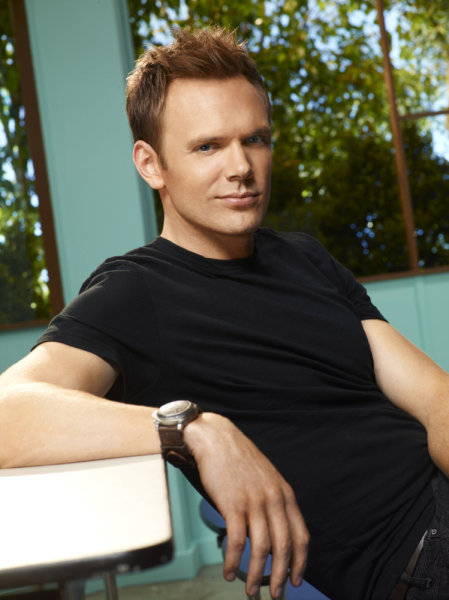
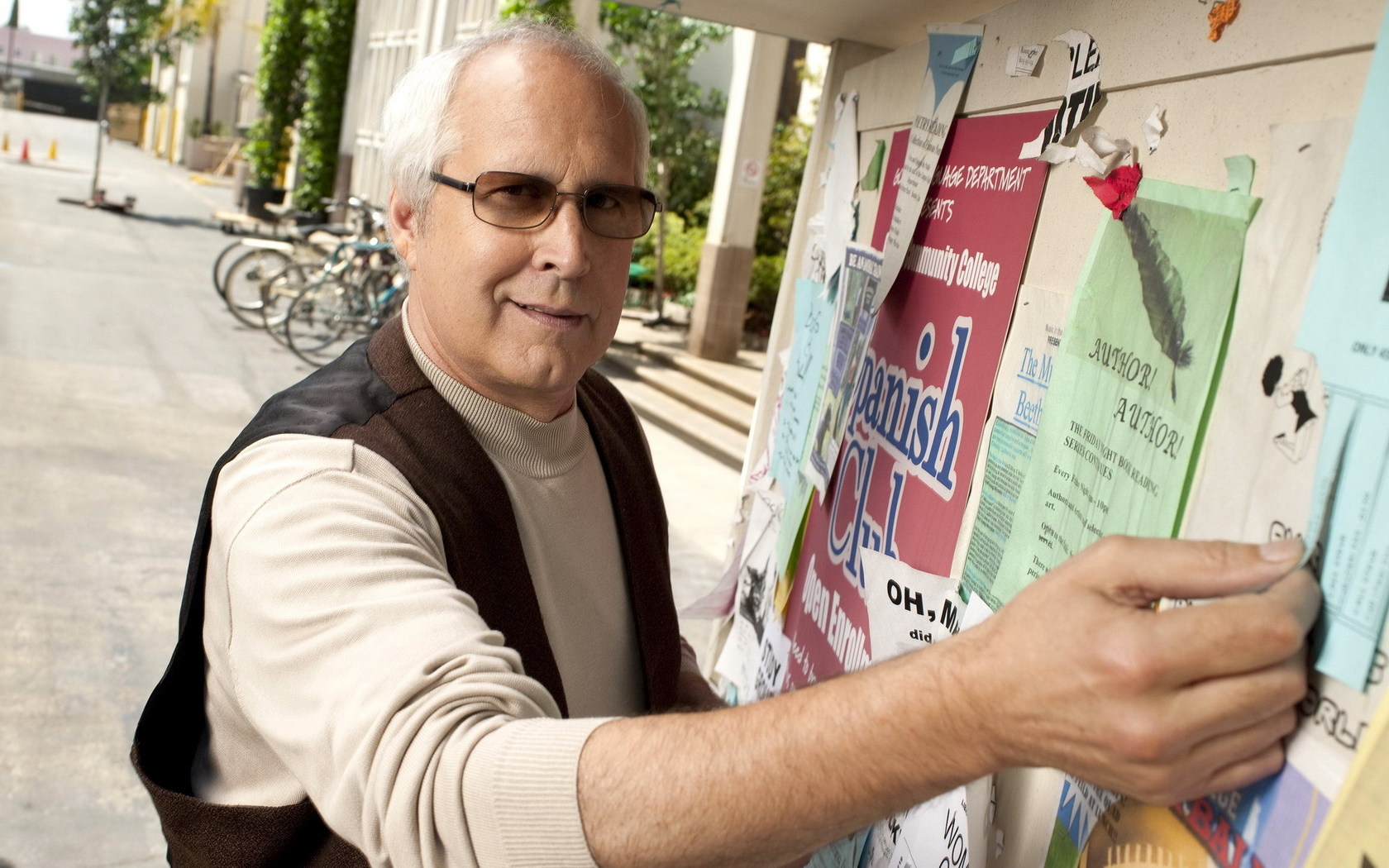
To many people Community is a television series about a group of students at a community college but it is so much more than that. The series heavily uses pop culture references and meta-humor often parodying film and television clichés. These episodes include a holiday stop-motion episode, a clip show of memories that never happened, a parody of westerns, and even a recent episode that had seven alternate timelines. Every single of one these are worthy of an entire blog post but today in the spirit of Halloween I am focusing on their annual Halloween episodes.

In the first season their Halloween episode was called “Introduction to Statistics” and dealt with Jeff and his decision to blow off his study group’s Halloween party in order to score with the young Statistics professor. However the b-plot of the episode is a great parody of superhero films and Batman. Abed is a student that is obsessed with pop culture and entertainment, much like the show’s creator Dan Harmon and the writers. At Halloween he dresses up as Batman and more specifically as the Christian Bale reboot version. At the end of the episode he saves the day as a chair and desk fort begins to collapse on Jeff who is trying to comfort Pierce about realizing he is old and “un-hip.” Jeff is usually the first to complain about the absurd behavior of Abed but at the end of the episode after he made his decision to choose the study group over the teacher he accepts Abed, his behavior, and his new batch of friends. The ending moment is then a straight parody of the heroic music and narration Batman will often do which was just recently seen in the movie The Dark Knight.

Last season the Halloween episode was called “Epidemiology” but most fans know it has the zombie episode. In this episode the study group is left to fend for themselves when their classmates become “zombies” due to tainted food the Dean cheaply bought. While it was actually an outbreak of rabies instead of them actually being zombies, the episode features numerous horror movie clichés the would be seen in a zombie or horror movie. First was a cat rustling in an abandoned area. Many times in movies characters are often spooked by some animal like a cat flying past them when they are trying to hide and escape the real evil outside. Community parodied this by having the cat constantly keep reappearing and showing it unconvincingly flying across the screen. Another funny comment on horror movies the show made was on music. Usually horror movies have scary, dark, and very intense music but on Community the music was the greatest hits of ABBA mixed in with the Dean’s voice memos. Unable to leave that section of school to change the playlist, upbeat songs like “Dancing Queen” played as the zombies attacked and bit the study group. Finally another comment on horror movies (or any movie in general) came when Troy tries to run through crowd to save the day and turn down the thermostat (which is believe to slow down the symptoms of the zombies before they suffer brain damage). While normally the action hero will burst through the group and destroy all the bad guys in his path, Troy is immediately attacked and stopped. He ends up reaching the goal but after he was bit himself.

I love Community and their themed episodes like their past two Halloween episodes. Tomorrow night at 8 pm on NBC their third episode airs called “Horror Fiction in Seven Spooky Steps” and I am sure based on the title and the prior history of the show that it will continue to make fun of and comment on horror movies, pop culture, and entertainment in general. I for one can’t wait for the hilarity and references to ensue.