Alright! Let's do some Shots! NO, not those kinds of shots, Films shots! (It's not the weekend yet kids!)
Today, in class we spoke about the importance of shots and frame. Ever since we discussed this in fiction field 1, a year ago (time flies), I've payed closer attention to the films I watch and I note the placement of the characters. Sometimes, it helps me understand a little better of what's going on in the film. Have you ever watched a film where you were completely lost? Most people at that point shut it off and never return. I try harder to understand, I like to give em' a chance! They could explain everything later! Anyways, I found sometimes I'll try to interoperate the choice of the camera position, movement or even the placement of props, or the placement of the character's themselves.
In the shot above, The camera frame shows you exactly what the character is looking at, it also shows through camera angle how much bigger this creature is in comparison to the character, possibly imposing a threat. The fact that it's raining makes it harder for the character to run and hide, it gives us a symbolic sense of nature's wrath, unfortunate events etc.
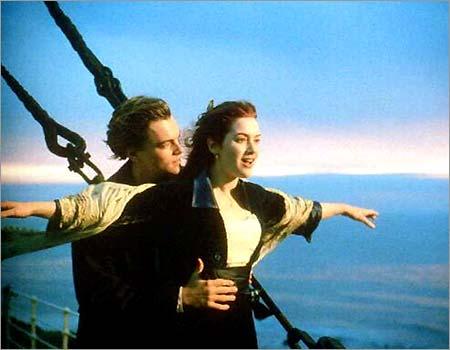
This shot is much less distressing! I would interpret this shot to mean that these character's are getting closer either as friends or as lovers. Judging by the closeness of their bodies and given other cliche shots like this, I would bet that their next action is that they look at each other intimately.
For this shot I suppose you could say the same. Again it's very close and intimate. There's a feeling of safety even in a dangerous position. The expressions of the characters are a combination of amazement and admiration.
Another concept we were touching upon when talking about the way people used to watch film and the way we progressed from where we came from, is the concept that Hitchcock called the Kuleshov effect!
There is also an importance to not letting anything foreign be in the photograph. Set decorating is VERY important. Last year on the Market our art department team made a character who was a religious freak and very uptight person with very intense secrets. We transformed a girl's room from a girly bed room in to a dark, organized, bedroom with a ton of religious symbols everywhere. It looked like an ENTIRELY different place when we got through with it and if you pick the right people to do it, it really doesn't take too long. Here's an example of a set that was designed in the french film OSS 117: Lost in Rio:
The film takes place in the 60's and as you can see, nothing here is out of place or misrepresenting even though the movie was made in 2009! Not one thing in this frame is out of context nor is it distracting. You want things (props, set dec., etc.) to be appropriate but not distracting. I think this room sets up a mood of the scene as well as being absorbing/ believable.
I have more to talk about but I'll save it for next week! Hope you all enjoy the rest of the week!
Given that this week we have gotten really in depth into acting and ways actors should express emotion in front of a camera, I decided to make my post on the Kuleshow effect. Over the summer I decided to watch 2001 Space Odyssey again (last time I watched it I was 13, of course I didn't like it) because I felt that analyzing this movie would be really beneficial for me. After watching the movie I decided to research more about it, and this is when I found out about the Kuleshov effect. This effect was "discovered" by russian director Lev Kuleshov (hence the name). It is basically a technique of editing in which he alternated an emotionless shot of famous russian actor, Ivan Mozzhukhin, with three other different shots. After showing the same different montages with the same shot of Mozzhukhin to different audiences, Kuleshov demonstrated that in film acting the audience is the one to attributes an emotion to character, depending on the different shots the director decides to cut to.
According to the different audiences, in the first shot Mozzhukhin looks hungry when he the shots cuts to the plate of soup. on the second shot he looks sad, and on the third one they said he had desire for this woman.
I think it is really interesting how this effect has influenced the acting and direction in the history of films. Going back to 2001 Space Odyssey, we found the effect in most of the shots of the computer Hal. Given that he is a computer he cannot show any kind of emotion, but the audience gives the computer human emotions by the way Kubrick intercuts between him and the crew members of the Discovery one.
The last part this video reveals to us that Hal feels betrayed and angry with the crew members just by the way it was edited. The shot of Hal is just a red dot, We don't even see any facial expression, but when it is intercut by Hal reading the crew members lips, the shot of Hal is more powerful. I feel that we can take this kind of editing in mind when we direct our actors during a scene.