Although I am most likely not going to pursue a career in the television industry, there are definitely aspects that I enjoy. You always have the opportunity to try something new (often not even by choice) , and it definitely never gets boring. I like being on my feet all day and the exhilaration of working on a time crunch. Set gets crazy and its a community experience. Its a great place to meet people and ultimately form life long friendships and bonds. I met some amazing people while in LA and they are definitely the ones that made it worthwhile. Although I am probably not going to end up living there, I am looking forward to going back and visiting and thanking all the people that made my time the best that it could have been.
Showing posts with label Set. Show all posts
Thursday, October 8, 2015
City of Angels
This past semester I spent in LA and I never thought I'd say this, but it was the one time in my life when I learned more about what I don't like than what I do. It took me until about 3/4 of the way through my junior year to realize that I picked the wrong career path. However, I don't really look at my change of interests as a negative thing because I've developed an immense amount of skills along the way. My college years have been the classic learning experience. One thing I've learned about the industry is to be prepared for anything and everything. This isn't even a reason why I don't like it, as I often like to push myself to try new things that I've never thought of before.
One of my internships was with a company called Central City Stages. This was a family-run business and I guess I was technically an unofficial intern as they didn't have an internship program. I heard about the company through a professor here at Ithaca and decided to pursue them on my own because I desperately wanted to get experience with art departments while out in LA. I called them up, told them I wanted to intern for them, went in to meet them and was pretty much hired off the bat. I even quit one of my other internships because I knew that this was what I REALLY wanted to do. This was quite the unique internship. Very untraditional as I often found myself sitting at the front desk with the owner listening to his stories and conversing about something new everyday. One day, he gave me an entire historical lesson on 70s rock. Ironically I say I learned that I don't like the industry but I loved my internships because I learned life skills. For example, I learned to deal with being thrown into the mix and doing ultimate bitch work as an intern. Sometimes I was treated really great and other times, pretty much treated like shit. At Central City, I was basically handed off as an intern for the art department to utilize when productions came into the studio. Some of the most stressful tasks I had to complete were emptying about 8 bottles of mustard for a commercial (the hardest part was figuring out what to do with the excess mustard), transporting 500 pound trusses on a dolly through very thin doorways, and slating for two cameras for my first time in front of the entire guest population at Disney Land that night. Basically, I was put into very uncomfortable situations at unexpected times and had to problem-solve on the spot. Very stressful, but ultimately one of the best learning experiences I could have asked for.
Although I am most likely not going to pursue a career in the television industry, there are definitely aspects that I enjoy. You always have the opportunity to try something new (often not even by choice) , and it definitely never gets boring. I like being on my feet all day and the exhilaration of working on a time crunch. Set gets crazy and its a community experience. Its a great place to meet people and ultimately form life long friendships and bonds. I met some amazing people while in LA and they are definitely the ones that made it worthwhile. Although I am probably not going to end up living there, I am looking forward to going back and visiting and thanking all the people that made my time the best that it could have been.
Friday, November 14, 2014
Run Bag
When Arturo brought in his run bag it inspired me to write a blog post about what is in my run bag and what should be in every good run bag. Every run bag will be different depending on what position you work on set, but from PA to director, every crew member should have a run bag.
I tend to Camera Assist more than anything else, so my runbag is built around that. Here are some of the most critical things in my run bag:
And to finish off the post, the most useful piece of set advice I've received:
If you wear pants to set bring shorts, if you wear shorts to set bring pants.
I tend to Camera Assist more than anything else, so my runbag is built around that. Here are some of the most critical things in my run bag:
(from left to right)
Tape leash (with carabiner) - Great for holding multiple rolls of tape, and with the carabiner attached can be easily clipped to a belt or other things (Filmtools sells real tape leashes but I just used an old dog collar.)
Tape - This is all the tape I carry on me but many more styles and sizes (paper tape) come in handy
2" Black Gaff - for everything
1" Black Gaff - for everything else
1" White Gaff - great for camera stuff and the slate
1/2" Colored Strike - for marking actors
Black Sharpies - Come in handy for everything, especially marking waterbottles
SD Card Case - Contains multiple SD cards of various sizes
Leatherman (with belt clip) - Swiss army knife x10
Interchangeable Screwdriver -
Headlamp - Great for working in low light situations or before lights are struck
Flashlight - Various things, especially shining a light on slate when not enough light
Tape Measure - Measuring for focus & mirroring camera shots & detailed camera reports
Airblower - Cleaning lens & blowing dust off camera
Lens pen - Cleaning lens
Belt - Good to clip things on, holds your pouch, and keeps yo pants up
Pancro - Cleaning lens
Lens Tissue - Cleaning lens
Insert slate - Fits in AC pouch, used when a real slate can't fit or MOS shots to save time
Pouch - Keeps various things on your person, much more organized than pockets
Crafty - You WILL get hungry on set, and storing crafty in your run bag will keep you, and more importantly, the DP, satisfied
The rest of my run bag
Scissors, pens, C47s, HDMI, follow focus whip (no idea where that came from), power strip, hammer, pliers, wrench, grip gloves, cardellini clamp, cards, lighters, gum, towel, string/rope, box cutter, extra black t-shirt, phone charger, and many other things I'm forgetting right now.
The Black and Blue has a great post about what's in his run bag.
http://www.theblackandblue.com/2011/12/15/camera-assistant-toolkit/
Here's a video of Evan Luzi going through his bag:
And to finish off the post, the most useful piece of set advice I've received:
If you wear pants to set bring shorts, if you wear shorts to set bring pants.
Monday, November 10, 2014
Assistant Directing for Dummies
Hey guys. I'm going to be completely honest with you all. I'm running out of ideas. And fast. I know for a fact that I've written about directing before, but I don't believe I've ever touched on Assistant Directing. If I have, I apologize, but I'm running out of fresh topics to talk about. So, without further ado, it's time for Assistant Directing for Dummies! It's the gameshow where you don't have a ton of fun and some of the facts may be slightly inaccurate, but you leave feeling wiser nonetheless.
Today, we'll be focusing on two types of assistant directors (ADs): the first one and the second one. For those of you who don't often work on film sets, or for those of you who don't have much knowledge on the topic, my previous statement isn't as dumb as it sounds (even though it kind of is). There are in fact two assistant directors, and their positions are called 1st Assistant Director and 2nd Assistant Director. SO GET OFF MY CASE AND ENJOY THE POST. Ok? Good.
Let us begin with the first type of AD: the 1st Assistant Director. The 1st AD is very much involved in the preproduction and production processes. To best summarize their responsibilities, I turn to the handy dandy bulleted list. Once again, I apologize, but it's quite the list and I have some editing to tend to. The 1st AD's job is to:
-Assist Unit Production Manager to prepare script breakdown and preliminary shooting schedule
-Assist the UPM in location business
-Check weather reports (exciting, right?)
-Prepare daily schedules for talent and determine cast and crew calls
-Supervise the preparation of call sheets
-Supervise background activity and crowd control
-Supervise the proper functioning of the set and crew
The 1st Assistant Director's job is to basically take care of everything the Director shouldn't have to worry about, allowing them to focus on making sure everything pertaining to what viewers will see is absolutely perfect.
"How does the 1st AD possibly get all of this done? It's so much stuff to get done!" You're right! It's a pretty demanding job. Luckily, though, they have a chief assistant who is in charge of conducting all the business of the set or location. This person is referred to as the 2nd Assistant Director. Go figure! How convenient is that? What exactly is the business of the set or location you ask? Well, it includes:
Today, we'll be focusing on two types of assistant directors (ADs): the first one and the second one. For those of you who don't often work on film sets, or for those of you who don't have much knowledge on the topic, my previous statement isn't as dumb as it sounds (even though it kind of is). There are in fact two assistant directors, and their positions are called 1st Assistant Director and 2nd Assistant Director. SO GET OFF MY CASE AND ENJOY THE POST. Ok? Good.
Let us begin with the first type of AD: the 1st Assistant Director. The 1st AD is very much involved in the preproduction and production processes. To best summarize their responsibilities, I turn to the handy dandy bulleted list. Once again, I apologize, but it's quite the list and I have some editing to tend to. The 1st AD's job is to:
-Assist Unit Production Manager to prepare script breakdown and preliminary shooting schedule
-Assist the UPM in location business
-Check weather reports (exciting, right?)
-Prepare daily schedules for talent and determine cast and crew calls
-Supervise the preparation of call sheets
-Supervise background activity and crowd control
-Supervise the proper functioning of the set and crew
The 1st Assistant Director's job is to basically take care of everything the Director shouldn't have to worry about, allowing them to focus on making sure everything pertaining to what viewers will see is absolutely perfect.
"How does the 1st AD possibly get all of this done? It's so much stuff to get done!" You're right! It's a pretty demanding job. Luckily, though, they have a chief assistant who is in charge of conducting all the business of the set or location. This person is referred to as the 2nd Assistant Director. Go figure! How convenient is that? What exactly is the business of the set or location you ask? Well, it includes:
-Preparing all call sheets
-Preparing the daily production reports in collaboration with the UPM
-Distributing all information to the cast and crew (scripts, changes, and call sheets)
-Communicating advance scheduling to the cast and crew
-Assisting the UPM, 1st AD, and Location Manager in location management
-Facilitating the transportation of all equipment and personnel
-Schedule all food, lodging, and other facilities
-Supervise the set and location wrap
-Maintain a liaison between the 1st Assistant Director and the Unit Production Manager
-Assist the 1st AD with the direction of background activity and crowd control
PHEW! Glad that's over. I was beginning to just feel sorry for anyone who's a 2nd AD. I guess if you really love what you do, who's to tell you that your job is no fun. What I've gathered from this information, is that the student producers I've worked with in the past have actually been conducting the responsibilities of the Assistant Directors while the ADs have actually just been clapping the slate and keeping us on schedule. Who knew?! You do now!
Assistant Directors are wonderful people who moviegoers never really know anything about, but they're some of the most important people to have on a set. They essentially do all the things a director doesn't have time for (and probably doesn't want to do). If you're ever in the market for a career that's physically and emotionally demanding and that doesn't get much of any public recognition, Assistant Directing is the career for you!
Sunday, November 2, 2014
Electrician-ing for Dummies
Electricity. It's an interesting topic to discuss in a blog post, right? I think so. In fact, I believe electricity is SO interesting that this very post is all about it! In case you didn't realize, electricity is actually a huge part of a film set. It's how the lighting and operation of many other systems run! It's fascinating, I know. But who runs all of this electricity? Who makes all of this stuff work? It's funny you should ask, because I just so happened to finish an article on electricians! Whoopie!
An electrician does what you would most likely assume they do. People typically just don't think very much about it. To begin, an electrician's main job on set is tending to lighting the sets and locations. They don't design the lighting for scenes or anything like that, but they make sure that everyone can actually see where they're going. The electricians actually work under the direction of the Gaffer, so they help out with the set up of the lights. Without lights, people would be bumping into each other and whatnot. Duh. Electricians make sure sets and locations are safe to work on before anyone else even gets there.
With all the lights and equipment in place, the electricians run electrical cabling throughout the set and distribute electrical power to all of the equipment. They work in coordination with the DP, Gaffers, and whoever else has their own equipment or whoever else can tell them where the wires won't be in shot. The electricians have got to make sure they have everything in place with absolutely none of it getting in people's way. For anyone who's ever set up lighting at a shoot before, they can tell you it's not an easy task.
"But what if something breaks? How do I keep track of all this lighting equipment?" Have no fear! Electrician Man is here! Another responsibility for the electrician is to maintain and manage all lights and lighting equipment. They make sure all the equipment is accounted for and is working properly. It's not exactly the most glamorous part of the job, but hey, someone's got to do it. The electricians are specialized in electrical work (again...duh), so they're the people to turn to when you're not quite sure how to work specialized equipment like a generator, or...you know...lights. The electrician is an incredibly skilled professional. They have knowledge of the workings of equipment many people never even pay much attention to, and for that, we thank you.
I'm truly sorry for the briefness of this riveting post, but alas, I'm writing it while eagerly awaiting my call time for the second shoot of the day for Guilty. I'll catch you all next week for another for Dummies!
Labels:
DP,
dummies,
electrician,
electricity,
equipment,
gaffer,
lighting,
Location,
operation,
responsibilities,
scene,
Set,
wires
Tuesday, October 28, 2014
Feeding the Crew for Dummies
| FOOD. |
Now, everyone knows that a person with a full stomach is a happy person. It's a fact of life. If you don't agree with me, get out. Leave. Don't ever come back here again. If you do agree with me, or if you simply don't care enough to leave, then join me as we explore the inner workings of the film food business. Essentially, the business includes three branches: craft services, caterers, and food stylists. These wonderful people have a lot on their plate...get it? Let's see what their exact responsibilities are...
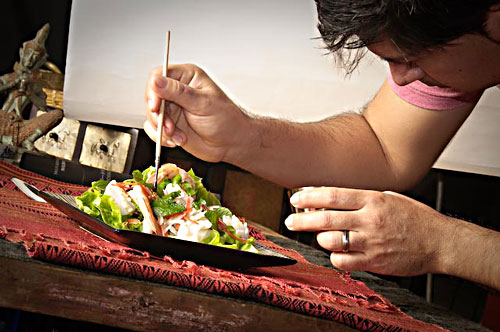
Craft Services.Sounds simple enough, right? Craft services, which is a separate entity from catering, encompasses all of the wonderfully assorted snacks and beverages provided to the film crew. The godsend in charge of craft service sets and maintains a station near the production that makes these snacks and beverages available to all the hardworking folk on the crew. A budget is given to the craft service person prior to attaining all the refreshments. I guess Costco just isn't good enough for some people. Personally, I'd be fine with some Cheez-Its and juice boxes.
Caterers.
The caterer takes care of the main meals for a production. While craft services prepares the snacks, the caterer plans, organizes, and prepares all the substantial nourishment for everyone. Having a caterer on location is a serious convenience. On one hand, the crew can be more efficient. The food is right there for them to grab on a thirty-minute lunch break. On the other hand, you save extremely valuable production time and money without the need to transport the crew to and from meals. Caterers have been known to serve small crews from ten people to enormous crews of hundreds of people. "But what can I eat? I'm vegan?" "What about me? I can't eat gluten!" No worries! These are fairly common requests for production caterers. They'll cater to your personal needs! (I'm on fire today with these puns).
Food Stylists.
It's often a crew member's first question when walking on set (or at least it's mine) to ask what's being served for lunch. It turns out that it's not actually the producers' job to take care of it, although that's how we've been doing it on our student films. Food service workers are, in my personal opinion, some of the most spectacular people on a production. And if you don't agree with that, well, you can just keep that to yourself.
Monday, September 22, 2014
Production Assisting for Dummies
Hello everyone! It's that time of the week again when you quietly sit at your computer screen, looking for something to do, and somehow stumble upon this blog. It's time for "[insert random film crew position] for Dummies!": the game show where this isn't actually a game and the points totally matter. Welcome! Let's get started shall we? If you haven't figured out what we'll be discussing today by now from the clear title at above, well, you've got bigger problems to worry about...but let's talk about Production Assistants.
Now, most people probably think of a production assistant (P.A.) as a type of "slave" or "under-appreciated, under-paid, over-worked" laborer just trying to make their way in the film industry. That's pretty much exactly what a P.A. is. I'm sorry P.A.s, but it's true and you know it. If you're otherwise convinced, stop lying to yourself. You're not helping anyone. You're just hurting yourself more.
SO! For those of you who didn't already know, there are four main P.A. categories. First up on our list is the Set P.A. This is certainly the most widely known type of P.A. due to the fact that they have the most widely spread list of responsibilities. These P.A.s often work directly for the Assistant Directors, but in reality work for all departments since they take information from the AD's and pass it on to the respective departments. Set P.A.s are key in managing extras, crowd control, or helping company moves. These tasks require as much help as possible, so P.A.s really save the day in this aspect. They also responsible for collecting paperwork and passing out scripts and schedules to those who need them. So basically they help in assuring everyone knows what they're doing and when, which can really make or break a production. Set P.A.s escort actors to and from their trailers, too, which is kind of awesome, as well as deliver film to the airport or the production office. They even get to touch the shiny equipment when loading or unloading from the trucks! How cool is that?!
Next on our list we have the Art Department P.A. This position will probably come off as, well, not that great to most people. Art Department P.A.s essentially do what most people think P.A.s do. They run errands and help out with miscellaneous office duties. It sucks, but someone has to do it. These P.A.s do, however, sometimes get to assist with the construction of props or set dressing. Ignoring the other two parts of the job, they do get at least a little bit of valuable experience in the art department.
Who helps out with the wardrobe?? Great question! It turns out there are actually Wardrobe P.A.s! While these P.A.s also run some miscellaneous errands, they get some hands-on work in the specific department as well. They assist the costumers in whatever it is that they may need including labeling and collecting costumes. They sometimes organize costumes for laundering, too. Nobody likes a dirty costume! At least I don't.
We close today's riveting episode with...wait for it...Location P.A.s! Location P.A.s are extremely valuable to the overall production of a film. Yes, they run errands, but they deal with a whole lot of big-boy stuff, too. They deliver contracts, put up signs to direct workers to set, make and distribute maps to to locations, and even get to clean up locations after filming! I'm jealous just thinking about it! In all seriousness though, without these wonderful people, cast and crew may not make it to set on time (if ever) and, without the proper delivery of the contracts, there wouldn't even be a location to shoot! You go, Glen Coco.
P.A.s are more than often taken advantage of and are far too under-appreciated. Really, they're the ones making sure that everything no one else wants to do gets done. If you would like to break into the film industry and consider yourself thick-skinned, become a P.A.
Who helps out with the wardrobe?? Great question! It turns out there are actually Wardrobe P.A.s! While these P.A.s also run some miscellaneous errands, they get some hands-on work in the specific department as well. They assist the costumers in whatever it is that they may need including labeling and collecting costumes. They sometimes organize costumes for laundering, too. Nobody likes a dirty costume! At least I don't.
P.A.s are more than often taken advantage of and are far too under-appreciated. Really, they're the ones making sure that everything no one else wants to do gets done. If you would like to break into the film industry and consider yourself thick-skinned, become a P.A.
Monday, September 8, 2014
How to complete a proper equipment checkout
We all for sure will be working with equipment this semester, whether is is checking it out from PPECS, on set, or something else, knowing that the equipment is functioning properly and will continue to function properly is a must.
The first step to ensuring that your equipment won't fail out on you is when you're checking it out. You need to check and set up EVERY piece of equipment you are checking out. This doesn't mean just setting up the camera and turning it on. It means checking every filter and making sure they're all clean and not broken, as well as setting up and fully extending every level on each C-Stand and so on for every piece of equipment.
While this seems like an extremely tedious process, especially when the technicians at PPECS tell you that all the equipment is working properly, mistakes have been made, and they will be made again, and one little mistake may be the difference between getting the shot while still leaving the location by your hard out time. I work at PPECS, and we always check the equipment to the best of our abilities to ensure it will continue working, but sometimes we miss things, or equipment fails suddenly. Another set of eyes, specifically your own eyes, will help make sure there is no faults.
Upon checkout you can always request an order form with the list of all the equipment you checked out with the specific numbers of each item, which I highly recommend. Give a copy to this list of each department head on your production so during any company moves you can make sure no equipment is left behind.
When checking out equipment to student productions I often notice it is only 1 or 2 people there for checkouts, and most often those are people in positions that won't be working closely with the equipment (director, producer). I strongly encourage productions to bring as many people as they can to PPECS upon time of checkout and checkin, not only to make the process go as fast as possible, but also to get more people to look at the equipment before it goes on set.
At PPECS we have counters lining all of the walls with outlets right on the counter tops. We encourage you to use this space to make checking all of your equipment easier. Checkout is a great time to become more familiar with the equipment you'll be using on set before you have to perform in a high stress environment. If you have any questions about how a piece of gear works or what its function is, I'm sure the counter workers will be more than happy to answer.
Here's a video from David Elkins, author of The Camera Assistant's Manual, on how to prep a camera package.
And always remember to have PPECS number in your phone in case anything goes wrong or you have any questions!
Here it is just in case: (607) 274-3636
*All views and opinions reflected in this blog post are my own and do not reflect the views and opinions of PPECS, it's employees, or any other members associated with PPECS or the Park School of Communications.*
The first step to ensuring that your equipment won't fail out on you is when you're checking it out. You need to check and set up EVERY piece of equipment you are checking out. This doesn't mean just setting up the camera and turning it on. It means checking every filter and making sure they're all clean and not broken, as well as setting up and fully extending every level on each C-Stand and so on for every piece of equipment.
While this seems like an extremely tedious process, especially when the technicians at PPECS tell you that all the equipment is working properly, mistakes have been made, and they will be made again, and one little mistake may be the difference between getting the shot while still leaving the location by your hard out time. I work at PPECS, and we always check the equipment to the best of our abilities to ensure it will continue working, but sometimes we miss things, or equipment fails suddenly. Another set of eyes, specifically your own eyes, will help make sure there is no faults.
Upon checkout you can always request an order form with the list of all the equipment you checked out with the specific numbers of each item, which I highly recommend. Give a copy to this list of each department head on your production so during any company moves you can make sure no equipment is left behind.
When checking out equipment to student productions I often notice it is only 1 or 2 people there for checkouts, and most often those are people in positions that won't be working closely with the equipment (director, producer). I strongly encourage productions to bring as many people as they can to PPECS upon time of checkout and checkin, not only to make the process go as fast as possible, but also to get more people to look at the equipment before it goes on set.
At PPECS we have counters lining all of the walls with outlets right on the counter tops. We encourage you to use this space to make checking all of your equipment easier. Checkout is a great time to become more familiar with the equipment you'll be using on set before you have to perform in a high stress environment. If you have any questions about how a piece of gear works or what its function is, I'm sure the counter workers will be more than happy to answer.
Here's a video from David Elkins, author of The Camera Assistant's Manual, on how to prep a camera package.
And always remember to have PPECS number in your phone in case anything goes wrong or you have any questions!
Here it is just in case: (607) 274-3636
*All views and opinions reflected in this blog post are my own and do not reflect the views and opinions of PPECS, it's employees, or any other members associated with PPECS or the Park School of Communications.*
Wednesday, September 5, 2012
Shots!
Alright! Let's do some Shots! NO, not those kinds of shots, Films shots! (It's not the weekend yet kids!)
Today, in class we spoke about the importance of shots and frame. Ever since we discussed this in fiction field 1, a year ago (time flies), I've payed closer attention to the films I watch and I note the placement of the characters. Sometimes, it helps me understand a little better of what's going on in the film. Have you ever watched a film where you were completely lost? Most people at that point shut it off and never return. I try harder to understand, I like to give em' a chance! They could explain everything later! Anyways, I found sometimes I'll try to interoperate the choice of the camera position, movement or even the placement of props, or the placement of the character's themselves.
In the shot above, The camera frame shows you exactly what the character is looking at, it also shows through camera angle how much bigger this creature is in comparison to the character, possibly imposing a threat. The fact that it's raining makes it harder for the character to run and hide, it gives us a symbolic sense of nature's wrath, unfortunate events etc.
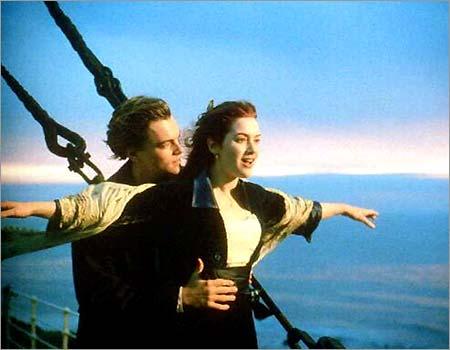
For this shot I suppose you could say the same. Again it's very close and intimate. There's a feeling of safety even in a dangerous position. The expressions of the characters are a combination of amazement and admiration.
Another concept we were touching upon when talking about the way people used to watch film and the way we progressed from where we came from, is the concept that Hitchcock called the Kuleshov effect!
There is also an importance to not letting anything foreign be in the photograph. Set decorating is VERY important. Last year on the Market our art department team made a character who was a religious freak and very uptight person with very intense secrets. We transformed a girl's room from a girly bed room in to a dark, organized, bedroom with a ton of religious symbols everywhere. It looked like an ENTIRELY different place when we got through with it and if you pick the right people to do it, it really doesn't take too long. Here's an example of a set that was designed in the french film OSS 117: Lost in Rio:
Today, in class we spoke about the importance of shots and frame. Ever since we discussed this in fiction field 1, a year ago (time flies), I've payed closer attention to the films I watch and I note the placement of the characters. Sometimes, it helps me understand a little better of what's going on in the film. Have you ever watched a film where you were completely lost? Most people at that point shut it off and never return. I try harder to understand, I like to give em' a chance! They could explain everything later! Anyways, I found sometimes I'll try to interoperate the choice of the camera position, movement or even the placement of props, or the placement of the character's themselves.
In the shot above, The camera frame shows you exactly what the character is looking at, it also shows through camera angle how much bigger this creature is in comparison to the character, possibly imposing a threat. The fact that it's raining makes it harder for the character to run and hide, it gives us a symbolic sense of nature's wrath, unfortunate events etc.
This shot is much less distressing! I would interpret this shot to mean that these character's are getting closer either as friends or as lovers. Judging by the closeness of their bodies and given other cliche shots like this, I would bet that their next action is that they look at each other intimately.
Another concept we were touching upon when talking about the way people used to watch film and the way we progressed from where we came from, is the concept that Hitchcock called the Kuleshov effect!
The film takes place in the 60's and as you can see, nothing here is out of place or misrepresenting even though the movie was made in 2009! Not one thing in this frame is out of context nor is it distracting. You want things (props, set dec., etc.) to be appropriate but not distracting. I think this room sets up a mood of the scene as well as being absorbing/ believable.
I have more to talk about but I'll save it for next week! Hope you all enjoy the rest of the week!
Ta Ta for now!
-Lucy Lynne' Hall
Subscribe to:
Posts (Atom)