I have a confession to make. Last weekend I movie hopped. I was with my boyfriend and we went to see The Night Before starring Seth Rogan and Joseph Gordon Levitt. Now don't get me wrong, that movie was phenomenal. Classic raunchy Christmas comedy, as anything would be with Seth Rogan in it. When the movie ended, it was only 7pm and right next door was The Good Dinosaur (Disney Pixar's newest movie) playing at 7:20. We decided to pop in, sit in the back and enjoy the easygoing film. The Good Dinosaur was also a great movie. I didn't last through the whole thing though, as sitting for 5 hours straight isn't really a hobby of mine. The best part of this whole movie-going experience however, was the Disney short at the beginning of our second feature. It's been all talked up and when it came on the screen, I couldn't have been more excited.
This Disney short is titled Sanjay's Super Team. Sanjay's Super Team leads Disney movies in a new direction. This is what I believe to be, the first time that Disney has covered religious topics in one of its films, intentionally and obviously that is at least. This story documents the bond between an Indian boy and his father. They are Hindu, and therefore Sanjay's father follows the ritual of meditation. He tries to teach Sanjay the importance of meditation, but Sanjay is preoccupied with his toys, coloring and television. However, once Sanjay sits down to meditate with his father, he accidentally extinguishes the oil lamp. As a consequence, he is a taken on a spiritual journey and meets the Hindu gods. Once he comes back into reality, his father is upset because he feels like he wasn't able to get through to his son. However, once Sanjay goes back to coloring, he draws a picture of the gods and presents it to his father. His father is ecstatic and we witness a major bond between the two. This is based off of a true story. Once again, Disney Pixar fails to disappoint!
Over Thanksgiving break I went to see Pixar's The Good Dinosaur. The movie was good, but it was the same as many other Pixar movies: the protagonist is somehow removed from their comfortable home and they must go on a long journey to get back to it, seeking help from some funny characters along the way. Eventually Arlo, the good dinosaur himself befriends the little boy who he blames for getting him into this mess to begin with, Spot. Their friendship grows as the movie progresses, and I don't want to spoil anything so I'll stop there.
Arlo and Spot agree to help Nash, Butch, and Ramsey along their journey, in return for their help.
SO PRETTY
The movie was BEAUTIFUL. It looked so realistic and definitely inspired me to go hiking. However, what really caught my eye was the short film that played before the movie, Sanjay's Super Team. For me, the short film had much deeper meaning than the movie.
Sanjay's Super Team is about the Patels, an Indian-American family. Sanjay's father prays to Hindu deities while Sanjay prays to his deities, the superhero cartoons he watches on television. Sanjay is annoyed when his father turns off the tv, takes away his action figure, and forces Sanjay to pray with him. Sanjay is distracted by his action figure during prayer when his imagination suddenly whisks him away to a Hindu temple. Inside the temple, statues of Durga, Vishnu, and Hanuman come to life and help him defeat an evil monster. This experience changes Sanjay, who accepts his father's religiosity and consequently joins him in prayer.
(L to R) Durga, Vishnu, and Hanuman
I thought the short was really cool for a couple of reasons. First, this is the first time an Indian character is the focus of a Pixar film, which is important in animation history. Second, I'm interested in mythology, and the portrayal of the deities brought me back to my high school English class, where my yogi storytelling teacher told us both the Ramayana and Mahabharata. Third, the juxtaposition between Sanjay and his father shows that people of different generations and cultures are more similar than we think. At the end of the film, it is revealed that Sanjay Patel, the creator of the short, based it on a true story.
Over the summer I saw the Disney Pixar film, Inside Out. I've loved this movie ever since and have been waiting anxiously for my next opportunity to see it again. However, the best part of this movie-going experience was the Disney animated short in the beginning, Lava. Disney is known for screening an animated short in the beginning of every movie they release. They are usually extreme clever and sometimes relate to previously released films such as Frozen Fever using context from the movie Frozen. Although I haven't seen a bunch of the Disney shorts, or not ones that I can remember, Lava makes me want to go back and watch all of them. Disney Pixar animation is notorious for giving inanimate or non-human objects life and these depictions go far beyond animals. Lava is so unique because it portrays a love story around two submarine volcanoes.
I know - sounds weird, but its got to be one of the most touching things I've ever seen. It depicts the idea of serenity and isolation, but the fact that love still exists in these circumstances. From the soft ukelele to its punny lyrics, Lava can't be compared to any other film I've seen. In fact, this isn't even clearly stated in the short, but the volcanoes actually have names reflecting the instrument playing the chords. The male volcano is named Uku and the female is named Lele. Together, their name creates the word Ukelele which further elaborates on the idea that they are meant to be together. I know, Disney can be a little bit cheesy sometimes, but I honestly feel that they think of everything and continue to be innovative. I can't wait to see what they come up with next and what kind of inanimate objects they bring to life.
"Take her to the moon for me, Joy." This quote documents a very sentimental moment in one of the best movies I saw all summer: Inside Out. Inside Out is the newest Disney Pixar film that premiered in June of 2015. It takes place inside the brain of 11-year old Riley as she goes through a major transition period moving from her homey town in the Midwest to a foreign life in San Francisco. It is a definite breath of fresh air as it is unlike anything I have seen before. Disney does an amazing job of articulating a very complex concept (the human mind and emotions) for all audiences. Adults will get a kick out of it just as much as children and will understand it on a whole other level. The reason why this movie has such an impact is because it is relatable; we are all human and we all experience emotions, both good and bad. From the animation to the metaphors in this film, it is completely clever and creative.
The five emotions: fear, disgust, anger, sadness and joy are all given human characteristics and sit in a control room behind Riley's eyes. They see her life before her and adjust the controls according to how she should be reacting in certain situations. Joy is ultimately in charge, as Riley's goal in life is to be happy. Riley's memories are released from her brain as glowing balls, color-coordinated to her emotions. Her brain is an alternate world for the emotions to explore including places such as "the subconscious", "abstract thought" and her "islands of personality". The whole concept of the film is how Riley struggles when Joy and Sadness get lost outside of headquarters (which is where they control her emotions from). Controlling Riley's mind is left up to Anger, Disgust, and Fear. They are very lost on how to take control and result in Riley experiencing what seems like depression to her parents and new classmates. She dresses in black and has random outbursts of anger and disgust, but ultimately she is numb, lacking the two most common and important emotions we feel: joy and sadness.
This film is very psychological and gets into the real details of what we experience inside the head; some things we may not even be aware of. For example, "abstract thought" is a place in Riley's head where she thinks about concepts that are unreal or difficult to understand. When she is going through her rut, she has to comprehend the abstract thought of loneliness which is an unfamiliar situation after moving and losing her emotions. Inside Out is sentimental film that depicts the themes of family, loneliness and the importance of feeling all emotions: even sadness. It is a breath of fresh air from other kids movies as it depicts life and emotions in a very realistic way and on a whole new level of maturity.
Take a second and let this fact sink in: The Academy Awards have been around for 86 years, and over that entire stretch of time, an animated film has been nominated for best picture only 3 times. Full-feature animated films weren't around until 1937 when Walt Disney's Snow White blew everyone out of the water, but over those 77 years, the only animated movies to get recognized as having the potential to be the best film of the year were Beauty and the Beast, Up, and Toy Story 3. I'll buy the first two losses - Silence of the Lambs beat out Beast and the Hurt Locker beat Up, both really good films - but if you're trying to tell me that the King's Speech is better than Toy Story 3 in any single regard (apart from maybe the use of the word "fuck") than you're a liar and I hate you.
We're currently in the midst of an animated film "revival," of sorts, and I for one couldn't be more excited. Disney, in particular, is really hitting their stride with a string of great animated films, including Frozen, Wreck-it Ralph, and this year's Big Hero 6. There's some big films coming from Pixar too; they may have taken a few missteps by greenlighting unnecessary sequels to Cars and Monster's Inc, but they've got movies in the works about dinosaurs and emotions (which has the potential to be their best yet) that both look pretty incredible.
The question is: are they Oscar worthy? Academy voters tend to shy away from anything that's too - for lack of a better word - different. It's the same reason that Birdman probably won't win best picture this year; these movies are dangerous. The voters want something safe, like Colin Firth as a king with a speech impediment or literally any other British actor doing Britishy things; they don't want Michael Keaton marching in his underwear through times square or anthropomorphic toys teaching lessons about friendship, as sad as that may be. However, as the average age of Academy voters becomes younger (E.G. all the old people are dying), there's the potential to have more openness to the possibility of an animated movie taking home the big prize.
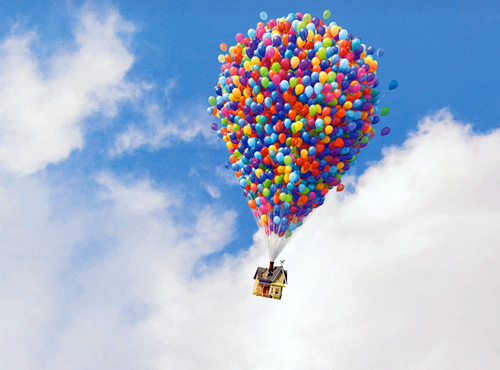
After all, there's nothing that "real" films do that animated films can't. I'm of the opinion that voice acting is still very much real acting, and story-wise, animated movies can pack as much of an emotional punch - hell, more usually - than traditional films. There's also more room for creativity. Sure, Matthew McConaughey can take a spaceship through a black hole, but Carl Fredrickson can attach his house to balloons and float to South America. We're willing to suspend our disbelief way more when we're watching animation, and this allows for basically endless situations and possibilities.
So, short answer, yes, I think it's possible that an animated film will win best pictures, for all that it matters. And I'm definitely not the only one. When it comes down to it, awards don't really mean shit; you should only judge a movie based on your overall enjoyment of it. That being said, I don't know anyone who hasn't immensely enjoyed a single animated film over the past 5-10 years, and I think it's about time the Academy reflected that.
Today I want to introduce a blog that I've recently go into, run by former Pixar employee Emma Coats. Here blog is called Story Shots, and it caters to a curious audience who are interested in seeing what actually goes into developing and making films (animated or not).
And an interesting piece that was brought up dealt with the technique of drawing storyboards from pre-existing films. Now you might think that that sounds silly. Why would you need to draw someone else's work? What if you can't draw? Isn't that just a waste of time better spent learning a more practical skill? Wrong, wrong, wrong!
See, the underlying basis to making any film is knowing what exactly you're going to make. This ranges from how it's lit, how it's staged, how it's colored, even how the character interact within their environment. It may seem like storyboarding is just one of those "small" things you do in the pre-production process, but you have to understand that without a good storyboard you're film is basically lost.
A storyboard is quite literally your film in its most negative form. Every single cut, transition, pan, tilt, etc., is captured in these drawings. But now you might be thinking, "cool, that makes sense. So this means I should start storyboarding!" Yes...and no.
You definitely don't have to be an artist when it comes to storyboarding, but knowing how light, shadows, colors, and perspectives interact with changing camera movements only helps in the preproduction process. And this is why this kind of technique should be encouraged for those looking to make a film (or to even just draw). Emma mentions that some movies that are famous for being "ground-breaking" in their genre are Jaws, E.T., Raiders, etc. are the best to draw from because it literally shows you what they did to make them.
This can teach you about composition, lighting, camera position, and even the types of lenses you should consider for each shot. So storyboarding isn't just some off-hand thing you can get away with half-assing. It needs to be taken seriously because it what makes a good film great.
Between the voiceover work that I'm planning on doing for my ICTV show Prerequisites and the bizarre kitchen appliance voices that our group needs for our short film, I thought it would be useful to figure out techniques on how to direct voice actors.
Well as it turns out, directing voices isn't a whole lot different from directing normal actions. More often than not, the most compelling performances are produced by the most unorthodox forms of directing. One my favorite examples of this (sorry if this is something Arturo showed before, but it just really stuck with me) is how the directors of Up had Jordan Nagai perform his lines as Russell. Whereas other studios may have brought in a more "theatrical" kid for the part - or even a professional adult voice actor, as so many cartoons now resort to doing - Pixar took a risk and banked on a totally inexperienced kid. To make him read the lines as a child would really speak, they made him do laps around the room, hang on to bars hung over his head, etc. It was a creative approach, one that I would imagine was comfortable for Jordan to work with and which ultimately ended in a better voice for the character.
A few other tips I like, curtesy of the Timbuktoons.com article you can find here, include going deep, not forgetting to record the incidentals, and always doing multiple takes. When you give an actor a line to read, it's going to be almost meaningless if they don't know the context. You need to give their character a backstory - as goofy as it sounds - and help the actor be able to identify with their character. Even if they're playing something that they have nothing in common with, a good director should be able to find that common ground and make actors see their characters in a different light.
Also, from a more technical standpoint, it's important to keep the mic running a bit both before and after each take, to catch some stuff that you may otherwise miss and want to keep in. At the same time, one take is never sufficient to know whether or not you have the content that you want (plus it's easier to lose), so you want to have your actors read their lines a variety of ways to make sure that you've covered all your bases.
So long story short, the next time you find yourself in need of some casual voice actors, make them do some weird things help them both A) Get their inflection right and B) get them in character. Canon and Diana (or whoever is directing producing our group's film) take note, and go cast an awesome blender.
Should I move the camera a little bit to the left or a little bit to the right?
You stand back and strike the pose of a renaissance painter about to carve into marble and, while it’s no Venus de Milo, what you’re about to do is equally as delicate. But you’re on a schedule and if you don’t get the shot in the next five minutes, you could easily find yourself scraping your feet as you look for another job. Harsh, but this is serious business.
This is composition.
For those who don’t have the time, the willpower, or the want to read for themselves: composition is basically how things are put together in an image (moving or not). We can look at articles like Chris Knight’s “The Ultimate Guide to Composition,” as a bouncing off point.
Images in their basic simplicity, are made of lines. Lines that form boxes, lines that intersect, and lines that draw the viewers’ eyes to where they need to be. Think of composition as a laser pointer. It's a subtle technique that filmmakers will use to get someone to subconsciously focus in on one aspect of the shot. But just talking about the technical jargon behind a film doesn't necessarily teach us what that means. Why should we use center composition? What's the difference between diagonal and horizontal arrangements? Is composition really that big of a deal?
And my answer is: yes, it is. But don't just take it from me. Don't just take it from Chris Knight. Take it from a physical product that was successful in its own right, that had this technique honed down to an art. Let's look at Pixar's The Incredibles. Directed by Brad Bird, and released back in 2004, the film is a cult classic (within animation). Really, it's a movie you either love or hate and I will be the first to say I had been the latter up until a few years ago. Honestly, I could go on forever about why this movie was one of the most well-put together films of its genre (writing and plot issues aside), but today we'll focus on its composition. For time's sake we'll look at its opening sequence:
Right away you'll notice these shots fall into what we call center composition. It's literally taking your point of focus and forcing it right into the middle of the scene. It's not something that most people recommend doing, and it's certainly not something that can be done well. But why? This in part, lies with how our brain takes in information. Yes, we have a certain affinity towards the symmetrical but there is something about focusing ourselves into the middle of an image that throws us off. Objects can be symmetrical, but an image has to have action. And that's the problem with centering your subjects. It immediately erases any depth around them and gets rid of the action in a scene. This is because your image has to literally stop in the middle. It's too abrupt for our senses to take in from a "two-dimensional" point of view. And it's boring. But this is why it can be such a powerful tool as well. As seen in the above video, centering the shot only works to really set up the feel of the interviews. While candid, they don't do much to give us insight into how these characters works. Yes, yes, we understand how they might feel but for the moment we are the interviewers. The common public that looks at these heroes in quite a two-dimensional way. And that's the problem set up, because these heroes are human. They make mistakes and they certainly aren't gods. For those who haven't seen it, the core of the movie is the dynamic between those who have superpowers and those who do not. For years, these heroes were idolized and put up on a pedestal. But through a series of events, their powers back-fire on them and they're forced to hang up the masks and gloves. They are forced to fit in. Yes, there's a lot more to the actual movie's plot but stay with me.
The above "interviews" only work because of the composition. The image is scaled down and positioned right smack dab in the middle of the frame. Adding to that, they've made it so every character is also put within the middle of their own shot. This gives us a layered centering of objects. They force us to look at these people as the movie looks at them.
As superheroes they are the center of attention. They own their surroundings in an almost arrogant sort of way. And because we've got nothing to look at but them, we feel uncomfortable. Obviously, this is old. Obviously, something isn't right. But in that moment, we are the public before the storm. All of our attention is focused on these people and we are literally watching their every move. But there's something about giving them all of our attention, that makes us feel uneasy.
Then it transitions to the sequence below:
While it may not be noticeable with how it was uploaded, but the composition changes in many ways. We've just faded out from the interviews and our perspective literally increases (meaning the screen literally gets bigger). It may not be what you consider composition but it is. It's creating invisible lines that expand our view and it adds dimensions.
Before, were were just watching the characters. Now, we are actually getting a glimpse at what they do. Immediately, the movie utilizes everything from golden triangles to the "Rule of Thirds." As the shots are set up, we can see that hardly anyone dominates the space and hardly anyone is centered in the middle anymore. This is a fantastic way to put action and life into the scene. From the skyscrapers in the back (during the car chase) to the sidewalk as the little old lady cries for her cat, the filmmakers are creating subtle lines that pull our attention inward to the points of focus (mostly Mr. Incredible in this case).
By not having him centered anymore, they also start to engage the audience. We are constantly moving our eyes to find the subject of the shot. And for an action-heavy sequence, this works delightfully well in keeping us focused on the movie. The constant movement confuses us just enough to make us want to notice everything. But it also makes us start to root for him. For the superheroes. And coming from those interviews, it feels good. Because we want to, don't we? I mean, they're superheroes.
Even in the last few shots, as she flings herself in to the sunset, we are left wanting more. We've come a long way from just staring at these people as they grin from the center of an interview to rooting for them as they do what they do best. And that's fantastic because it won't last. But by making us have to work to root for these guys, it nicely sets us up to become more emotionally invested as things start to crumble.
And this couldn't be achieved without proper composition. We, as an audience, don't want to just sit there and stare at something head-on. We need movement. We need depth. We need action. We need the characters to move: a little bit to the right, a little bit up, a little bit down, and a little bit to the left.
Over the break I watched Brave with my family after Thanksgiving dinner. It was a cute movie with a good message. I thought that the animation was very well done. Pixar has come a long way with their animation and this was by far one of their best animated films so far. My mom kept commenting how some of the shots showing mountain ranges and ocean bays looked almost real. The one issue I did have with this film was the fact that the scottish accents were hard to understand. I missed many chunks of dialogue and even considered turning on subtitles so I wouldn't miss anything important. I understand that they wanted to make it more authentic by using real scottish voice actors, but felt that they should have slowed the dialogue down or had the voice actors pronounce their words more clearly. I really liked the story and thought it showed a relationship we haven't seen in a while, the relationship between a mother and daughter. I watched it with my mom and Grandma (Mom's mom) and it was a nice way to end Thanksgiving.
Here is a behind the scenes look at the making of Brave.
Last year in one of my classes we analyzed Knick Knack, one of Pixar's very famous short films that I'm sure most of you remember.
I love Pixar because most of its short films are interesting and appealing to everyone. Knick Knack in particular is the perfect example of a short story told in less than 4 minutes. It also proves that if you are creative enough you can make a simple story stand out from most films. Just like any other featured film, Knick Knack introduces us to a character with a defined objective, and many conflicts that prevent him from achieving it. The creators of this short film made an excellent job introducing the world of the film visually, and in less than 40 seconds. I also like that all the beats of the film are shown visually rather that by dialogue. This aspect of the film makes it even more funny to watch. Finally, another reason I love this short film is because like most good short films it has a little twist at the end. I feel that all of us can take this movie as an example when we work in future projects. It'll be great if instead of trying to tell a complex film with several plot, we would focus in a simpler story. I feel that if we do this we'll add to the creative value of our work.