Wednesday, November 12, 2014

Stefani Joanne Angelina Germanotta aka Lady Gaga


I am not fan of Lady Gaga or her music but I have realized that she is absolutely brilliant and very talented. Yes she has crazy music videos and outfits like these:
But that’s how she keeps everyone talking. She is known for her diverse contributions to the music industry via her fashion, live performances, and music videos. She has a net worth of $110 million (as of June 2011) and has developed fan communities like her Little Monsters. She is now setting the standard for creating mesmerizing, memorable experiences. 

“Bad Romance” is one of her eccentric music videos. It’s elaborate sets, dance routines, and costumes make the video mesmerizing. Many people are not on board with the Little Monsters fan community but she still manages to get more than 600 million people to watch this music video.
She is known by most by the name of Lady Gaga. However, before her crazy musical persona emerged she was known as Stefani Joanne Angelina Germanotta. She began playing the piano at the age of four, wrote her first piano ballad at thirteen, and started to perform at open mic nights by the age of fourteen. At the age of seventeen she was one of twenty student t ogain early admission to the musical theater training conservatory at New York University's Tisch School of the Arts. This is one of her performances without all of the eccentric costumes and craziness:
People love her and others hate her, but after watching this performance everyone should agree she’s very talented and an ingenious marketer.

OK Go - Making Music Into Transmedia


OK Go is a music group known for their innovative music videos. Their fame started over five years ago when their music video for "Here It Goes Again" became popular for its quirky creative use of treadmills.


For every song OK Go has released, they have made a music video to go along with it that tries to top their last video. "Here It Goes Again" was made with little to no budget and no camera movement at all. Their videos have since expanded to include marching bands, green screens, guile suits, Rube Goldberg machines, musical cars in the desert, and much more. Some of them seen here:


Moving on from all of this though, they recently came out with their latest music video "I Won't Let You Down". This is the most professionally produced video I have seen from them, and the great part is that it goes far beyond the music video. But before I get too ahead of myself check out the music video below:

Pay close attention to the movement of the camera. The ending is the most impressive. And don't forget: one shot. 


The video's true quality came with their effective use of the Movi rig. 


This rig allowed them to have shots at eye level with the actors and then sporadically go to an ariel shot over the entire scene. But what I actually want to talk about is the transmedia aspect OK Go added to this video.

What is transmedia?

A lot what is sounds like. Different forms of media that are presented in a unified ways to create one larger piece of media  – all promoting the same materiel. In this case, their music video. For this they created an entire website with articles, games, and interviews pertaining to the video.


The Game, labeled as "Pre-Visualization", let's you design your own formation of characters and share it with friends as a video concept. This project goes above and beyond any music video I've seen, and I give several hats off to OK Go for not only surpassing the creativity of other music groups, but continually surpassing their own creativity. 

Monday, November 10, 2014

Netflix Picks Up A Series of Unfortunate Events for Adaptation


Lemony Snicket's popular book series, A Series of Unfortunate Events, was adapted into a film in 2004, starring Jim Carrey. It received decent reviews and did well in the box office (making $209 million worldwide), however was criticized for "not staying faithful to the source material's edgier bits."


Netflix recently picked up the rights for the series to adapt into a full series. Because it will be a television show rather than a film, Netflix can follow each story line more closely and completely. It also doesn't have to worry about MPAA ratings, so it will be able to provide the "edgier bits" that were missing from the film adaptation.

Vice President of original content at Netflix, Cindy Holland, said, "The world created by Lemony Snicket is unique, darkly funny and relatable. We can't wait to bring it to life for Netflix members."

When Snicket (novelist Daniel Handler's pen name) himself heard about this, he said, "I can't believe it. After years of providing top-quality entertainment on demand, Netflix is risking its reputation and its success by associating itself with my dismaying and upsetting books." This is a continuation of the marketing ploy that he's used for the series ever since the first book was published. The back cover says, "I'm sorry to say that the book you are holding in your hands is extremely unpleasant."

The story follows three siblings who are orphaned after their parents are killed in a fire that burns their home. Their evil Uncle Olaf knows that Violet, the eldest daughter, will inherit the family's fortune once she turns 18, so he creates tries several schemes to try to steal the money.

Being a huge fan of the series and also of all things Netflix, I cannot wait to see what they do with their adaptation.

Assistant Directing for Dummies

Hey guys. I'm going to be completely honest with you all. I'm running out of ideas. And fast. I know for a fact that I've written about directing before, but I don't believe I've ever touched on Assistant Directing. If I have, I apologize, but I'm running out of fresh topics to talk about. So, without further ado, it's time for Assistant Directing for Dummies! It's the gameshow where you don't have a ton of fun and some of the facts may be slightly inaccurate, but you leave feeling wiser nonetheless.


Today, we'll be focusing on two types of assistant directors (ADs): the first one and the second one. For those of you who don't often work on film sets, or for those of you who don't have much knowledge on the topic, my previous statement isn't as dumb as it sounds (even though it kind of is). There are in fact two assistant directors, and their positions are called 1st Assistant Director and 2nd Assistant Director. SO GET OFF MY CASE AND ENJOY THE POST. Ok? Good.

Let us begin with the first type of AD: the 1st Assistant Director. The 1st AD is very much involved in the preproduction and production processes. To best summarize their responsibilities, I turn to the handy dandy bulleted list. Once again, I apologize, but it's quite the list and I have some editing to tend to. The 1st AD's job is to:
      -Assist Unit Production Manager to prepare script breakdown and preliminary shooting schedule
      -Assist the UPM in location business
      -Check weather reports (exciting, right?)
      -Prepare daily schedules for talent and determine cast and crew calls
      -Supervise the preparation of call sheets
      -Supervise background activity and crowd control
      -Supervise the proper functioning of the set and crew

The 1st Assistant Director's job is to basically take care of everything the Director shouldn't have to worry about, allowing them to focus on making sure everything pertaining to what viewers will see is absolutely perfect.

"How does the 1st AD possibly get all of this done? It's so much stuff to get done!" You're right! It's a pretty demanding job. Luckily, though, they have a chief assistant who is in charge of conducting all the business of the set or location. This person is referred to as the 2nd Assistant Director. Go figure! How convenient is that? What exactly is the business of the set or location you ask? Well, it includes:
      -Preparing all call sheets
      -Preparing the daily production reports in collaboration with the UPM
      -Distributing all information to the cast and crew (scripts, changes, and call sheets)
      -Communicating advance scheduling to the cast and crew
      -Assisting the UPM, 1st AD, and Location Manager in location management
      -Facilitating the transportation of all equipment and personnel
      -Schedule all food, lodging, and other facilities
      -Supervise the set and location wrap
      -Maintain a liaison between the 1st Assistant Director and the Unit Production Manager
      -Assist the 1st AD with the direction of background activity and crowd control


PHEW! Glad that's over. I was beginning to just feel sorry for anyone who's a 2nd AD. I guess if you really love what you do, who's to tell you that your job is no fun. What I've gathered from this information, is that the student producers I've worked with in the past have actually been conducting the responsibilities of the Assistant Directors while the ADs have actually just been clapping the slate and keeping us on schedule. Who knew?! You do now!

Assistant Directors are wonderful people who moviegoers never really know anything about, but they're some of the most important people to have on a set. They essentially do all the things a director doesn't have time for (and probably doesn't want to do). If you're ever in the market for a career that's physically and emotionally demanding and that doesn't get much of any public recognition, Assistant Directing is the career for you!

Friday, November 7, 2014

Bee and Puppycat: From Pilot to Premiere


It started as most trips did for my friend and I: half a tank of gas and a GPS that we suspected was secretly trying to kill us. It was the just the right mix of confused and justifiably concerned that we needed to get us anywhere. And on a particularly sunny morning in June we found ourselves crossing over into the land of maple leaves and no highway rest stops: Canada. We were sleep-deprived, listening to the only station that would come through clearly (a strange mix of jazz and 80s-esque rock and roll), and had long gotten over trying to read the kilometers conversion on our speedometer when it struck us.

We had actually just traveled to another country to meet someone who has been one of the biggest inspirations to us art-wise (and for me, film-wise). See, my friend and I have a strange sense of humor that consist of a series of half-assed miming and off-beat puns. It’s become a second language to us and it’s something that’s defined the things (of comedy) that we enjoy. That being said, we had had the amazing opportunity to stumble across the works of Natasha Allegri, creator of Bee and Puppycat, earlier in the summer and just so happened across this convention she was attending (the “Toronto Animation Arts Festival International”). Now, Natasha had been a well-known name in the cartoon-industry, for her work on award-winning shows such as Adventure Time and Cartoon Hangover-curated Bravest Warriors, but it was the unique style of her animation and writing that hooked us.

Bee and Puppycat premiered on Cartoon Hangover’s youtube channel in July of 2013. It was originally a quirky little short about a girl who loses her job, bumps into a dimension-skipping puppycat, and takes on a freelance job in Fishbowl space. Pretty ordinary, right? But the amazing thing about Bee and Puppycat is not only the visual style and natural flow of dialogue, but the process it has gone through (and the influence it has had on my own filmmaking) to become an actual full-length series.

With a kickstarter that launched back in October of 2013, Bee and Puppycat collected $872,133 by the end of its fund-raising period making it the most successful animation kickstarter in the history of the website. And after months of waiting, the newest and most re-vamped version premiered yesterday (November 6th).

And I remember sitting in the third row of a lecture hall, out in Toronto, watching the original storyboards for the first episode (of the newer version). It’s a weird and nostalgic feeling to realize that I was there witnessing the creation of something truly delightful. It was worth the moments of panic as we missed our exit more than once, and that one time that biker got mad at us and flipped us off.

Fast-forward a few months and everything that had been discussed was a completed thing. It’s gives me goosebumps, in a good way. Because what was Bee and Puppycat before was not what Bee and Puppycat was now.

For starters, the visual look of the series has changed significantly from its pilot-era. While it definitely threw me off for a few seconds, it wasn’t necessarily a bad thing. If anything, it just shows how much can change in the production process and how much power you (as a content creator) has to to change the things that you want. For me, this new style only helped match the ideals and characteristics that screamed Bee and Puppycat.

You look at how Bee is drawn, you look at Deckard, you look at Puppycat, and any of the other characters and you see diversity. And it’s sadly hard to find that in mainstream media. You know, a female character who not only looks like someone you’d see in everyday life but someone who has embraced this sort of can-do attitude for the things (that would be trivial to some) in her life.

And the dialogue of the series only attests to the sense of realness that comes with such a personality as hers (and the others). It’s like you’re physically in the room having a conversation with the characters, or at least observing in close proximity. It’s natural. It’s insanely natural and it adds to the atmosphere.

Bee and Puppycat at its base, is a very whimsical story but it tackles very serious and actual problems in our lives: unemployment, heartache, betrayal, budgeting, ugly work uniforms. Haha, well not every problem is a very serious one but you get my point.

Sure, it’s not what it was a year ago but that doesn’t make it any less of the show that attracted thousands. And sitting in the back of that mildly-warm room, in an unfamiliar city in Canada, I didn’t feel like I couldn’t make it anymore: as an artist, as a filmmaker, etc. Hearing how Natasha cried when she had run, sweating in an uncomfortable business suit, through the streets of California to get to a pitch meeting that she utterly bombed, was strangely inspiring. Because it had failed. She had failed. But that didn’t stop her. She pushed on and it pulled off because someone was interested. And that’s the best thing to keep in mind these days. That no matter what, there will be on person who will be avidly captivated by your work. So let yourself fail. Let yourself make that wrong turn, and get over it. Because you learn from it and you learn to pick yourself up and to find a different route.

So here’s me pointing a big arrow-shaped stick at this series. Hopefully you’ll give it a chance, if not a quick glance, because it did something great. Maybe not to you, but to someone.

And maybe you’ll find yourself traveling across the border with half a tank of gas and a GPS out to get you. Who knows? I guess the point of this entire thing is that you just have to create.


Birdman or (The Unexpected Virtue of Ignorance)

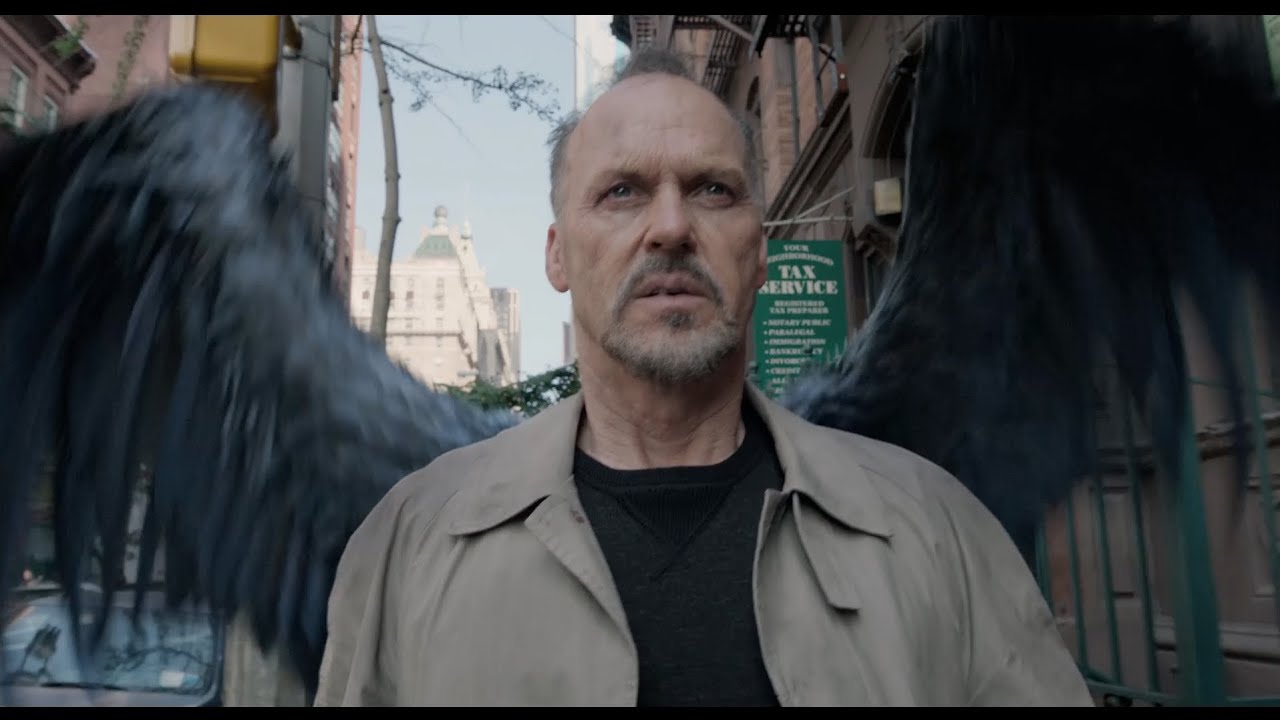
Look up in the sky... it's a bird... it's a plane...It's Michael Keaton portraying a washed up actor who mounts show in an attempt to return to his former glory! If you had not guessed by the previous sentence, Birdman, the most recent film by Babel director Alejandro González Iñárritu follows the story of Riggan, an actor who in his heyday played a superhero known as Birdman. Now over twenty years later, Riggan attempts to mount a play version of What We Talk About When We Talk About Love, which he has adapted, directs, and stars in. Keaton's performance is remarkable as a man who just wants to be remembered for something and to matter. His conscience speaks to him in a schizophrenic like manner, berating him and talking down to him, seemingly forcing and pushing him towards failure. 
Riggans character seemingly makes an antagonist in a fellow actor portrayed by Edward Norton, who is in his prime and is everything Riggan wishes to be.


Perhaps one of the most interesting aspects of the film is how it is shot. 95% of the film is made to seem as one continuous shot, jumping ahead in time, changing locations but seemingly never cutting. Though obviously the film was, unlike Russian Ark, not actually filmed as such, though the director is not trying to convince us that it is. The film has moments of magic realism as Riggans visions and discussions are portrayed in such a manner that we are unsure whether they are actually happening or not. 
The films score is almost entirely jazz percussion based, with the lone drummer appearing on screen for fleeting moments as a character walks past. Birdman is currently at Cinemapolis and is not one to miss, being both a cinematic spectacle and powerhouse story.  

Props to Netflix

Recently Netflix has become its very own network of original series. Combined with the endless amounts of series it already has streaming, it has started to produce its very own media.
For example its hit series Orange is the New Black and House of Cards have been the frontrunners for Netflix's original series.  Both of which have caught the eyes of millions of viewers worldwide. Both of which have also managed to become award winning series.


But what I really love about Netflix is their work with the Trailer Park Boys series. Trailer Park Boys is a comedic mockumentary about a drug dealer and his friends living in a trailer park in Canada trying to make it out of poverty. The series has been around for 8 seasons and has made multiple movies before making its debut on Netflix. In my opinion the 9th and most recent season which was produced by Netflix is by far the best. This season offers the best quality videography and editing as well as writing.  
 

Things are changing in the way of watching television. Just about every show and season of that show can be seen on Netflix. Viewers much prefer the instant and on demand style of watching television and Netflix is taking advantage of that.  Watch for Netflix to start producing even more original series for us to watch. 

Drone Porn

This is exactly what it sounds like. Not in the same way that food porn is awesome pictures of food or nature porn is majestic pictures of nature, this is actually a porn shot with a drone. But it also includes beautiful drone shots. Actually it seems like the drone shots is the main focus of the video, with the naked people humping as kind of an afterthought.

Here are some SFW screen grabs:


One of the filmmakers, Brandon LaGanke, had this to say about it.

"We wanted to explore the whole idea of drone privacy and strikes—this idea of 'make porn, not war. It started as a kind of funny commentary on privacy and voyeurism, but it quickly became a conceptual grounding."

I'll leave it up to you if the film accomplishes his goal or not.

NSFW NSFW NSFW


Tuesday, November 4, 2014

Everything that Pisses me off About American Horror Story

Yes, I'm fully aware that Halloween is over, but with American Horror Story: Freak Show only four episodes into it's new season, I thought it would be the perfect time to whine about everything that the show is doing wrong. I'm not typically a fan of horror shows/movies in general, but after watching the first episode of the show's first season (Murder House) I was hooked. It was some weird combination of intrigue, disgust, and - admittedly - fear, that kept me going. It was enjoyable, and I'll be damned if it wasn't a little scary to boot.

Then the second season came and lost me a little bit with it's convoluted story lines, but I was willing to ignore these and hang on for the ride. The third season almost lost me completely: while the title sequence was (and always has been) terrifying, the overall campiness and basic lack of anything scary drove me to almost ditch the show. But then they announced what the theme of the fourth season would be - Freak Show - and pulled me right back in.

RIP buddy
"Alright," I thought. "Clowns scare the shit out of me. This should be perfect." And it was! At least, some of it was. In the few episodes since the season began, there's been one storyline in particular - that of the deranged, murdering, ultimately misunderstood clown Twisty and his whiny, mother's-boy protege - that has been some of the best material that Horror Story has done since it's first season. The clown was, obviously, disgustingly scary, and was easily the most interesting part of the show.

I say was because - BIG OL' SPOILERS AHEAD - they already killed off Twisty. And with that, they may have killed off my viewership.

Let's go through everything that's wrong with the show right now. I've got time to kill, I guess. For starters, the dialogue is laughably bad. As in, I actually spend most of the episode laughing at some of the shit that these characters say. I honestly don't know if it's intentional at this point, but it's just so campy and awful. Also, Kathy Bate's accent is way overdone and outrageously weird.

Aesthetically, Ryan Murphey spends too much time - as always - attempting to make weirdly stylized and dynamic shots. This season is set in the 50s, and as Meghan Malone has so adeptly pointed out, if they had filmed the season as if it was something filmed from that era, it would be way less distracting and make the acting/dialogue slightly more believable. Instead, we're stuck with 30 different shots to cover a 1 minute scene. Not to mention that half of the strange shots are done just so Murphey can cover his own ass when it comes to saving on special effects (every time Sarah Paulson's two-headed character is framed with just one head in shot, you know they got a little lazy)
ooh yah, eh

Finally, this season has featured some of the weakest characters of any Horror Story season thus far. You'd think that the Freaks - each of the main characters is easily distinguishable by some physical deformity or another - would be relatable or unique or even significant in their own way. This is what made Twisty - and, if we're lucky, Dandy - so special: they were interesting. Three dimensional. Complex. The last episode briefly dipped into the past of a few other key characters, but apart from this, all of the plot lines that don't feature a killer psycho clown have just been boring. Find a way to make me actually care about some of the other freaks, Ryan Murphey, and I'll stick with the show for at least the rest of this season.

Eh. Who am I kidding. As long as there's at least one more psycho clown out there, I guess I'm committed.

Sunday, November 2, 2014

Electrician-ing for Dummies

Electricity. It's an interesting topic to discuss in a blog post, right? I think so. In fact, I believe electricity is SO interesting that this very post is all about it! In case you didn't realize, electricity is actually a huge part of a film set. It's how the lighting and operation of many other systems run! It's fascinating, I know. But who runs all of this electricity? Who makes all of this stuff work? It's funny you should ask, because I just so happened to finish an article on electricians! Whoopie!


An electrician does what you would most likely assume they do. People typically just don't think very much about it. To begin, an electrician's main job on set is tending to lighting the sets and locations. They don't design the lighting for scenes or anything like that, but they make sure that everyone can actually see where they're going. The electricians actually work under the direction of the Gaffer, so they help out with the set up of the lights. Without lights, people would be bumping into each other and whatnot. Duh. Electricians make sure sets and locations are safe to work on before anyone else even gets there.

With all the lights and equipment in place, the electricians run electrical cabling throughout the set and distribute electrical power to all of the equipment. They work in coordination with the DP, Gaffers, and whoever else has their own equipment or whoever else can tell them where the wires won't be in shot. The electricians have got to make sure they have everything in place with absolutely none of it getting in people's way. For anyone who's ever set up lighting at a shoot before, they can tell you it's not an easy task.


"But what if something breaks? How do I keep track of all this lighting equipment?" Have no fear! Electrician Man is here! Another responsibility for the electrician is to maintain and manage all lights and lighting equipment. They make sure all the equipment is accounted for and is working properly. It's not exactly the most glamorous part of the job, but hey, someone's got to do it. The electricians are specialized in electrical work (again...duh), so they're the people to turn to when you're not quite sure how to work specialized equipment like a generator, or...you know...lights. The electrician is an incredibly skilled professional. They have knowledge of the workings of equipment many people never even pay much attention to, and for that, we thank you.

I'm truly sorry for the briefness of this riveting post, but alas, I'm writing it while eagerly awaiting my call time for the second shoot of the day for Guilty. I'll catch you all next week for another for Dummies!