Showing posts with label assistant. Show all posts

Sunday, November 16, 2014

Assistant Cameraperson-ing for Dummies!

Hello and welcome back! I hope everyone's weekends were filled with splendor and fascination. Keeping up with our century-long tradition, today I'll go into infinitely specific detail of a film crew position. Bet you can't guess what position it is! Can you? You can?! Wow, you're smart! Here's a cookie.


Last week, we discussed the importance of the 1st and 2nd Assistant Directors. Today, we'll be discussing a very similar topic. Like the director, the director of photography has two assistants. Can you guess what those assistants are called?...You're right! They're the 1st and 2nd Assistant Camerapersons.

The camera assistants' main responsibilities involve assisting the Director of Photography in camera operation and maintenance. They essentially help the DP with the execution of their (hopefully) well-planned shots. They assist. It's what they do. It's what they've always meant to do. It's their destiny.

More specifically, in helping the DP in camera operation and maintenance, the 1st Assistant Cameraperson's duties include:
      -Operation of cameras
      -Slating and loading
      -Focus marking and pulling
      -Preparation, maintenance and management of camera equipment
Where their responsibilities really differ from the 2nd AC is in the physical operation of the camera. A person may think, "Oh, they're just an assistant, what could they possibly be allowed to do?" Well, frankly, that's a very silly question. While 'assistant' is in their title, an AC is really anything but an assistant. They're practically part-time director of photography.


What about the 2nd AC? Where do they come into all of this madness? It turns out that the 2nd AC actually shares many of the responsibilities of the 1st AC. It'd be too much to do for one person, so the film industry thought it'd be good to get a second! The 2nd AC is responsible for:
      -Slating and loading
      -Preparation maintenance and management of camera equipment
      -Maintenance, labeling, logging, and safekeeping of reels and tapes
The last point is where the 2nd AC stands out from other AC's. Basically, they work in coordination with the script supervisor to make sure all the reels and tapes are labeled and organized so those who work with them later know what they're messing with. The process of digitizing the film would be a much more grueling process without this step.

So who are AC's? What do they do? Why are they here on Earth with us? What is their purpose in life? In layman's terms, they do everything the DP has to do but doesn't have the time for. While the DP is setting up the perfect shot, the 1st and 2nd AC's are busy doing everything else camera related. Thank you, AC's!

Monday, November 10, 2014

Assistant Directing for Dummies

Hey guys. I'm going to be completely honest with you all. I'm running out of ideas. And fast. I know for a fact that I've written about directing before, but I don't believe I've ever touched on Assistant Directing. If I have, I apologize, but I'm running out of fresh topics to talk about. So, without further ado, it's time for Assistant Directing for Dummies! It's the gameshow where you don't have a ton of fun and some of the facts may be slightly inaccurate, but you leave feeling wiser nonetheless.


Today, we'll be focusing on two types of assistant directors (ADs): the first one and the second one. For those of you who don't often work on film sets, or for those of you who don't have much knowledge on the topic, my previous statement isn't as dumb as it sounds (even though it kind of is). There are in fact two assistant directors, and their positions are called 1st Assistant Director and 2nd Assistant Director. SO GET OFF MY CASE AND ENJOY THE POST. Ok? Good.

Let us begin with the first type of AD: the 1st Assistant Director. The 1st AD is very much involved in the preproduction and production processes. To best summarize their responsibilities, I turn to the handy dandy bulleted list. Once again, I apologize, but it's quite the list and I have some editing to tend to. The 1st AD's job is to:
      -Assist Unit Production Manager to prepare script breakdown and preliminary shooting schedule
      -Assist the UPM in location business
      -Check weather reports (exciting, right?)
      -Prepare daily schedules for talent and determine cast and crew calls
      -Supervise the preparation of call sheets
      -Supervise background activity and crowd control
      -Supervise the proper functioning of the set and crew

The 1st Assistant Director's job is to basically take care of everything the Director shouldn't have to worry about, allowing them to focus on making sure everything pertaining to what viewers will see is absolutely perfect.

"How does the 1st AD possibly get all of this done? It's so much stuff to get done!" You're right! It's a pretty demanding job. Luckily, though, they have a chief assistant who is in charge of conducting all the business of the set or location. This person is referred to as the 2nd Assistant Director. Go figure! How convenient is that? What exactly is the business of the set or location you ask? Well, it includes:
      -Preparing all call sheets
      -Preparing the daily production reports in collaboration with the UPM
      -Distributing all information to the cast and crew (scripts, changes, and call sheets)
      -Communicating advance scheduling to the cast and crew
      -Assisting the UPM, 1st AD, and Location Manager in location management
      -Facilitating the transportation of all equipment and personnel
      -Schedule all food, lodging, and other facilities
      -Supervise the set and location wrap
      -Maintain a liaison between the 1st Assistant Director and the Unit Production Manager
      -Assist the 1st AD with the direction of background activity and crowd control


PHEW! Glad that's over. I was beginning to just feel sorry for anyone who's a 2nd AD. I guess if you really love what you do, who's to tell you that your job is no fun. What I've gathered from this information, is that the student producers I've worked with in the past have actually been conducting the responsibilities of the Assistant Directors while the ADs have actually just been clapping the slate and keeping us on schedule. Who knew?! You do now!

Assistant Directors are wonderful people who moviegoers never really know anything about, but they're some of the most important people to have on a set. They essentially do all the things a director doesn't have time for (and probably doesn't want to do). If you're ever in the market for a career that's physically and emotionally demanding and that doesn't get much of any public recognition, Assistant Directing is the career for you!

Monday, October 20, 2014

Editing for Dummies!

I promised myself I would never do this. I told myself that I would never ever touch on this subject. Well, unfortunately, it is time. I must delve into a topic that I'd much rather leave alone. A topic that is hitting a little too close to home for my taste. A topic that would possibly tell me that I've been doing it wrong the whole time. That I haven't been doing my job. That I haven't been living to my full potential. It is indeed time...for Editing for Dummies!


I don't like to refer to myself as a "dummy," but I often am. I don't prefer to undermine myself, but I often do. I would rather not make myself, along with everyone I know, realize that I could do so much more than I already do...SO WHY START NOW?! I don't mean to toot my own horn or anything (although this is very exciting news), but it turns out that I've actually been doing [almost] everything I could possibly be doing to help the productions I've worked on in the past.

First, let's get our jobs straightened out. In the world of editors, there are two main positions: the editor, and the assistant editor(s). I say "editor(s)" because, while there can sometimes be only one assistant editor, there's more often than not multiple assistant editors. It's true (probably). Look it up (please don't). In a nutshell, the assistant editors report directly to the editor. They do what the editor tells them to do and the editor does what the director and executive producer tells him to do.

They're worked like dogs...get it? It's funny!
Let's begin with the responsibilities of the assistant editor, considering that will lead into the responsibilities of the editor. See how organized I am? The assistant editor's foremost job is to log and capture media; basically put all the files onto a hard drive and label them. After the files are logged and captured, the assistant editor organizes them in coordination with the script supervisor's log on an offline edit timeline in a rough cut format. They take the specific clips the script supervisor recommends they use and put together a very rough cut of the film without doing any detailed edits. The assistant editor also keeps a system of backups of all the files and assists the editor in compressing and the timeline and exporting it in multiple formats.

In short, the assistant editor's job is to make the editor's job as painless as possible. They gather and organize everything and even put together a rough cut of the film, pretty much just leaving the more minute, detailed edits up to the editor. Having logged at least a couple thousand files myself, it's not fun. It's definitely not fun. Hats off to you, Mr. and Ms. Assistant Editors!

Now let's move onto the editor. The chief. The head honcho. The top dog. The big cheese. Like I said, the editor is responsible for delegating responsibilities to the assistant editors. Once he/her receives the rough cuts from the assistant editors, the editor takes what they're given and cut, slice, and dice the footage into successive cuts until the final cut is reached.
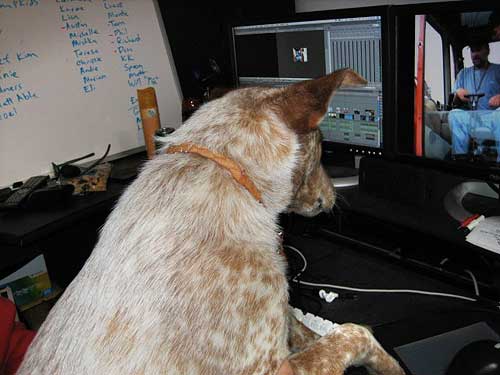
An editor looking very deep in thought.

The editor doesn't only make the meticulous edits and turn the film into the masterpiece it will hopefully become, but they're also the ones who receive all the criticism. They sit down with the director and executive producer on a regular basis to receive criticism about how they can improve their work. It's pretty mentally and physically exhausting! Not only is their work ripped apart by some very important people, but they also work unimaginable hours to change their work so that these very important people like it.

Once the "final cut" is reached (I say "final cut" because, well, the final cut isn't typically reached until the day before the project's hand-in date) the editor often assists the Directory of Photography with color correction and other postproduction effects. There's more often than not other people who are specialized in these areas who are hired for color correction and special effects, but the editor gets some level of input in what is done or how it's done.

The editor's final job is to output the final cut of the film to several formats. The format can depend on who it's being sent to. This can include film festivals, theaters, online, etc. Assistant Editors and Editors have it rough. Their jobs are to basically polish and refine with the very little time and resources that's [most likely] available.