Showing posts with label character development. Show all posts

Monday, October 26, 2015

Limited Exposition: CAN YOU DIG IT?

This weekend while perusing through the realm of Netlfix I came across Walter Hill's The Warriors (1979). I'm usually not a big fan of movies from the 80's (1979 close enough), I just have a hard time getting past the cheesy, outlandish, synth- filled madness that is known to accompany films of this era. That being said, The Warriors  is a clear exception. I love this movie. 

This stylized film centers around gang life in NYC, but not the rough and tough street gangs that you see on the evening news- this is the 80s, remember. The gangs in The Warriors are more of a protective family, not a lucrative organization specializing in a drug trade or other illegal activities. They are violent, but only to protect their turf and their gang.

Not the most intimidating crew


The thing I like most about this film is the almost nonexistent exposition to help set up the story. We as the viewer are immediately thrust into this world as the Warriors gang is traveling on a subway. We have no idea who they are, what they are doing, or generally what the hell is going on. The opening is just a mash up of trains whizzing by and different groups of people (characterized by their specific matching outfits) traveling to some unknown location. Details slowly get revealed and pieced together- although not very clearly. A quick cutaway of a subway map reveals they are traveling to Manhattan. Through some brief dialogue we get a sense of the huge scale of this meeting, which also reveals that there are many other gang factions in attendance. Talk of a "truce" and some mysterious character Sirus  give us more questions than answers- at least to start. 

Normally movies like this just annoy me and make me feel out of the loop- I like things clear cut and explained. But the ambiguity of The Warriors works very well. It feels like  a fantasy/alternate reality film at first, but everything we see on screen indicates a normal earth in present day (1979). This is mainly due to the various gangs in outlandish costumes (leather vests, painted mime faces, baseball jerseys, roller skates- the list goes on and on). It almost gives off a post apocalyptic, urban Mad Max type of vibe. It is very off-putting, yet oddly satisfying and believable. 

This film makes you focus more (subconsciously) on the minute details we see and hear on screen and piece together the background of the narrative. It is up to the viewer to decide how the film world came to the specific starting point of the movie. The events that unfold throughout the film are dependent on a specific understanding of the narrative universe and how this world works, but those "rules" are never clearly explained.  However, the average viewer doesn't really perceive this or even know it is happening. That is what makes The Warriors so good. They give us so little information, yet we are able to understand everything about this world and instantly relate it the characters and their unfortunate situation (don't worry- no spoilers). 

I really like this alternate-exposition technique; I think it makes the viewer more engaged and immersed in the film as they try to figure out the nuances of the story world, even if they don't realize it. I think this is a problem that our film Dollhouse had initially- we tried to initially tell too much of the story explicitly  instead of implying story details  visually or through brief dialogue. As our script goes through minor changes I hope we are able to incorporate more (less?) of this into our story exposition.

I understand that not everyone is fan of this exposition choice. I'm usually not. But I thought it really worked for The Warriors. Can You Dig It?



Thursday, September 17, 2015

Production Design in Narcos

This week I watched two episodes of Narcos, a Netflix original series. (I'm really bad at binge watching television.)

Narcos is about the most notorious drug dealer of all time, Pablo Escobar. Much of the story takes place in Colombia in the late 70s and early 80s, where Pablo and his team produce mountains upon mountains of cocaine to sell in other South American countries and the United States. ('narcos' = narcotics. If you didn't get that, it's cool--I didn't until at least halfway through the first episode). The story is told by Steve Murphy (played by Boyd Holbrook), a DEA agent who moves from Miami to Colombia to stop Escobar.

Pablo and his cocaine. Bffs 4 life.

Th production design in Narcos, as I would expect with any major drama series, was excellent. Scenes in episodes one and two take place in the middle of the jungle, a fancy Colombian hotel, a random street in South Beach, Miami, the airport, a plane, a bowling alley, and a ton of other places. There was so much effort put into every little detail--as it should be.

This has inspired me to get involved in this part of production for our project, which was recently retitled as Dollhouse. In class we talked about using our location to resemble a dollhouse, so I started to think about exactly what that means.

I may have had this exact dollhouse growing up, actually.
I played with dolls (Barbies, Polly Pockets, Bratz) all the time growing up. However, I think what makes dollhouses a little creepy is when all the furniture is glued down. Not all dollhouses are like this, but the ones for very young children are, so they can't pick up the tiny furniture and start eating it. Maybe glued down furniture is an element that we can play with. We want the dollhouse to reveal characteristics about our antagonist, Hannah, so very minimalist designs might be best. Perhaps we could have shots of her straightening or tidying things around the house as she talks to Vivian, our protagonist. Vivian's room, in contrast, will look like the "normal" college student's--pictures and posters on the walls, some laundry on the floor, homework sprawled across the desk.

Obviously, we don't have the money that Narcos did, but that doesn't mean we can't put a lot of effort into our production design.


Thursday, October 16, 2014

Writing for TV Vs. Writing for Film

If you're like me and want to be a screenwriter (which apparently applies to like, half of our class) you might assume that all scripts are more or less the same: just throw something decent in celtx and boom. Script. Film, Tv, whatever, a script is a script. However, as I'm learning very quickly in my writing for series television class, there are some major differences between writing a film (short or feature) and writing for a weekly television show. Here are just a few.

1. Television writers are more likely to get/keep jobs.
Yay jobs!

Not to say that people who write TV shows are better at their jobs than those who choose to write films; it's simply a matter of numbers. While film scripts are typically written by only one or two people as a kind of freelance project, TV scripts are made by - almost always - staff writers. Staff writers collaborate on scripts to keep episodes of any given TV show consistent with that show's tone and brand. Simply put, there are more positions available to write for TV than to write for film. To find out a bit more about the various positions and hierarchy of a television writing team, check out the Writer's Guild of America's official overview here.

2. Characters develop differently...if at all.

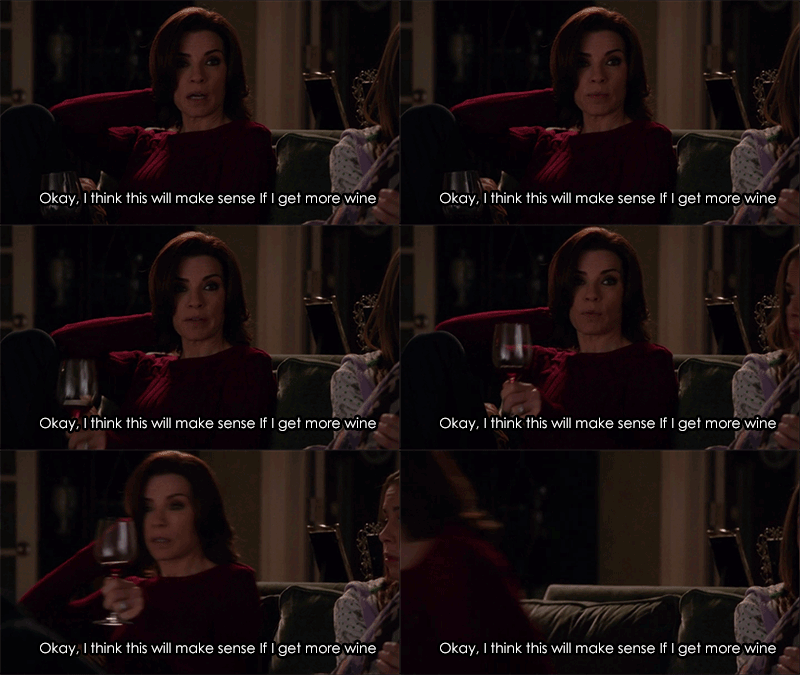
Ja feel, Alicia.
In any good film, the main character will undergo some kind of change as they progress from point A to point B. A movie with a static character is kind of just a boring movie. Television, however, is more or less the exact opposite. Apart from certain cable dramas (cough cough Breaking Bad), people watch TV shows for consistency. If Michael Scott suddenly realized that he was a gigantic doofus and wanted to change his ways halfway through season 3, there never would have been a season 4. As weird as it sounds, we want to know what we're getting into before we watch a show. I watch the Good Wife because it's an intensely dramatic show about lawyers; even though major, major changes occur during its fifth season, I continue to watch it because it's characters are consistent and awesome. It's perfectly fine to reveal new traits and things about your characters as a show goes on, but they should always have the same basic characteristics that made your viewers want to watch your show in the first place.

3. TV is faster and there's way more of it.

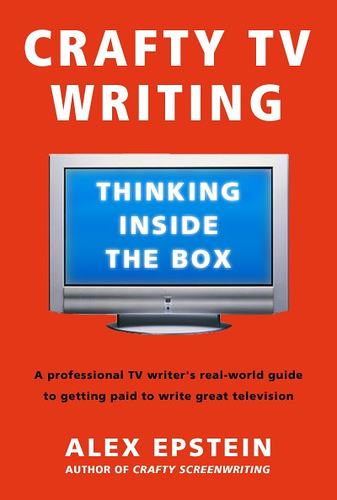
Whereas a feature film writer can take months (or even years!) to write a first draft of a commissioned screenplay, a television writer typically has to churn out a script that's ready for production in 5-7 days. That's less than a week to go from concept to breakdown to outline to rough draft to shooting draft, with a few extra drafts thrown in there somewhere for good measure. And don't even think of missing deadlines. Alex Epstein details the entire process in section taken from his book, Crafty Screen Writing, which can be read here. The upside to this tight production schedule, however, is that television writers are some of the most powerful people in the industry. Unlike film writers - who are typically never on set and practically thrown away after they've turned in a decent draft - television writers are often the producers and showrunners of their own productions. All of this basically just means that the actors shouldn't piss off the writers, since they could literally kill off your character at any moment.

While both television and film have their pros and cons, it almost goes without saying that writing for TV is the more difficult of the two. But if you are up to the challenge and can somehow not consistently get chronic writers block, it also may be the more rewarding.

Thursday, October 4, 2012

One shot- director reflection


      Last Saturday, I shot my one shot film in my apartment and for the most part, the shoot went really well and I was pleased by the efforts of my group members and actors. Admittedly, I planned my first shoot at the last minute and my original location fell through. Because I was not able to shoot at Hammond Health Center, I was forced to find new actors, write a script, and find a new location within a few short hours. I was very disappointed that my first location fell through, but it was my fault on behalf of bad planning and last minute decision making. My new script was not a reflection of my best work. Fortunately, my actress was great and did an excellent job of bringing an emotional aspect to my seemingly cliche script and develop Liz's character. When it came down to the actual filming, my teammates worked really hard. I think that my lighting was very blown out and could have been more subtle. After color correcting in post, darker lighting worked much better with my story and the actions of the actors. 
        As i watched my film in class, I realized that I could have used more camera movement and that my shot was very static. I think that the strongest part of my piece was the acting. i was really pleased with Talia's delivery and think she did a great job of portraying Liz's character. The weakest part of my film was definitely the lighting. It was very weak and did a poor job of representing the high emotion involved in my production. I aslo think I could have chose a better location. My apartment is very bare and does not seem lived. I should have concentrated more on art direction to make a stronger character presence in the home. By using an off campus house, my location would have had more character and would have seemed more natural for the script. 
        As far as my role as a director, this is actually the first project I have worked on as a student that allowed me to fully direct my actors. I think that I did a really good job directing my actors. I realized it is extremely important to know your script and the types of emotions you would like your actors to portray. I also learned that blocking is important when directing. I found it difficult to make the actions of my actors appear natural and struggled to emphasize the importance of the actors physical interactions with the location and set. As a director, you need to know your script, how you would like your production to be portrayed, and the physical and emotional actions you want from your actors. I really enjoyed directing. 
    Overall, I am really pleased with how my production turned out and learned a great deal about production value, directing, and location scouting. I really enjoyed this project and look forward to using these skills for later projects. I learned that post production can greatly increase production value and that is extremely important to maintain the same settings you shot with while exporting. The production of Palmer, was the first time I have felt fully involved in each aspect of a production.

-Brie