Showing posts with label shot. Show all posts

Wednesday, October 1, 2014

Script Supervising for Dummies

Welcome back! Don't know how you got here? Don't know why you're here? Me neither! As long as I have you, though, let's discuss a very important matter. Now, I don't know about you, but I've been wondering what a script supervisor does for quite some time. I understood the very basics of the job, but what in the world are the specifics?! I don't know! Or at least I didn't know. Until now! It's "Script Supervising for Dummies!"

What most people already know about being a script supervisor is that they, well, supervise the script. "But what exactly does that entail?" one may ask. The paramount job of a script supervisor is to maintain a daily log of the day's shots and their relation to the script during the production process. They act as the chief continuity person on set and act as the on-set liaison to the postproduction staff.

Essentially, the script supervisor is the editors' best friend. They're practically the only ones on set who have the postproduction staff's best interests at heart. They keep track of every shot and make sure it'll be able to be cut together later in the production process. We love our script supervisors!

Getting a little more into the details of the job, a script supervisor's foremost task is to maintain of log of all shots taken on set. This log has every bit of information an editor could possibly need. It has shot numbers that match up with the script, slated shot numbers, comments from the director or DP (usually explaining important details of what to use/not use), continuity information, the tape/reel number, camera settings, the date and time, production statistics, etc., etc., etc. Any and all questions postproduction staff may have should be answered by this log. If there are any questions left unanswered, the script supervisor didn't do his/her job and will most definitely be fired...ok, maybe not fired, but someone will definitely be slightly upset.

Along with the continuity notes on the shot log, the script supervisor must also have keen eyes on set so as to call out any errors while shooting. This can include anything from an actor's hand movements from shot to shot to a prop placement error. Clearly, they can't interrupt a shot just to point out an error, but instead will relay their notes onto one of the directors so that they can correct them in future takes. To assure for consistent prop/set placement and design from day to day (you never know what fool will decide to move something), the script supervisor cross-references with the continuity stills photographer daily. They need to make sure they'll have easy access to any continuity stills during production so they can quickly double-check anything they need to without costing the production any time.

A script supervisor who's particularly good at their job will most likely have some level of editing experience, or at least a general understanding of how it works. It makes for a much better judge of what can and what cannot be cut together (continuity). Speaking for anyone who's ever worked in postproduction, we love our script supervisors. We really, really do.

Thursday, August 28, 2014

First Assignment: Understanding the basics of good composition

According to Chris Knight, the writer of The Ultimate Guide to Composition, there are 5 main 'guidelines' to follow in order to achieve at least half-decent composition in a photograph (or a film shot). These guidelines include the following techniques: center composition, the rule of thirds, golden triangles, the diagonals, and the golden ratio/rectangles/spiral. It's been brought to my attention by this composition guru that you pretty much need one of these 5 framing techniques in order to have a shot that even has a chance of being a pleasant one. Well, here's my opinion on these 5 composition guidelines as laid out by Mr. Knight. I'm sorry in advance.

Center composition, put simply, places the most important objects in an image in the center. When done correctly (as displayed in the image to the right), this type of composition can work very effectively in creating a certain feel to a shot. What is that person doing all the way out there? Are they lost? Reminiscent? Suicidal? I have no idea. The shot certainly makes you wonder, though, doesn't it? Not only does it evoke some sort of emotion, but it's also extremely aesthetically pleasing. The person is placed exactly in the vertical center of the frame along with the horizon in the horizontal center. Knight did a decent job explaining this.

Next we have the rule of thirds. Now, if you've ever attended a Park class, picked up a camera, or have lived in the modern world, you've heard about the rule of thirds. It's not a particularly hard concept to grasp. You basically just imagine (or many cameras will even show you on the viewfinder) four evenly spaced lines that divide the shot into nine sections. You then place the important objects in the shot on these lines, and you place the absolute most important objects on the intersections, like the subject's eyes. Knight explains that this kind of off-center composition adds more visual interest and tension for viewers. I mean, he's right. I don't know why there needed to be such a detailed explanation of the topic, but what the hell. Power to you, Guru Knight.

This third composition technique is completely beyond my understanding. The golden triangles is basically when the photographer divides the frame into three or four triangles, with the 'major line' dividing the image diagonally, and with one or two 'reciprocal lines' perpendicularly intersecting the major line from the corners of the frame. Just look at the image of the Eiffel Tower. It'll save you a whole lot of grief rather than trying to understand my explanation. Now, I'm not sure if I'm just not grasping the concept, or if Knight's explanation is simply terrible. Probably the first one, but hear me out. When looking at the Eiffel Tower, nothing particularly important is on the lines' intersection. Yeah, it's the center of the tower, but I feel that the shot would look exactly the same if the photographer had just aligned the tower with the major line. Am I wrong? I don't think so. If there's something obvious that I'm missing, comment on the post. I'd love to better understand this concept. Please and thank you.

I usually like to think of myself as a reasonably intelligent guy, but in this case, unfortunately, I don't quite understand the composition technique of the diagonals either. You win some, you lose some. Am I right? Anyway, Knight explains the concept of diagonals as splitting an image from corner to corner with either a Baroque Diagonal (read left to right) or a Sinister Diagonal (read right to left). I have two things to say about Knight's explanation of the ballerina image. He says the diagonal used in the composition is a Sinister Diagonal (read right to left). He says the ballerina's eyes line up with the ballerina's pointed toe on the right. First of all, wouldn't a person looking at the photograph immediately look at the ballerina facing us, forcing the viewer to start at the left of the image? Second, the ballerina isn't looking anywhere near the pointed toe. She's looking off to the right, not down. How was the pointed toe chosen as the second object to decide which way the diagonal would lean? Either this photograph is a very poor example of the use of diagonals for composition, or I'm missing something very important here. I usually like to assume I'm not the wrong one.

Last but not least, we have our famous golden ratio/rectangles/spiral concept. This is probably the most useful composition technique out there. It's not only used in photography, but can even be found in architecture and music. For its high level of universality, the golden ratio is an unbelievably simple concept. I'm not going to go into specifics (you can find those here), but all it takes is a little math, really. Knight doesn't do a terrible job of explaining the technique, either. Even I understood it. Kind of. The golden ratio is a fascinating concept. I strongly recommend you look more into it. You'd be absolutely amazed at all of its applications.

All in all, Composition Guru Knight did a quasi decent job of explaining the five main composition techniques all photographers should take into consideration when framing a shot. For all of you folks out there with a camera, take note.

Friday, October 5, 2012

One Shot Reflection

Directing has always been something that I've been somewhat interested in, but not too sure of myself in. At least in production classes, I've been used to developing an idea in a group and being the DP-essentially being able to frame my own project as I see fitting. It was a challenge for me this time to step back from this role, and tell someone else how I wanted my vision to be seen. However, I found that (even though I was only able to do one take) when you have faith in your crew and their abilities, this can end up looking really great.

The pre-production process, however, proved to be much more stressful than I had initially anticipated. My idea sort of 'came to me' in a brainstorming process, somewhat out of nowhere. I knew it was a bit ambitious, but for once I wanted to go outside of my comfort zone in a production class and really try something I'd never done before. I went through about 3 trials of making the sugar glass that essentially failed. The first one didn't harden at all. The second ended up looking alright (but ended up failing...I'll get to that). Then, the night before shooting, my talent suggested I try doing it again just in case. So I did, and it again came out decent.

At the time of the shoot, I first decided to use the last piece of sugar glass because I thought it looked the worst. The shoot went great and the photography looked amazing. As I went to remove the first piece I made from the pan, it broke right in front of me. So I had to go with what I had. It ended up looking really great and I was able to do some cool stuff in post. I think I'm gonna try my hand at directing the next opportunity that arises.

Thursday, September 15, 2011

101 Acting


After watching the video today, I realized that acting is not so much a talent, but more of an art. Michael Cane went on to talk about how simple you have to look in front of the camera and that less is more, especially on close ups. I did some researching of my own and found some other helpful tips that might help the rest of the class with their replication project.

1. If your scene has dialogue, tell your actor/actress to make sure he/she knows the character they are playing. if the character is serious, then the dialogue shouldn't come across funny or sarcastic. IF your having trouble keeping your actors from laughing, go through the scene a couple times until the laughter dies out. It is too easy to spot out on screen actors holding in their laugher, and it only ruined the shot.

2. If you have characters in the background or just simply not speaking, give them something to do while on camera. What I mean by
that is to make sure he/she isn't doing something to just get T/V time. They should have a purpose to the shot and should be doing every day kind of things.

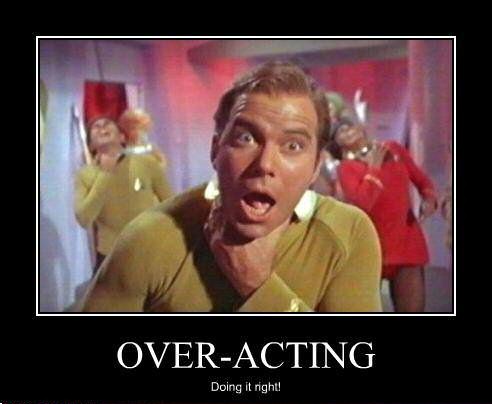
3. Last, be aware of overacting. Make sure you understand what the scene's purpose is and that you don't exceed or miss the point. A lot of the time, beginner acts feel like they need to stand out from the others so they feel obligated to try and make more of what they are suppose to do. This mistake is easily avoideable and shouldn't be seen in any of our projects.


I hope this helps to all that read. Give me any feedback you got or anything else that I should maybe add to the list.

Steve Kinslow