Showing posts with label crew. Show all posts

Tuesday, October 28, 2014

Feeding the Crew for Dummies

FOOD.
Great! Now that I have your attention, I'd like to discuss an important matter with you all. For years, film crews have been going hunger. Whether they're not being properly fed on set or if they simply forgot their granola bar at home as they were running out the door to make call time, film crew members are hungry. Heck, I'm hungry right now! Imagine how the people working feel! With the poor, malnourished souls in mind, I think it's time. It's time to learn how to feed these hard workers. It's time to learn how to keep your crew happy. It's time for "Feeding the Crew for Dummies!"

Now, everyone knows that a person with a full stomach is a happy person. It's a fact of life. If you don't agree with me, get out. Leave. Don't ever come back here again. If you do agree with me, or if you simply don't care enough to leave, then join me as we explore the inner workings of the film food business. Essentially, the business includes three branches: craft services, caterers, and food stylists. These wonderful people have a lot on their plate...get it? Let's see what their exact responsibilities are...

Craft Services.
Sounds simple enough, right? Craft services, which is a separate entity from catering, encompasses all of the wonderfully assorted snacks and beverages provided to the film crew. The godsend in charge of craft service sets and maintains a station near the production that makes these snacks and beverages available to all the hardworking folk on the crew. A budget is given to the craft service person prior to attaining all the refreshments. I guess Costco just isn't good enough for some people. Personally, I'd be fine with some Cheez-Its and juice boxes.

Caterers.
The caterer takes care of the main meals for a production. While craft services prepares the snacks, the caterer plans, organizes, and prepares all the substantial nourishment for everyone. Having a caterer on location is a serious convenience. On one hand, the crew can be more efficient. The food is right there for them to grab on a thirty-minute lunch break. On the other hand, you save extremely valuable production time and money without the need to transport the crew to and from meals. Caterers have been known to serve small crews from ten people to enormous crews of hundreds of people. "But what can I eat? I'm vegan?" "What about me? I can't eat gluten!" No worries! These are fairly common requests for production caterers. They'll cater to your personal needs! (I'm on fire today with these puns).

Food Stylists.
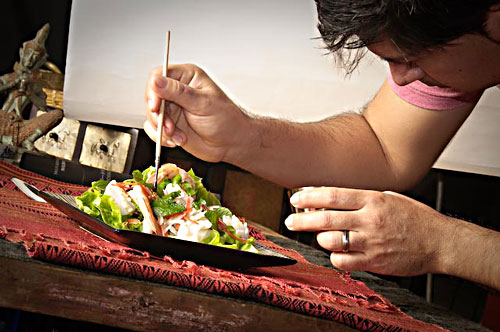
But what if you want your food to look nice? Let's be honest, we ALL want our food to look as good as it [hopefully] tastes. This is where the food stylist comes in. Their job is to prepare and arrange food in a particularly appealing way. They typically have an extensive background in cooking, recipe development, and the ability to make food look its best. Oh yeah, I almost forgot to tell you that the food stylist doesn't actually help out the crew. Not really, anyway. Their job is aimed at food used in photographs, commercials, or movies. So they're making sure the food looks good on camera, not on your plate. Sorry I didn't mention that sooner.

It's often a crew member's first question when walking on set (or at least it's mine) to ask what's being served for lunch. It turns out that it's not actually the producers' job to take care of it, although that's how we've been doing it on our student films. Food service workers are, in my personal opinion, some of the most spectacular people on a production. And if you don't agree with that, well, you can just keep that to yourself.

Monday, October 13, 2014

Director of Photography-ing(?) FOR DUMMIES

Oh hello there. Didn't see you there. No, don't go! As long as I have you here, we have a very important matter to discuss. For centuries (or at least for a little while), there has been a daunting question on people's minds. What exactly does a Director of Photography (or cinematographer) do for a film production? Hmph, that's certainly a tough question. Let's go to the expert to try to find an answer to this inquiry.
...

What's up, guys?! You know me. I'm that guy. From that thing. You know, that thing? No? Ah well, might as well just give you what you came here for. So you want to know what a director of photography does, huh? Well you're in luck! It's time for this week's "...FOR DUMMIES!"


Like quite a few other crew positions (Producer, Director, etc.) the director of photography's (or DP for short) job stretches out over all three stages of production: preproduction, production, and postproduction. They really don't get any sleep, but who needs sleep?! Let me break it down for you.

Obviously, we start with preproduction. Duh. The DP begins his/her job with discussing the director's vision for the overall film as well as scene by scene. Based on what the director is looking for, the DP determines what exactly is needed for each scene, and, following that, hires a camera crew and organizes and purchases any equipment and supplies that will be needed. When deciding what's needed for each scene, the DP works with many other departments--including sound and lighting--to coordinate production needs. In summary, the DP uses his preproduction time very wisely. He pretty much plans out every shot and gets any and all the tools he'll need to acquire these shots.

After many months of planning, the DP's job moves into production. The most essential thing the DP must do during this step of the process is to coordinate the crew while working closely with the director to make sure every scene and shot is set up to match the director's vision. If the director doesn't get what they want, may Hitchcock have mercy on your soul. Here's where the difficult stuff comes in. For each and every shot, the DP must decide on: the best combination of cameras (oh yeah, filters and lenses, too), the placement of the cameras, what the lighting should look like, AND when the best time would be to shoot. On particularly large films, the DP often oversees several cinematographers who supervise different camera set-ups. He often ALSO manages the photography budget, so the DP is kind of like a part-time production accountant.

Finally we come to postproduction (yeah right, we're not done yet). The first step of the third step of the three-step film production process begins with the DP working with the processing lab to make sure the film retains the color and the mood that he and the director were aiming for. If this part of the process gets screwed up, then a big chunk of all the hard work and planning goes right down the drain. The DP also reviews dailies as well as cuts of the film throughout the editing process. It's important for the DP to participate as a critical eye throughout postproduction.

Alongside the film director, the director of photography has some of the most creative control of the entire crew. They decide what we see and how we're going to see it. Often times, the DP is the person who makes a good film into a film that we'll never forget...

Or they can be the person who absolutely ruins it. Either way, they're really important.

Monday, September 15, 2014

Directing for Dummies

Welcome to the newest edition of "[insert random film crew position] for Dummies!" I'm you're host, Mike, and today we shall be delving into the world of the director. *Oooo ahhh* Now, I know what you're all thinking: "Duh! A director is the guy/girl that directs people!" You know what? You'd be correct in saying that. Go figure!

I'm sure you all know the basics of a director's job. I'm here today, though, to try to teach you a little something that you may not have already known. Let's start from the beginning. Now, after a director is hired by producers for a project, the director must then work side-by-side with the producers to cast actors for the film. This can be an extremely long and tedious process, but it's one that simply must be done. Clearly. Without quality actors, you can't possibly dream to have a quality film. Well, I guess you could, but that's all it would be: a dream.

Next up on the list of things to do, the director has to organize and select shooting locations. Of course, the director has location scouts working for him to truly find the best locations for shooting, but he has creative control and authority as to which locations will appear in the film. At the same time, the director interprets--and sometimes even writes or selects--the script for the film. The director rarely ever writes the script himself, but if he's not hired by a production house to direct the film, the director will often go out and find a script he'd like to work with. The location selections are hugely dependent on the script and the way the director interprets it, so the two steps are pretty much synonymous.

The director's next job is the last step before filming can begin. He must approve the sets, costumes, choreography (not present in most films), and music. These aspects of film are usually completely invisible to the untrained eye, or ear, because the only time most people will find them noticeable is when they are done incorrectly. If a film is set on a 1950s Japanese farm, and the actors are wearing tuxedos and sneakers with Kanye vaguely playing in the background, something went wrong...very, very wrong. It's the director's job to make sure mistakes like this never happen.

What else does the director do? Well I'm glad you asked! The rest of the director's work is pretty straight forward and most of you already know all of these things. But guess what! I'm going to tell you about it anyway! The director has a whole lot to do during production. The most obvious task is directing the actors. Whether it's explaining to actors how he wants them to portray their character in a given moment or if it's simply helping actors get into character, the director is the guy doing it. While doing this, the director also keeps the crew on track and makes sure everyone's doing what they need to be doing. Film shoots are generally tightly scheduled, so there's no time for excessive screw-ups and messing around. While doing this, the director also works with the cinematographers on shot composition and makes sure he likes what's in the frame.

Production is quite a daunting time for directors. They're basically the ringleaders for the wildest circuses on the planet. If they crack, the film is doomed to fail. The director must keep his cool so that everyone else does.

So now the film is shot. Yay! The only thing that's left for the director to do is work with the editors on creating first a rough cut and then a final cut of the film. The director gives his input throughout the process on what he thinks looks and feels better. Sometimes, this leads to reshoots of scenes or even cutting entire scenes from the film. But hey, who ever said directing was easy?

Thursday, December 13, 2012

Goodbye, Farewell, and Amen

We are approaching the end of the semester and I can say that I am looking forward to break, but I am going to miss Fiction Field 2. I enjoyed my projects and I feel like I learned more about directing from my first project than any other film I have worked on, even though it was only a minute long. I learned that length is not important as detail and action.

I also got a chance to try script supervising, which I did enjoy. I realized the importance and difficult that can come with keeping track of shots and how long they are.


I really enjoyed my classmates and their creativity on the different projects. I learned more about the collaboration process that comes from making student films. I discovered what qualities a person should have for them to be good to work with. Crew chemistry is probably one of the most important things that a producer should keep in mind and that is something I will remember when I do my thesis next year.


At first, I was not sure of what to think of the blogs posts, but as time went on, I realized it was a great way to force me to sit down and watch a movie or a television episode every week. It gave me time to relax and think about my major and the medium I want to work in.

To end the semester, here is my top movie list of the year, all of which I recommend.

5. The Master
4. Moonrise Kingdom
3. Argo
2. Skyfall
1. Lincoln


Monday, December 3, 2012

Who you calling a Rat Bastard?

It's a WRAP!! 


Get it? Because in film that say its a wrap when they are done with a shoot but that is a picture of a wrap like the sandwich! Get it? Oh you people don't know comedy!

Sunday was a GREAT production day. In all of 9 hours we were able to shoot our final project. Though the day was long, the crew and cast made the day run a lot smoother then I thought it would. I was very impressed on how organized and detail oriented we were as a team during the production. I've been on productions where everything is just all over the place and we would waste a lot of time trying to figure things out when things should have been figured out already. This past Sunday, the crew showed up an hour before the cast. We set everything up and went over shots before the cast even came, this way when the cast did come, we were able to jump right into recording. We ended our production 45 minutes before the scheduled end time. Impressive right? Yea I know, I know. I just want to give a big thank you to the crew for holding everything down, from the script writing, to directing on set, to making sure we had all the audio covered. A very organized team made for a successful day of shooting and i'm happy we're done. BOOM!

Friday, October 5, 2012

One Shot Reflection

Directing has always been something that I've been somewhat interested in, but not too sure of myself in. At least in production classes, I've been used to developing an idea in a group and being the DP-essentially being able to frame my own project as I see fitting. It was a challenge for me this time to step back from this role, and tell someone else how I wanted my vision to be seen. However, I found that (even though I was only able to do one take) when you have faith in your crew and their abilities, this can end up looking really great.

The pre-production process, however, proved to be much more stressful than I had initially anticipated. My idea sort of 'came to me' in a brainstorming process, somewhat out of nowhere. I knew it was a bit ambitious, but for once I wanted to go outside of my comfort zone in a production class and really try something I'd never done before. I went through about 3 trials of making the sugar glass that essentially failed. The first one didn't harden at all. The second ended up looking alright (but ended up failing...I'll get to that). Then, the night before shooting, my talent suggested I try doing it again just in case. So I did, and it again came out decent.

At the time of the shoot, I first decided to use the last piece of sugar glass because I thought it looked the worst. The shoot went great and the photography looked amazing. As I went to remove the first piece I made from the pan, it broke right in front of me. So I had to go with what I had. It ended up looking really great and I was able to do some cool stuff in post. I think I'm gonna try my hand at directing the next opportunity that arises.