Showing posts with label stanley kubrick. Show all posts

Monday, November 16, 2015

Clockwork Orange

This semester I've been trying to watch on the films that I've been chastised for not watching yet. It's been a great ride so far and a lot of the classics I thought were over hyped actually turned out to be pretty great! However every once and awhile there come a time when I flick on a film that really grips me. And this time dear friends and trusted readers, that film was Stanley Kubrick's a Clockwork Orange.
Spoilers Y'all
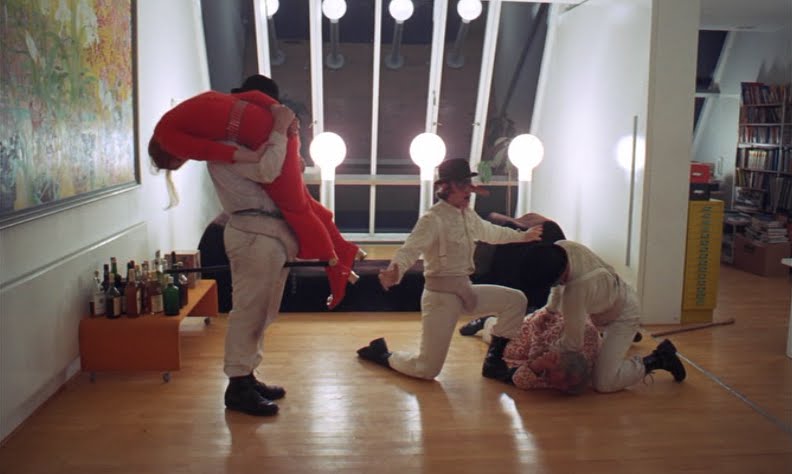
I really didn't know what I was expecting coming into the film. For years I'd heard that it set the bar for ruthless onscreen violence, and for the most part it lived up to the hype. Sure we may see more Ultraviolence nowadays, but I'm sure that back then this film really was a real horror show. Overall I loved the film, I loved the character of Alex as a self aggrandizing psychopathic narcissist, I loved the sets seen below:

And I loved how the change the main character goes through. I feel as though most of what I loved about this film can be summed up in the following clip, which I don't suggest you watch if you haven't seen the film. It's wacky, weird, and works wonderfully to frame the psychological instability of the main character.

Friday, October 4, 2013

Single Point Perspective

Film and photography by definition are a two dimensional medium. They are flat. Half of our jobs as film makers is to break that view and bring our audience into the picture as if it is happening right in front of them.One of the ways we can do this is by changing the perspective of the shot, adding depth of field to our image. One specific technique for adding depth of field is using a single point perspective. For those who don't know what single point perspective is, think about standing in the center of a railroad track and watching it disappear into the distance.
One of the greatest film makers of all time used single point perspective in many of his films. Stanley Kubrick has been regarded as one of the best directors in the history of film. His films include, The Shinning, Full Metal Jacket, A Space Odyssey 2001, Clockwork Orange, Barry Lyndon and many more.The single point perspective is apparent in all of these films. But what I have been taught many times is don't make a symmetrical shot. Set the eye line just off from center. By watching great film makers we see that being the best, means breaking all the rules.

Kubrick // One-Point Perspective from kogonada on Vimeo.

Friday, September 20, 2013

Lighting in A Clockwork Orange

The name Stanley Kubrick is synonymous with innovation both on the screen and off. He was the first to bring the steadicam onto the scene for the filming of The Shining, and has also created other tools and techniques that make his films stand out as some of the best. As I was re-watching the cult classic A Clockwork Orange, I couldn't help but notice one specific scene where there appeared to be no set up lights, which I found astonishing.

The scene where Little Alex chases, and subsequently murders the Cat Lady is shot on a handheld 18mm Arriflex camera, and involves him moving around the room as the scene unfolds. The camera focuses on all four walls at some point throughout the shot, which means it would be impossible to set up lights in the room (you can see the ceiling too). Kubrick used his innovation, and actually included illuminated sculptures around the walls, which ended up lighting the room perfectly, and was soft enough to cast no shadows, including his own as he moved around the room.

This was not the first time Kubrick had used this technique; he used similar lighting in the war room in Dr. Strangelove and the circular space ship in 2001. I really like the whole aspect of him building the lighting into the scene as opposed to using set lighting. It adds a certain realistic and natural quality to the scene which in my opinion makes this shot rather eerie.


Monday, October 10, 2011

Clockwork Orange

I watched Stanley Kubrick's Clockwork Orange for the first time a couple of days ago. To say the least the movie was intense. I could tell from the very beginning that Alex, played by Malcolm McDowell, had some pretty deep psychological problems.

clock01.jpg

Never trust a man in with eyeliner.


That was only the beginning though. The treatment that he went through was just disturbing.


Then when he finished with the treatment everything that could go wrong went wrong. His parents replaced him with another guy. When he left he got beat up by a bunch of homeless guys. Then he was picked up by the police... who beat him more and almost drowned him. He manages to stumble to a nearby house. But he raped the late wife of the person who lives there. The man tortures him by playing the former favorite song of Eric. This leads to Eric attempting to commit suicide.


There are many different lessons to be learned from this. Don't trust people. The government can be worse for people than free will. What goes around comes around.


The scariest part about this movie is that Eric was such a vile and violent person that showed no remorse, but by the end of the movie we sympathized with him and so did the rest of the people in the movie.

Sunday, September 18, 2011

Editing and Acting!

Given that this week we have gotten really in depth into acting and ways actors should express emotion in front of a camera, I decided to make my post on the Kuleshow effect. Over the summer I decided to watch 2001 Space Odyssey again (last time I watched it I was 13, of course I didn't like it) because I felt that analyzing this movie would be really beneficial for me. After watching the movie I decided to research more about it, and this is when I found out about the Kuleshov effect. This effect was "discovered" by russian director Lev Kuleshov (hence the name). It is basically a technique of editing in which he alternated an emotionless shot of famous russian actor, Ivan Mozzhukhin, with three other different shots. After showing the same different montages with the same shot of Mozzhukhin to different audiences, Kuleshov demonstrated that in film acting the audience is the one to attributes an emotion to character, depending on the different shots the director decides to cut to.


According to the different audiences, in the first shot Mozzhukhin looks hungry when he the shots cuts to the plate of soup. on the second shot he looks sad, and on the third one they said he had desire for this woman.

Here is Alfred Hitchcock explaining the effect. I feel he makes a better job trying to explain the effect.

I think it is really interesting how this effect has influenced the acting and direction in the history of films. Going back to 2001 Space Odyssey, we found the effect in most of the shots of the computer Hal. Given that he is a computer he cannot show any kind of emotion, but the audience gives the computer human emotions by the way Kubrick intercuts between him and the crew members of the Discovery one.

The last part this video reveals to us that Hal feels betrayed and angry with the crew members just by the way it was edited. The shot of Hal is just a red dot, We don't even see any facial expression, but when it is intercut by Hal reading the crew members lips, the shot of Hal is more powerful. I feel that we can take this kind of editing in mind when we direct our actors during a scene.

Tuesday, September 13, 2011

What does Gravity have to do with it?

We talked about this in class today. Defying gravity on the set from the simple to the complex, from the cheap to the extravagant!

Though a very simple solution, it has always caused wonderment on the eyes of the public. It is probably older than that but 1930's Blood of a Poet by avant garde artist Jean Cocteau comes to my mind as one of the earliest in which gravity was defied.

le sang d´un poète

More famously and better known by the American audiences is the 1951 Fred Astaire movie Royal Wedding by Stanley Donen .

Royal Wedding by Stanley Donen

That famous sequence of course inspired an even more famous scene, albeit more complex, in one of cinema's great modern movies, Stanley Kubrick's 1968 masterpiece 2001: A Space Odyssey

The "centrifuge" set used for filming scenes depicting interior of the spaceship Discovery

And of course...INCEPTION