Showing posts with label writing. Show all posts

Thursday, October 29, 2015

On set experience for Stopover City, pt. 1.

As you know, we did our first shoot for Stopover City this past weekend, and it was an absolute blast. It was incredible to get to see the script I co-wrote come to life with all the components--pretty amazing to think that it all started out as just a random idea between us writers one night. As for on-set experience, it was stressful at times, but I think that overall the work I did was a success so far.

Here's the breakdown of what I thought about how things went in my department:

Positives:
-set decoration, costumes, and props looked AWESOME :-)
-my art squad was so on point and they are all wonderful humans. There were a lot of things to bake and one of them did all of that for me which was a huge time savor. (I am learning to delegate, it's a process.)
-there were many costumes but I kept it all organized by putting small stickers on them that numbered which scenes they were worn in!!!
-positive relationship with my lovely director, director of photography, and AD. We all understood that each other had a job to do and tried to help the best we could.

Negatives:
-only had ~20 minutes to set up EVERYTHING in the bakery. (holy heck that's not a lot of time)
-was also pressed for time setting up for the bedroom scene...everyone started arriving at my house at 9 AM and the room we were shooting in was rather small so we all had to take turns setting up stuff ha.
-I'm worried about some continuity errors with placement of ash on Hazel's face in one scene, but we have pictures so we can hopefully re-create something similar this Sunday
-someone threw up all in my car saturday after the shoot which wasn't fun at all and kind of threw a wrench in my ability to remain stress-free for sunday's shoot ha ha ha

I am so excited for the last day of filming, and can't wait to see the scenes that our editor has already cut together. Will check in next week with updates on this Sunday's outcome!!

Until then, I'd like to share this precious photo taken on set of the other 2 writers & myself that I love a lot.


Thursday, September 24, 2015

Learning to Drive

I spent my Saturday evening getting my indie film fix by seeing Learning to Drive at Cinemapolis. Most movies I see there are very well done, but frankly this one make my film student mind go completely ~~~beserk~~~! It is a dramedy about Wendy (Patricia Clarkson, Shutter Island) a middle aged Manhattan woman who after her husband divorces her, takes driving lessons from Darwan (Ben Kingsley, Schindler’s List, Shutter Island). It was not completely horrible, (Clarkson and Kingsley both gave good performances) but there were production flaws that did not enhance and in some cases, kind of ruined the production.

For one, the cinematography was kind of crappy. There were very few creative shots, and many were badly framed. And in every scene where they were in the car (there were a lot) there was always this awful glare on the windshield. Every time there was this type of scene it was so off-putting because the sound was perfectly audible but we were watching from outside the car??? Also, it seemed like the editing done by Thelma Schoonmaker (The Departed, Wolf of Wall Street) was more salvaging than getting to do creative cuts and all that jazz.

A major thing I found quite jarring was the the story itself. A lot of the themes were very scattered and I felt that there were unnecessary scenes that did not further the storyline along at all. The problem was definitely in the screenplay, because both Wendy and Darwan's reactions were so unrealistically calm whenever she was driving. As someone who learned how to drive once upon a time, I truly felt that the stakes were high enough for the amount of fear she was feeling, because I was in that position once too. Wendy would also go into these flashbacks/hallucinations of her ex husband & father talking to her while she was driving. It's as if the writer was forcing symbolism into the story when it was frankly, a little over the top. The part that really irked me was when there was a really weird will they, won’t they? moment toward the end when Darwan asks Wendy out (even though they were just discussing his marriage) and she rejects him and simply moves on with her life. And then the movie ends with her driving off into the distance????? So overall a very jumpy plot and quite confusing.

Overall, it was a cute movie, but I definitely wouldn't see it again.

Friday, September 11, 2015

Give the Bad Guy Some Love

When it comes to film's I feel like I'm a picky watcher. There are things that I see in films, maybe only for a few seconds that almost completely ruin the experience for me (I.E. in the newest hobbit film when legolas was able to jump up the falling debris). Although there is one transgression that to me ranks high above the others, and that's having a bad Bad Guy.

What constitutes having a bad bad guy? Well that's a question that could yield many a thesis, but for now I'll say that I think a bad guy should always have solid reasoning for their actions. Take Davy Jones in the Pirates of the Caribbean movies, now besides having one of the coolest designs of any Disney villain, he was also one of the most well written characters in the Pirates series. Look at the way he's introduced in the film:


He doesn't slither onto the screen declaring his delight in general dobaddery, rather he sinks down to the eye level of one of his captives and offers him a choice. A choice by the way that resonates with us as an audience. We know that Davy Jones is a bad guy, but the temptation of a prolonged life is so attractive to us on a primal level, that many of us may be tempted to look past the tentacles and see this swarthy cephalopod as someone who is looking to save us from whatever judgement we may be subject to in the great beyond. 

Now on the other hand let's look at the villain from Marvels newest solo film "Ant Man". 
"Imagine a Soldier the Size of an insect"
...
What does that even mean? So what if a soldiers the size of an insect? I squash six bugs before breakfast, talk to me about an insect the size of a soldier and then I'll by twelve of whatever you're selling me.

Yellow Jacket's plan makes no sense, his threats hold no weight, and as a character his isn't the slightest bit memorable. This kind of thing makes a difference.

 If you watched both of these clips blind, which one would interest you more? I rest my case your honor.


Thursday, September 18, 2014

House of Cards Part One: The Parts to Like

So on my 22nd birthday, I got a package from my girlfriend. I was at the age when I wasn't expecting too much, just happy to get something. Hopes for something cool and mysterious were not high but there were there. I opened it up. It was the second season of House of Cards on DVD.
A cheeky grin and a hushed string of expletives followed.
See, around episode eleven of House of Cards, I decided a casual distaste for the show would not suffice and I would instead need to take upon myself a rather fiery, impassioned crusade that involved spewing overly-analytical bile upon any person who crossed my path with even a vaguely informed positive impression of the show, a mindset that would win me no friends but a whole series of very, very casual acquaintances that probably wouldn’t mind not seeing me again. I made this clear to Ms. Ryan O’Leary and perhaps labored upon the point a tad too often because a week later all talk of House of Cards was banned. A few months later, smartass little bastard, she had a joke at my expense with my birthday gift.
House of Cards came into play with perfect timing. People are dissatisfied with the wallowing cesspool of greed and incompetence that defines the government, with 75% of people expressing dissatisfaction with the direction of America and Congressional approval ratings at an all time low. And yet at the same time there is also a distinct absence of mainstream entertainment willing to address this unease. It was Kevin Spacey’s first big project since we, as a people, realized we missed Kevin Spacey. Also, acclaimed director David Fincher’s first foray into television after a wildly successful career in film. All this delivered to viewers via Netflix’s revolutionary bulk delivery of episodes, an innovation not unlike when HBO first debuted The Sopranos fifteen years ago without commercials but with boobs and fucks and blood. Yes, House of Cards had the narrative of innovation and singularity behind it to be considered for entry into the Pantheon alongside the other greats such as The Sopranos, The Wire, Breaking Bad, Mad Men. And Deadwood if you pretend it has an ending, which I do, and Twin Peaks if you ignore the ending, which I don’t. Honorable mentions to Hill Street Blues for kicking it all off though. That show gets something like a plaque on the wall or they name the whole building after it.
Anyway.
House of Cards, in case the reader is unaware, is about a Congressman with a nice southern drawl but probably a penis a couple sizes too small for his liking cause he sure works hard to compensate for something we’re never really made aware of by ruining a variety of lives until he reigns supreme and powerful at the top of it all, named Frank Underwood. Slighted and angered when he’s denied the promised position as Secretary of State by the administration, he crafts an elaborate plot to attain revenge and power. Shenanigans follow.
There was a lot to like as I started watching. Sometimes, to marvel at. Spacey as Frank Underwood kills it, giving him a somehow simultaneous edge of camp and malevolence. Robin Wright, as his wife Claire, is just as good, though Claire is not given nearly enough interesting material for Robin to shine as much as she could. Of the bunch though, the stand out is Corey Stoll as an alcoholic congressman looking to clean up his act for the big time named Peter Russo. For the first few episodes he was the only actor of the ensemble to ever make feel any emotions, but that’s more due to the character than anything. The plot machinations can be hit or miss, but there are certain moments and episodes that offer a real cathartic look at just how dreadfully fucked government can be. On a technical level, the cinematography is a pitch perfect collection of dull grays and blues that bring to mind for whatever reason a cold unexpectedly caught on a cloudy summer day or a dreary day spent in a hospital room when it’s raining outside but for some reason you leave the window open. It’s a perfect match for the cynicism that underpins every facet of the show.

All this added up to a good show. In its strongest moments, a really good show. But as I kept watching, I still felt a distance. When a TV show hits me, it burrows into my gut and rests there. I’ll spend countless hours, though only really countless because I don’t care to know how much time I’m wasting on this shit, reading, understanding, analyzing, rewatching the parts I can’t quite let go of. And it wasn’t happening with House of Cards. But it was with everyone else. Next week, I'll get into what wasn't clicking with me. 

Friday, September 21, 2012

A Great Show

One televisions show that I enjoy and I think a lot of other people on this campus enjoy is It's Always Sunny in Philadelphia.  This is a show about 5 friends that own a bar in philadelphia and go on crazy antics with different schemes each episode.  Each character is funny in a different way and they are all very self-centered.  With the Emmy awards coming up, I was surprised to see this show not nominated for Best Comedy.  I wondered why, because it has gotten a lot of critical praise.
     One thing about this show is that it is not flashy.  Aesthetically, it is nothing special.  The low budget probably plays an factor in this.  But there aren't any crazy camera shots or special effects or zooms that make this show special.  To sum it up, the show is shot in a very simple, unchallenging way.  Now I'm sure there are difficulties with filming and that not every shot is super-easy, but in comparison to other shows, this show is shot in a very basic way.  What separates this show from others is its writing and acting.  Its writing is what makes it so funny.  And the actors are brilliant with their characters.  This proves a belief that good acting and good writing can trump something that is aesthetically pleasing.  That the writing and acting are just as if not more important than the way it is filmed.  Here is one of my favorite clips from the show.

Wednesday, September 12, 2012

Archer

I've recently gotten into the TV Show Archer. My initial reaction to the show was, "Wow this animation is poorly done!" Two minutes in, I was about to shut it off, thinking it looked like a waste of time, but I soon found that what the show lacked in graphics, it made up for in writing. The witty, quick-paced dialogue is so entertaining that I started to overlook the ancient animation. I find this style of television production interesting. The writers clearly drive the show and it is the dialogue and subtle jokes that make the show so great. As someone who is interested in writing, I really like that the script of the show has gotten the most attention. It goes to show that the story drives every episode, and even with lackluster graphics, the show can be successful. Although I love the show, it is clear that it is made for a niche audience. I assume it resonates best with men 18-25. The show's raunchy humor and the impossible proportions of the female cartoon characters leads me to believe men of these ages would definitely enjoy watching at least an episode or two. Although I don't fit into this demographic, I still find the humor wildly entertaining. If you like shows like Family Guy or South Park, I would definitely check this show out!


Tuesday, December 13, 2011

Rule of Corny

This is a writing trick that not many people like to use, because it either creates unwarranted fame or results in their death or the deaths of others. Puns are dangerous weapons, mind.

RULE: The limit of the willing suspension of disbelief for a given element is directly proportional to how corny the element is, as long as the writer knows it's corny.

Think about it: How many times has some character pulled a cheap pun or trick for the sake of humor? In this way, the Rule of Corny is related to the Rule of Funny, where reality can take a rain check if a certain element is too hilarious to fail.

Our project, entitled "CIA", meddles with the Rule, because the movie is about cookies. What's the name? "Cookie Intelligence Agency." Groan.

What about the beginning to CSI: Miami? "We've got a serial killer who murders his victims based on puns!" "I guess our suspect isn't... *sunglasses*... clowning around." YEAHHHHHHH! (Groan.)

In conclusion, corniness can work if it's conscious corniness. Otherwise, you look stupid. You are stupid. Puns are stupid. But they're so fun. They're pun-sational. Kill me.

Wednesday, October 19, 2011

The Genius Writing of Arrested Development

During the years of 2003 and 2006 one of the funniest and best-written shows was on television struggling to find an audience. Arrested Development was an American sitcom created by Mitchell Hurwitz and follows a wealthy and dysfunctional family as they fall apart due to their father’s arrest. Even though it earned six Emmy awards in its first season including best comedy series, due to the network’s program and time shifting it could not attract an audience when it was on. After its cancellation it has developed a huge cult following and it was just recently announced that it would be coming back for a 10 episode season before a full feature length movie.

From the acting to the directing everything on the show was top notch. However it was in the writing where it really excelled. Most comedies and sitcoms do not plan or have arcs for a full season. Usually when something wants to be referenced the earliest you may see it be mentioned is an episode or two before. On Arrested Development they would bring up something in season one and then it would show up and be explained in season three! A lot of the jokes would feel like they were written with the entire series planned out. For example, Buster who is socially inept due to his mother Lucille’s sheltering and dominance begins dating another older woman named Lucille. In one episode Buster is told not to go into the ocean by his mom because it was dangerous. Later on he goes in the ocean to go against his mother and what happens? A loose seal (sounds just like Lucille) bites off his hand! His hand is later replaced with a claw. Earlier that season the production team made clear points to show Buster’s hand chair and him winning a seal in a toy claw game. Talk about genius writing! Other great jokes include the family accidentally calling their adoptive son Annyong (which is Korean for hello). This happened after when they originally asked for his name he said tried to say hello before he said what his name actually was.

The show is also full of pop culture references. A great situation was in the episode purposely entitled “Good Grief.” Every character has a depressing moment and walks slouched over like the character Charlie Brown. They even used the music and put a red dog house with Snoopy look-a-like in the back! Another pop culture reference went all the way back to Happy Days from 1977. Fonzie, played by Henry Winkler, literally jumped a shark water skiing in one episode. Since then the term “jumping the shark” has become an idiom for when a show hits a decline in quality beyond recovery. On Arrested Development Henry played the family lawyer and in one episode when they found a shark that bit off the tracking device on the seal that bit Buster, Henry hopped over the shark on his way to Burger King!

The references on the show even include their own show! In one later episode Michael Bluth is on the company phone complaining how it was unfair that they were cutting their housing construction orders from 22 to 13 when they already have the blueprints made up. This is a reference to when their episodes were cut back from 22 to 13 episodes due to low ratings! In another episode Tobias, who wants to be an actor, explains how those Hollywood show sets are so detailed and life-like. As he says this he opens up the cabinet in the model home the family lives in to find one conveniently placed food prop and a McDonald’s cup left by the crew. They further picked on their ratings by having the narrator just come out and say please watch our show and to tell your friends!

Arrested Development was one show that was cut too soon and was not a show made for network television. Today if it was on a cable network like FX or even on something like Showtime I think it would have been more successful. In the end I am happy that it is coming back and that I get to spend at least a few more hours with the Bluth family.

Tuesday, October 18, 2011

Subtle Is Good

I'm not going to torture you with a Doctor Who reference this week. Instead, let's take a moment to discuss writing.

The current climate of movies is based around a society with the attention span of a fruit fly. I'm guilty of lacking focus. I can't spend five minutes on a project without thinking about books or eating or when I'm next going to see my family or friends. I should join the club.

To accomodate humanity's shrinking attention span, some movies and television shows have resorted to frantic stories, loud voices, and exciting characters. But More Isn't Always Better. Sometimes the subtle details of a character matter more than the overarching story, even if the story is this grand adventure that takes the audience through time and space.

This doesn't mean that Boring Is Better. A boring story means that there is nothing notable at all. The characters are one-dimensional, the setting is bland, and the story might as well have been written by a twelve-year-old. If a story is intriguing with small details and characters with enjoyable (or disagreeable) quirks, you don't have to include any explosions or sweeping CGI scenes to get people to like your film.

Just remember that it's the little things that count. Sometimes, they count more than the big picture. A writing tip to keep in mind.

~Will

Thursday, September 22, 2011

The God Complex


After a big, emotional episode like last week's "The Girl Who Waited," it seems like "The God Complex" was in a bit of a lower key. The story was okay, but it seems like Toby Whithouse and Steven Moffat cobbled it together in order to lead up to the end, which is a major plot point in the story arc. This series has had its fair share of standalone episodes, where the story has nothing to do with the overarching plot; and that's fine. That's what Doctor Who is famous for, little science fiction diatribes that all link together.

But this story seems forgettable, if not for the ending and the look deeper into the Doctor's and Amy's characters. The technical work was, of course, beautiful; camera shots looking straight down a spiral staircase, a giant minotaur roaring down a hotel hallway, special effects giving the illusion of a creepy 80s hotel. But that's obvious from the show at this point. Technical brilliance has become a staple, much unlike the show's classic years as a low budget production.

Where the show really shines is in the subtleties of its writing. The ending and the way this episode ties into the arc is pretty brilliant, if heartbreaking. There's also a scene where the Doctor finds what scares him most; and although we don't see it, we know that it's someone whom the Doctor fears. "Of course it's you," he says, as the TARDIS cloister bell rings. This small detail blew the door open for fan speculation, and provide a piece of great writing and camera work in an otherwise average episode.

Not much else to say this week. Next time, the Cybermen make a return as well as an old friend. From the preview, it looks like it'll be a good one. See you then.

Saturday, September 3, 2011

Wadup!


Hey, First of all, I'm a huge fan of British Television. This summer I started watching Skins (you guys have probably heard of it), and I really liked it. I would highly recommend it. It's set on Bristol, UK, and it basically follows the lives of a group of friends. The whole cast usually changes every two seasons which makes it kinda cool because you get involved with the different characters, and it gives the show a chance to develop new stories. People usually say that it's just a show about drugs, partying and sex, but I think it's more than that. The writing is great, and the way they tell the story of each of the characters is really innovative. My mind gets like blown every time I watch it. The only bad thing about this show is the technical aspect. While I was watching it, I noticed several continuity problems, like harsh movement of the characters, or stuff appearing and disappearing. But besides that, what really makes the show (as I already mentioned) is the writing. They hire people our age (around their 20's) to write the show. It really gives the show a fresh style, so if you have time to check it out I would totally recommend you to do so!

Thursday, September 1, 2011

The Greatest Movie of all TIME

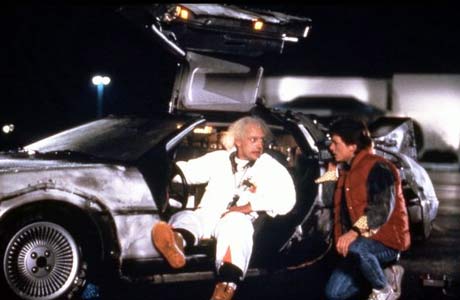
For my first post I decided to write about my favorite movie of all time: Back to the Future. Originally Back to the Future came out in 1985 and starred Michael J. Fox as Marty McFly who with the use of Doc Brown’s DeLorean time machine is accidentally traveled back to his hometown in 1955. This is where he alters history and his own existence by bumping into his high school parents and ruining the first time they fell in love.

I have probably seen this movie (and the two sequels) hundreds of times and every time I find something new. I think this is why I love these movie so much. The production team including Director Robert Zemeckis and Executive Producer Steven Spielberg cared so much about the story and focused on so many details that many do not even know existed in the first few viewings. For example in its sequel they used actual sport statistics from 1955 so Biff Tannen, the antagonist of the films, could bet on these events and create an alternate future with this information he stole from 2015. They also use music from the time period and dress the sets with movie posters of movies that came out during the 1950s. Huey Lewis, a popular musician in the 1980s even makes a cameo in the first film as a teacher who tells Marty’s band that they are “too loud” to play at the school dance. It’s funny that he says that because Marty’s band is playing his own song!

One of the coolest details involves the sign for Twin (and later Lone) Pine Mall. The mall in town is explained by Doc to be named after old man Peabody, who used to own the land and had a “crazy idea” about breeding pine trees. Well when Marty travels back in time he crashes into Peabody’s barn and accidentally runs over one of his pine trees. Later in the movie when we return to the present day mall the sign has been changed to affect Marty’s time travel adventure. In my last viewing I also noticed that Marty’s house prominently has a set of electricity poles behind it perhaps foreshadowing the movie’s climax where a single lighting bolt hitting the clock tower will be what is necessary for Marty to make it back home to 1985.

The script is also great and was written by Bob Gale and Robert Zemeckis. There is tons of set-up especially in the first film to events later in the movie. For example in the beginning of the film at the dinner table his sister brings up Marty’s parents first meeting. Later in the film you will actually see Marty accidentally take his father’s place thus altering history. I guess somebody should have paid attention at dinner! Also in the first few minutes of the film a lady downtown gives Marty a flyer to “Save the Clocktower!” and Marty just throws it into his pocket thinking nothing of it. However later it will help give Doc Brown the information about the lighting storm that helps Marty get home.

Finally throughout the trilogy Gale and Zemeckis convey the theme that history repeats itself. In every movie Marty experiences ironically similar events, whether it is waking up in a bed next to his mom thinking his adventures were all a dream, being chased by a Tannen family member around the courthouse, or seeing a Tannen get covered in a pile of manure. The writers use these similar yet different scenes to show that it is true history does in fact repeat itself. If only Marty and Doc realized this they would have a lot easier time traveling through time.

See the Back to the Future Poster

See the Mall Screenshot

See the Manure screenshots