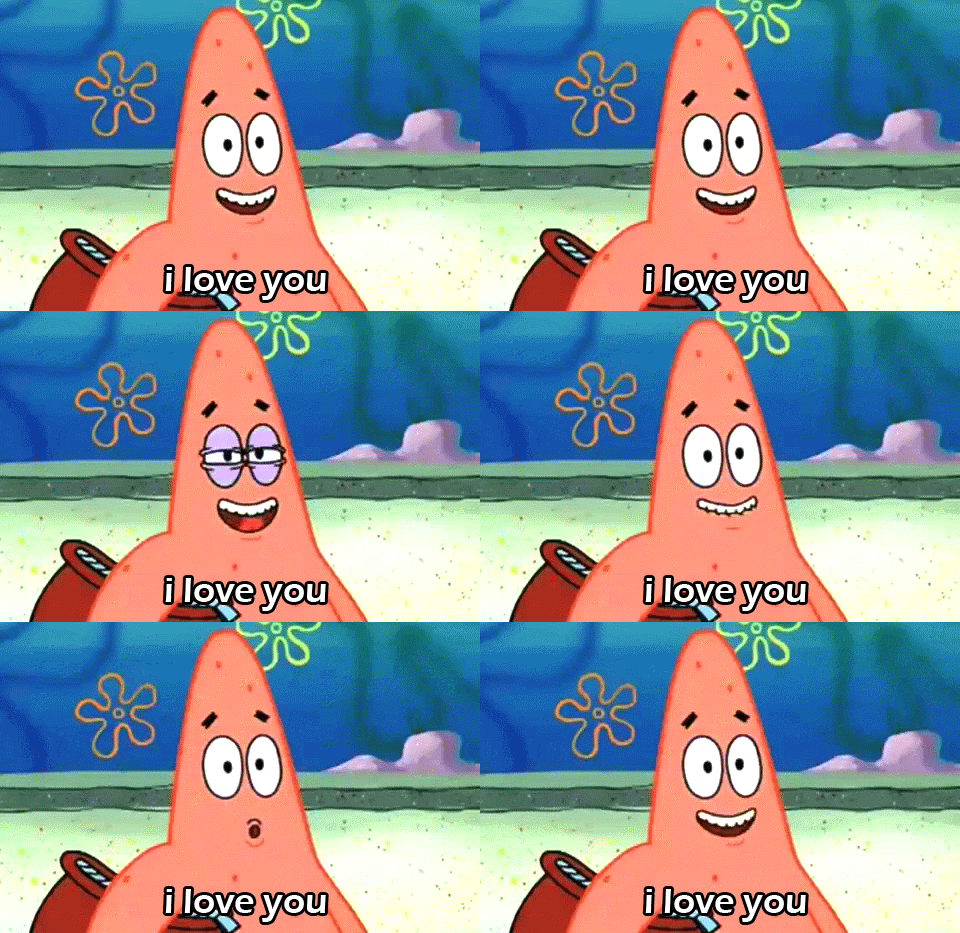
Essentially, the script supervisor is the editors' best friend. They're practically the only ones on set who have the postproduction staff's best interests at heart. They keep track of every shot and make sure it'll be able to be cut together later in the production process. We love our script supervisors!
Wednesday, October 1, 2014
Script Supervising for Dummies
Essentially, the script supervisor is the editors' best friend. They're practically the only ones on set who have the postproduction staff's best interests at heart. They keep track of every shot and make sure it'll be able to be cut together later in the production process. We love our script supervisors!
Monday, September 15, 2014
Directing for Dummies
Next up on the list of things to do, the director has to organize and select shooting locations. Of course, the director has location scouts working for him to truly find the best locations for shooting, but he has creative control and authority as to which locations will appear in the film. At the same time, the director interprets--and sometimes even writes or selects--the script for the film. The director rarely ever writes the script himself, but if he's not hired by a production house to direct the film, the director will often go out and find a script he'd like to work with. The location selections are hugely dependent on the script and the way the director interprets it, so the two steps are pretty much synonymous.
What else does the director do? Well I'm glad you asked! The rest of the director's work is pretty straight forward and most of you already know all of these things. But guess what! I'm going to tell you about it anyway! The director has a whole lot to do during production. The most obvious task is directing the actors. Whether it's explaining to actors how he wants them to portray their character in a given moment or if it's simply helping actors get into character, the director is the guy doing it. While doing this, the director also keeps the crew on track and makes sure everyone's doing what they need to be doing. Film shoots are generally tightly scheduled, so there's no time for excessive screw-ups and messing around. While doing this, the director also works with the cinematographers on shot composition and makes sure he likes what's in the frame.
Production is quite a daunting time for directors. They're basically the ringleaders for the wildest circuses on the planet. If they crack, the film is doomed to fail. The director must keep his cool so that everyone else does.
So now the film is shot. Yay! The only thing that's left for the director to do is work with the editors on creating first a rough cut and then a final cut of the film. The director gives his input throughout the process on what he thinks looks and feels better. Sometimes, this leads to reshoots of scenes or even cutting entire scenes from the film. But hey, who ever said directing was easy?
Thursday, September 11, 2014
Producing for Dummies
A producer's job begins in preproduction. Psh, I knew that. What I didn't know is that the producer is the person who pretty much gets the project off the ground. First, he (or she, of course) needs to find material for his next project from either a script or a book. Then he needs to get a script in good enough shape to attract the attention of a possible director (and even a studio if a studio wasn't the one who started the project). After that, the producer's job in preproduction is pretty much done. HAH! Yeah, right.
Once the producer has a workable script and a choice of director, all he needs to do is secure financing for the film, choose a director and other members of the creative team, work with the director to cast actors, determine shooting locations and budget, decide on a cinematographer, hire the rest of the production team (including other producers), develop a shooting schedule, and create a detailed plan of action for the entirety of production. PHEW! That's one demanding job! Oh wait, the producer isn't even close to being done.
Time to begin shooting! Now it comes to the actual production; the fun part! Or at least it's fun for some people. Sorry, producer, you're on the clock. Production is when the producer offers creative suggestions to the director, handles any and all problems with the actors and creative staff, monitors the production timetable and budget, and reviews the film shot each day. Essentially, the producer has to watch over everything. If something goes wrong, the producer better find a solution, and fast.
And now it finally reaches postproduction, the time for most people to relax and wait to see what they've worked so hard on for so many months. Postproduction is really only horrible for the editors, sound, and special effects guys, right? Wrong. Believe it or not, the producer's job still isn't done. To begin the final step, the producer sits down with the director over a nice cup of tea and decides the order and selection of scenes that will appear in the final cut of the film. After that, he reviews each cut of the film until it's satisfactory. NOW all the producer's got to do is secure a distributor for the film and review the distributor's advertising campaign. After this, and only after this, is the producer's job finally complete.
Never before today did I truly appreciate the work of producers. I honestly believed they were just the piggybanks of the production team. I know it's difficult to believe, but I was wrong. Oh so wrong. Here's to you, producers!
Friday, September 7, 2012
One-Shot Film
I finally got a short story idea and wrote up a rough draft but before I reveal too much here is the script. I'd love to hear what you guys thinks and any constructive criticism would be appreciated.
-nickp
Wednesday, September 14, 2011
The Music and Script of Inception
First for those who have not seen the film, Inception is a 2010 film written, directed and co-produced by Christopher Nolan one of my favorite directors who has done movies like The Dark Knight and Memento. It was also nominated for a Best Picture Oscar. Leonardo DiCaprio stars and plays Dom Cobb, a specialized thief. Instead of robbing, banks he steals ideas from the unconscious minds while they are asleep and dreaming. This is called extraction. Cobb has been on the run and unable to go home to America to visit his children because he is wanted for his wife's murder. Cobb is offered a chance to go home and have his old life back if he could perform the impossible task of inception; the planting of an idea into someone's subconscious. That is Inception in a nutshell. It is a lot more complex and a definite watch for anyone who loves science fiction, action or heist movies.
The music from Inception is just beyond epic. Hans Zimmer, who has worked on movies like The Lion King, The Dark Knight, and Rango, completed the score. Now the score is described as a very electronic score but the coolest part about Zimmer's Academy Award nominated score involves Charles Dumont's 1956 song "Non, je ne regrette rien." In the movie this song is used as a "kick" to wake up them up. To know they are running out of time in the dream the song softly starts as headphones are placed on the dreamer's ears. The music builds and then they are awakened. 
Two final points, one small and one large, I want to bring up involve the story and the script, which was nominated for an Academy Award for Best Original Screenplay. Let's start small first. Nolan was so detailed when writing the script that some of the character names are allusions. Ellen Page's character Ariadne is an "architect" who creates the various dreamscapes, which are designed like mazes. The name alludes to a princess in a Greek myth who aided by the hero Theseus by giving him a sword and a ball of string to help him navigate the labyrinth, which imprisoned the Minotaur. Ariadne in the movie aids the hero Cobb and the rest of the characters on how to navigate the dream mazes.
The other point I must bring up when talking about Inception is the ending. The ambiguous and controversial ending involves a spinning top wobbling. For the characters in the movie they each have a totem that allows them to find out if they are dreaming or in the real world. For Cobb if the top stays spinning he is dreaming but the ending fails to show if the top falls or not because of the abrupt cut. In other words the audience is unsure if the final sequence of the film is reality or just another dream. While many of speculated and even came up with theories involving Cobb only wears his wedding ring during dreams and that is your clue to look for, Nolan has denied this. When I first saw the movie I was a little confused and looked for clues to find out what happened but after my second viewing I realized how it doesn't matter what happened. Whether he is dreaming or not, Cobb is not looking at the top for the answer but is looking at his kids. If he doesn't care, neither should we. Nolan has backed this in interviews but the audience is free to believe whatever they want. Maybe they should sleep on it and dream their own ending to this wild movie.
Thursday, September 1, 2011
The Greatest Movie of all TIME
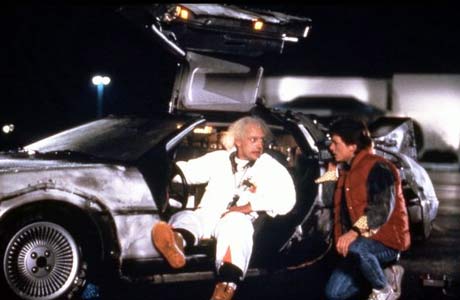
For my first post I decided to write about my favorite movie of all time: Back to the Future. Originally Back to the Future came out in 1985 and starred Michael J. Fox as Marty McFly who with the use of Doc Brown’s DeLorean time machine is accidentally traveled back to his hometown in 1955. This is where he alters history and his own existence by bumping into his high school parents and ruining the first time they fell in love. I have probably seen this movie (and the two sequels) hundreds of times and every time I find something new. I think this is why I love these movie so much. The production team including Director Robert Zemeckis and Executive Producer Steven Spielberg cared so much about the story and focused on so many details that many do not even know existed in the first few viewings. For example in its sequel they used actual sport statistics from 1955 so Biff Tannen, the antagonist of the films, could bet on these events and create an alternate future with this information he stole from 2015. They also use music from the time period and dress the sets with movie posters of movies that came out during the 1950s. Huey Lewis, a popular musician in the 1980s even makes a cameo in the first film as a teacher who tells Marty’s band that they are “too loud” to play at the school dance. It’s funny that he says that because Marty’s band is playing his own song!
One of the coolest details involves the sign for Twin (and later Lone) Pine Mall. The mall in town is explained by Doc to be named after old man Peabody, who used to own the land and had a “crazy idea” about breeding pine trees. Well when Marty travels back in time he crashes into Peabody’s barn and accidentally runs over one of his pine trees. Later in the movie when we return to the present day mall the sign has been changed to affect Marty’s time travel adventure. In my last viewing I also noticed that Marty’s house prominently has a set of electricity poles behind it perhaps foreshadowing the movie’s climax where a single lighting bolt hitting the clock tower will be what is necessary for Marty to make it back home to 1985.The script is also great and was written by Bob Gale and Robert Zemeckis. There is tons of set-up especially in the first film to events later in the movie. For example in the beginning of the film at the dinner table his sister brings up Marty’s parents first meeting. Later in the film you will actually see Marty accidentally take his father’s place thus altering history. I guess somebody should have paid attention at dinner! Also in the first few minutes of the film a lady downtown gives Marty a flyer to “Save the Clocktower!” and Marty just throws it into his pocket thinking nothing of it. However later it will help give Doc Brown the information about the lighting storm that helps Marty get home.

Finally throughout the trilogy Gale and Zemeckis convey the theme that history repeats itself. In every movie Marty experiences ironically similar events, whether it is waking up in a bed next to his mom thinking his adventures were all a dream, being chased by a Tannen family member around the courthouse, or seeing a Tannen get covered in a pile of manure. The writers use these similar yet different scenes to show that it is true history does in fact repeat itself. If only Marty and Doc realized this they would have a lot easier time traveling through time.
See the Back to the Future Poster
See the Mall Screenshot
See the Manure screenshots