I stumbled across an
article earlier this month that's titled "How Spike Jonze's Films Come Together in Editing." When seeing the link, I thought to myself, "How convenient! I love
Spike Jonze and I tolerate editing! Let's take a look." So I did. While much of the article discusses the happenings at the most recent American Cinema Editor's EditFest LA at Disney's Frank G. Wells Theatre, there was a small piece of the article which I wasn't expecting.
Eric Zumbrunnen—whose collaboration with Spike Jonze began with editing in the music video industry—joked at
EditFest that there are pretty much five main steps in the editing process for any project. Whether he was actually joking or not, he hit the nail right on the head.
It's going to be amazing.

This is the first stage of the editing process. Now, it doesn't actually involve any physical editing, but more visualizing than anything. More often than not, editors are never on set when the projects are being shot; therefore, we never see what mistakes (usually continuity errors) are being made during production. This stage involves a whole lot of naïvety (Yes, that's a word. I checked.). Editors usually sign onto projects that they're excited to work on and that they have a lot of faith in. We have to. We're looking at the same film for weeks, even months on end. At this point in the process, we have the utmost confidence in the crew's ability to hand us something spectacular to get working on.
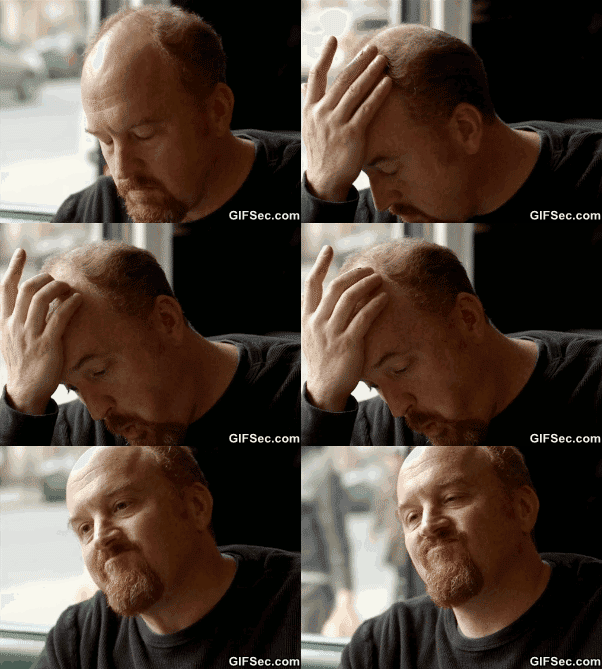
I don't know what I can do with this.
After having the mentality that he's about to help create one of the greatest films of all time, the editor is handed the first batch of footage. "What is this shit? You've got to be joking." This is when the work really begins. The footage never—I repeat—NEVER turns out the way you had imagined it in your mind. All those hours of visualizing the perfect scene, the most perfectly timed cuts an editor has ever made, gone straight down the drain with what looks to be the most horrible shots ever taken on a camera. "What were they thinking? What am I supposed to do with this garbage?" Now, it's never anywhere close to as bad as it is in your mind, but it's nothing like you imagined and it's terrifying. Sometimes you're just handed shit. It's the sad truth.
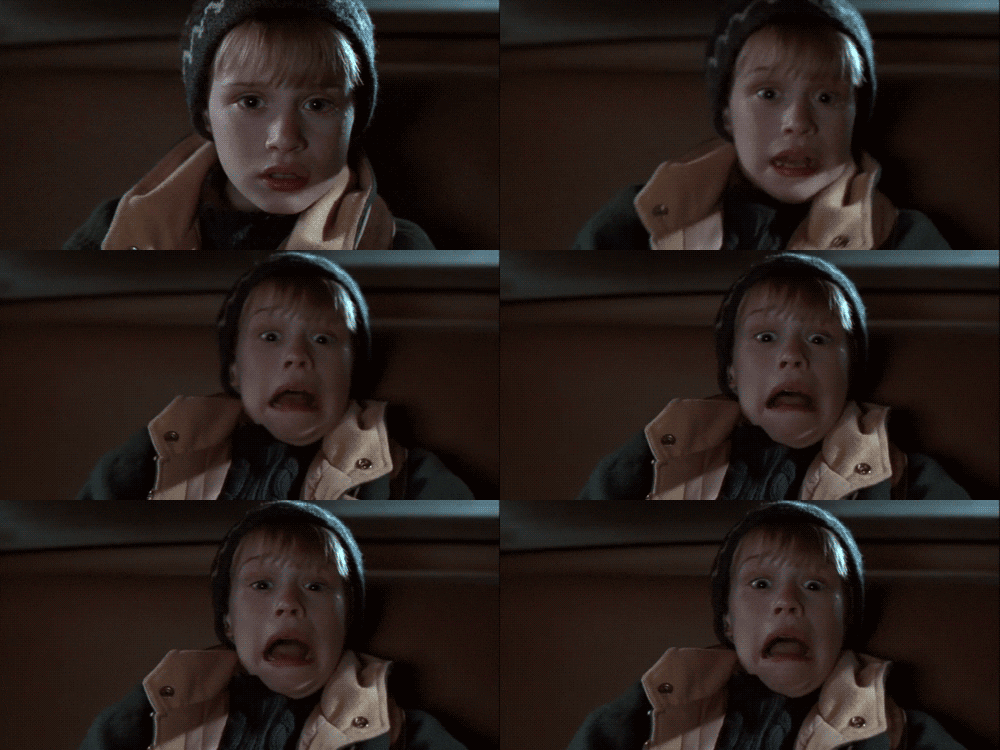
What if everyone finds out I'm a fraud?

It's getting to the point when you've been making the first cuts on the same 2-minute scene for twelve hours and there seems like there's no way out of that one horrible, horrible continuity error. There's nothing you could ever dream of doing to get around it. Jesus himself couldn't fix it. "Who would ever think I could cut this together?" This stage is pretty much the same as the previous one, but after the stress and frustration really set in. Up to this point in your career, you've been fairly confident in your skills as an editor. You started out small, but have worked your way up to some pretty notable projects. This is, however, the moment all editors have during every editing job where they feel their career is over. If this problem isn't taken care of, you're done. Finished. You'll "never work in this town again." Basically, you're screwed.
Damn the deadline.
"Is it even possible? Could
anyone do this?" Where'd the time go? Well, while you were slaving away at your computer for the past few weeks, everyone else on the crew was celebrating the fact that they wrapped the film. Sure, your work probably extends over a fraction of the amount of time that the rest of the crew had to work on the project, but—as everyone believes is the case for themselves—your job is significantly more difficult than everyone else's. It's a couple days before you have to hand over your newest cut of the film to the director and you have nothing to show for it. After the endless hours of blood (not really), sweat (of course), and tears (you betcha) it seems like it's impossible for you to ever turn it in on time.
I'm a genius.

"Damn, I'm good. Like I'm
really good." You just finished your
nth cut of the film and it looks damn good. It probably won't be the last one, but you now have some serious proof of your skills. You're bragging to the director. "You see right here? Where he does this? Well, he actually kept doing this, so I used this to cover up that and now he does this." You can't stop smiling and basking in the glory that is this new work of art. No one will ever truly comprehend what you had to do to make the final product, but it's fine. It's totally ok. Because you'll tell each and every friend and family member about it in extreme detail after the premiere.