Showing posts with label editor. Show all posts

Monday, October 20, 2014

Editing for Dummies!

I promised myself I would never do this. I told myself that I would never ever touch on this subject. Well, unfortunately, it is time. I must delve into a topic that I'd much rather leave alone. A topic that is hitting a little too close to home for my taste. A topic that would possibly tell me that I've been doing it wrong the whole time. That I haven't been doing my job. That I haven't been living to my full potential. It is indeed time...for Editing for Dummies!


I don't like to refer to myself as a "dummy," but I often am. I don't prefer to undermine myself, but I often do. I would rather not make myself, along with everyone I know, realize that I could do so much more than I already do...SO WHY START NOW?! I don't mean to toot my own horn or anything (although this is very exciting news), but it turns out that I've actually been doing [almost] everything I could possibly be doing to help the productions I've worked on in the past.

First, let's get our jobs straightened out. In the world of editors, there are two main positions: the editor, and the assistant editor(s). I say "editor(s)" because, while there can sometimes be only one assistant editor, there's more often than not multiple assistant editors. It's true (probably). Look it up (please don't). In a nutshell, the assistant editors report directly to the editor. They do what the editor tells them to do and the editor does what the director and executive producer tells him to do.
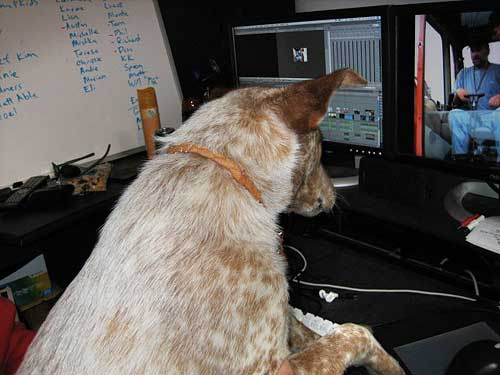
They're worked like dogs...get it? It's funny!
Let's begin with the responsibilities of the assistant editor, considering that will lead into the responsibilities of the editor. See how organized I am? The assistant editor's foremost job is to log and capture media; basically put all the files onto a hard drive and label them. After the files are logged and captured, the assistant editor organizes them in coordination with the script supervisor's log on an offline edit timeline in a rough cut format. They take the specific clips the script supervisor recommends they use and put together a very rough cut of the film without doing any detailed edits. The assistant editor also keeps a system of backups of all the files and assists the editor in compressing and the timeline and exporting it in multiple formats.

In short, the assistant editor's job is to make the editor's job as painless as possible. They gather and organize everything and even put together a rough cut of the film, pretty much just leaving the more minute, detailed edits up to the editor. Having logged at least a couple thousand files myself, it's not fun. It's definitely not fun. Hats off to you, Mr. and Ms. Assistant Editors!

Now let's move onto the editor. The chief. The head honcho. The top dog. The big cheese. Like I said, the editor is responsible for delegating responsibilities to the assistant editors. Once he/her receives the rough cuts from the assistant editors, the editor takes what they're given and cut, slice, and dice the footage into successive cuts until the final cut is reached.
An editor looking very deep in thought.

The editor doesn't only make the meticulous edits and turn the film into the masterpiece it will hopefully become, but they're also the ones who receive all the criticism. They sit down with the director and executive producer on a regular basis to receive criticism about how they can improve their work. It's pretty mentally and physically exhausting! Not only is their work ripped apart by some very important people, but they also work unimaginable hours to change their work so that these very important people like it.

Once the "final cut" is reached (I say "final cut" because, well, the final cut isn't typically reached until the day before the project's hand-in date) the editor often assists the Directory of Photography with color correction and other postproduction effects. There's more often than not other people who are specialized in these areas who are hired for color correction and special effects, but the editor gets some level of input in what is done or how it's done.

The editor's final job is to output the final cut of the film to several formats. The format can depend on who it's being sent to. This can include film festivals, theaters, online, etc. Assistant Editors and Editors have it rough. Their jobs are to basically polish and refine with the very little time and resources that's [most likely] available.

Wednesday, October 1, 2014

Script Supervising for Dummies

Welcome back! Don't know how you got here? Don't know why you're here? Me neither! As long as I have you, though, let's discuss a very important matter. Now, I don't know about you, but I've been wondering what a script supervisor does for quite some time. I understood the very basics of the job, but what in the world are the specifics?! I don't know! Or at least I didn't know. Until now! It's "Script Supervising for Dummies!"

What most people already know about being a script supervisor is that they, well, supervise the script. "But what exactly does that entail?" one may ask. The paramount job of a script supervisor is to maintain a daily log of the day's shots and their relation to the script during the production process. They act as the chief continuity person on set and act as the on-set liaison to the postproduction staff.

Essentially, the script supervisor is the editors' best friend. They're practically the only ones on set who have the postproduction staff's best interests at heart. They keep track of every shot and make sure it'll be able to be cut together later in the production process. We love our script supervisors!

Getting a little more into the details of the job, a script supervisor's foremost task is to maintain of log of all shots taken on set. This log has every bit of information an editor could possibly need. It has shot numbers that match up with the script, slated shot numbers, comments from the director or DP (usually explaining important details of what to use/not use), continuity information, the tape/reel number, camera settings, the date and time, production statistics, etc., etc., etc. Any and all questions postproduction staff may have should be answered by this log. If there are any questions left unanswered, the script supervisor didn't do his/her job and will most definitely be fired...ok, maybe not fired, but someone will definitely be slightly upset.

Along with the continuity notes on the shot log, the script supervisor must also have keen eyes on set so as to call out any errors while shooting. This can include anything from an actor's hand movements from shot to shot to a prop placement error. Clearly, they can't interrupt a shot just to point out an error, but instead will relay their notes onto one of the directors so that they can correct them in future takes. To assure for consistent prop/set placement and design from day to day (you never know what fool will decide to move something), the script supervisor cross-references with the continuity stills photographer daily. They need to make sure they'll have easy access to any continuity stills during production so they can quickly double-check anything they need to without costing the production any time.

A script supervisor who's particularly good at their job will most likely have some level of editing experience, or at least a general understanding of how it works. It makes for a much better judge of what can and what cannot be cut together (continuity). Speaking for anyone who's ever worked in postproduction, we love our script supervisors. We really, really do.

Monday, September 1, 2014

Zumbrunnen's 5 Stages of Editing

I stumbled across an article earlier this month that's titled "How Spike Jonze's Films Come Together in Editing." When seeing the link, I thought to myself, "How convenient! I love Spike Jonze and I tolerate editing! Let's take a look." So I did. While much of the article discusses the happenings at the most recent American Cinema Editor's EditFest LA at Disney's Frank G. Wells Theatre, there was a small piece of the article which I wasn't expecting.

Eric Zumbrunnen—whose collaboration with Spike Jonze began with editing in the music video industry—joked at EditFest that there are pretty much five main steps in the editing process for any project. Whether he was actually joking or not, he hit the nail right on the head.

It's going to be amazing.

This is the first stage of the editing process. Now, it doesn't actually involve any physical editing, but more visualizing than anything. More often than not, editors are never on set when the projects are being shot; therefore, we never see what mistakes (usually continuity errors) are being made during production. This stage involves a whole lot of naïvety (Yes, that's a word. I checked.). Editors usually sign onto projects that they're excited to work on and that they have a lot of faith in. We have to. We're looking at the same film for weeks, even months on end. At this point in the process, we have the utmost confidence in the crew's ability to hand us something spectacular to get working on.

I don't know what I can do with this.

After having the mentality that he's about to help create one of the greatest films of all time, the editor is handed the first batch of footage. "What is this shit? You've got to be joking." This is when the work really begins. The footage never—I repeat—NEVER turns out the way you had imagined it in your mind. All those hours of visualizing the perfect scene, the most perfectly timed cuts an editor has ever made, gone straight down the drain with what looks to be the most horrible shots ever taken on a camera. "What were they thinking? What am I supposed to do with this garbage?" Now, it's never anywhere close to as bad as it is in your mind, but it's nothing like you imagined and it's terrifying. Sometimes you're just handed shit. It's the sad truth.

What if everyone finds out I'm a fraud?

It's getting to the point when you've been making the first cuts on the same 2-minute scene for twelve hours and there seems like there's no way out of that one horrible, horrible continuity error. There's nothing you could ever dream of doing to get around it. Jesus himself couldn't fix it. "Who would ever think I could cut this together?" This stage is pretty much the same as the previous one, but after the stress and frustration really set in. Up to this point in your career, you've been fairly confident in your skills as an editor. You started out small, but have worked your way up to some pretty notable projects. This is, however, the moment all editors have during every editing job where they feel their career is over. If this problem isn't taken care of, you're done. Finished. You'll "never work in this town again." Basically, you're screwed.

Damn the deadline.

"Is it even possible? Could anyone do this?" Where'd the time go? Well, while you were slaving away at your computer for the past few weeks, everyone else on the crew was celebrating the fact that they wrapped the film. Sure, your work probably extends over a fraction of the amount of time that the rest of the crew had to work on the project, but—as everyone believes is the case for themselves—your job is significantly more difficult than everyone else's. It's a couple days before you have to hand over your newest cut of the film to the director and you have nothing to show for it. After the endless hours of blood (not really), sweat (of course), and tears (you betcha) it seems like it's impossible for you to ever turn it in on time.

I'm a genius.

"Damn, I'm good. Like I'm really good." You just finished your nth cut of the film and it looks damn good. It probably won't be the last one, but you now have some serious proof of your skills. You're bragging to the director. "You see right here? Where he does this? Well, he actually kept doing this, so I used this to cover up that and now he does this." You can't stop smiling and basking in the glory that is this new work of art. No one will ever truly comprehend what you had to do to make the final product, but it's fine. It's totally ok. Because you'll tell each and every friend and family member about it in extreme detail after the premiere.