Monday, October 3, 2011

Pushing Daisies

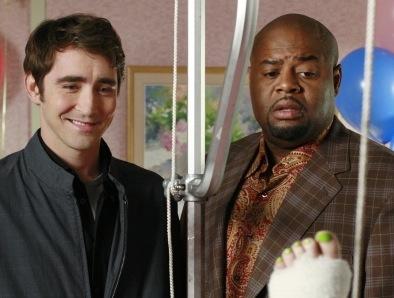
Freshman year, I took a class where we looked at different TV shows and critiqued on its aesthetics and presentation. One show that really jumped out at me was called Pushing Daisies. This Tv drama was like no other. The colors and patterns shown on screen really made an impact to the viewer. The creator of the show, Bryan Fuller, told several magazines and publishing company's that he was going for a "Tim Burton trippy" look, with bright colors and exaggerated patterns. the picture below says it all.


It gives the viewer an Alice and Wonderland look, with a twist of a cartoon fashion. Many shades of red and orange brighten the picture, and you also get a sense of symmetry in ever shot. The NY times say the show looks like a Candyland version of life. Even the plot has a fantasy feeling.

New, the town pie maker, discovered a special gift he had when he was young. He had the power to touch anything dead, whether it was a person, plant, or animal, and make it come back to life. However, the next time he touched him, her, or it, it would remain dead forever. Watching the pilot episode, I really thought this looked corny and stupid. But the characters really kept the driving the story. Ned and a detective pair up to solve murder mysteries to collect the reward for catching the killer. There is no Law and Order terms in this show, and the dialogue is funny and easy to keep up with. The music sounds like a fairy tale Disney movie, but for adults, setting the tone of every scene. This is a show I definitely recommend to all looking for something new to pick up.


Hanna

This weekend a friend came over to my apartment with the movie Hanna so my roommates and I all sat down and watched it with my friend. At first we were a little hesitant of the movie, we knew it was a good movie but we did not think it would be amazing.

We were dead wrong.

The plot itself was good, nothing great but a solid story. But the cinematography was absolutely amazing, I will probably go deeper with it in a later post. I tried to find my favorite scene of the movie but I only found the last minute of it.


Yes that was all in one shot. There is about three or five minutes before that fight and it is all from the same shot. I just thought this was an amazing scene and should be shared to the class.

Senior thesis looking for crew members

Hello Fiction Field II!

My name is Jen Tracy and I am producing my senior thesis this semester. I am still looking for a few crew roles, and I want you to come join our super fun project! Get some great on-set experience with graduating seniors, and another film to add to your resume. This film will be submitted to national festivals, so you will also get the chance to have your name on the credit reel for a film (hopefully) seen around the country.

It is a fiction comedy done loosely in the style of the FX show Louie.

I am looking for:

1. DP for one day of shooting (Monday, October 17th at night time) that the main DP will not be able to attend
2. 1st AC
3. Boom Operator
4. Key grip/gaffer (not too much to do for these shoots, so I am planning on combining this job)
5. Production Assistant(s)

Please let me know if you are interested by shooting me an email at jtracyo1@ithaca.edu

Thanks!

(And thank you, Arturo, for letting me do a guest post!)

-Jen

Covert Affairs


As a fan of espionage shows (such as my favorite show Chuck), I am surprised that the show Covert Affairs has eluted me for over a season. I finally sat town to watch this USA Network show and almost instantly fell in love with it's amazing combination of wit, action, romance, and surprising realism for a show based on the CIA. Piper Perabo was nominated for a Golden Globe for her portrayal of lead character Annie Walk, who is a rookie at the CIA's Domestic Protection Division. One of the main attract to the show for me is the interstaction of Annie and her tech opts specialist Auggie Anderson (played by Christopher Gorham), who despite the fact that he became blind several years ago is still one of the best operatives on the show. It is very fun to see how the blind guy is basically her eyes and ears when she is on missions and is her guide at the CIA....and he occasionally makes blind jokes about himself which is always good for a cheap laugh. Other interesting story-lines include Annies mysterious ex-boyfriend and how he keep cropping up after she get recruited and the fairly realistic battle with the CIA and some local D.C. journalist who are digging for me transparency with the government.

The show's creators Matt Corman, Chris Ord, and Dough Liman (who was also the producer for The Bourne Trilogy) have gone to a lot of effort to make the show as realistic as possible. Before the show started they took a trip to Langley, Virginia where the real CIA headquarters. At Langley they observed, interviewed, and took notes on stuff they could recreate for the show from a replica of the marble in the entrance to the classic CIA seal to the burn bags in the offices they have strived to make the show look at real as possible. Since it is a summer show and does not air as many episodes as a regular show they have had the time (and thankfully the recourses) to even do some shoots on location across the world, following their travel-crazy spy characters.

Though the show has only aired one and a half season, it is off to a great start. True to the network's slogan "Character Welcome", Covert Affairs has compiled a group of intriguing, funny, and relatable characters that pull you into a life that not many can understand. It is a fun, adventures, and thrilling show that I am hoping will have a great future a head....not that the CIA are aloud to look to far into the future.


Free Music For Films

As we get closer to moving past the planning stages of our films and onto actually shooting our fiction projects, I've found myself thinking about possible directions we could go with our music. Our project starts off with a fun but aggressive, energetic play-battle scene, and I wanted to make sure the music reflected that. I had a couple of suggestions, but was told that unfortunately, because of copyright issues, it would be hard to use most popular and/or produced music. This issue has me scouring the internet (and often double-checking who it is by, and if it is free before I get too excited about it) to find the best free online music, and I have to say, I've found a couple really good ones that people might want to check out:

FreePlay Music

Royalty Free

Partners In Rhyme

Free Soundtrack Music

Hope these links help everyone else as much as they've helped me!

Notorious


For this week's post I wanted to talk about a movie that I watched last week and that I would highly recommend. I'm talking about Alfred Hitchcock's Notorious. As with most of Hitchcock's movies, I wasn't disappointed with this one. It was the perfect combination of a romantic and suspenseful thriller. I feel that what makes Hitchcock's movies so compelling is the fact that he takes his time to set up the sequence of events that will lead to the resolution. I notice a variety of elements in this movie that we've discussed in the past. Like the key which served as a Mcguffin. I feel it was an essential element to move the story along and keep the audience enthralled.
Another Mcguffin that I noticed in Notorious was the bottles of wines in the wine cellar.
Hitchcock doesn't really expands why they were transporting this substance in the wine. He just uses the wine bottles to bring the story together. Another interesting fact about the way Hitchcock tells a story is that his story lines are very focused. Even thought this story took place in a Post-World War II setting, Hitchcock didn't emphasized this story line. He focused more on Devlin, Alicia, and Alexander's story. I feel that this helped me engage more in the story and care more about the destiny of this characters.

TV Show Spinoffs


When a movie is relatively successful, people will do anything to squeeze that extra buck out of it. We have seen sequels, equally unwanted trilogies, creepy dolls and possibly even a book series with the movie poster thrown on the cover. However, one that is hard to ignore is unsuccessful television series based on popular films. Most recently, Matt Damon and Emily Blunts forbidden romance from The Adjustment Bureau is being made into a TV series for Syfy while it's barely been put onto the shelves. Usually when I turn onto Syfy, I either see Battlestar Galactica reruns or original movies where badly animated alligators eat models tanning on the beach. For such a popular movie, I am surprised that they are taking the remake this route and not going for a network station.
This brings up other bad TV spinoffs, usually not even making it past the first season before it gets cancelled. My favorite that I found was one I hadn't heard of before, a spinoff of Ferris Buellers Day off that ran for one season in 1990. They completely break the fourth wall when they introduce Charlie Schlatter as an annoyed Ferris Bueller complaining about the movie based on his life. He even goes so far as to take a chainsaw to a cardboard cutout of Matthew Broderick (below).
Other notably short lived series would be Fast Times based on the famous Fast Times at Ridgemont High (although it did stem Patrick Dempseys career) and the 1976 Delta House based on the cult classic, Animal House. Without the raunchy humor, drug references and foul language that made the movie so popular, the small screen version that was fit for TV audiences did not last long (it also didn't help that they rewrote Belushi's character and introduced his younger brother, Blotto). It is usually the recasting that dooms these series to their single season, as well as the fact that movies are made to follow that one story line and are resolved for the audience's sake at the end of the movie, the series tend to drag them out. I have talked about how the content varies from British to American screens, but the same goes for movies and television. Without the safety of a rating to back up more adult themes, television shows are handicapped by their time slots and broadcast channels. Reasons that shows fail is because they can't show what they want at 8 PM on a saturday when the kids might still be up.

50/50 Beats the Odds


This past weekend I went and took a chance on the serious, but comical 50/50, starring two of my favorite actors in Hollywood—Joseph Gordon-Levitt and Seth Rogan.

The film, based on a true story is about how the lives of two twenty-something best friends change when one of them, Adam (Gordon-Levitt’s character) finds out he has spinal cancer and has a 50/50 chance of surviving. What follows after Adam’s diagnosis is a perfect balance of the upsetting realities of cancer as well as the amusing quirks of every day life—from chemotherapy to smoking medical marijuana as well as a troubling relationship with his girlfriend and trying to use cancer as a pick-up line to get girls.

While Adam struggles with the relationships with his mother, played by Anejlica Huston and the one with his girlfriend, Rachael, played by Bryce Dallas Howard—he forms a comforting friendship with his young and unconventional therapist, Katherine, played by the Oscar-nominated actress, Anna Kendrick.

Throughout his treatment, Adam transforms from a hesitant and soft-spoken young man into a stronger and reassured person who actively fights for his life. His best friend, Kyle, played by Rogan provides much of the humor in the film, and even through his crazy shenanigans, he is consistently there for Adam from the very beginning--making sure that his best friend kicks the cancer's ass.


The film was extraordinarily written (by Will Reiser who the story is based on)—capturing the difficulties of dealing with an illness while maintaining a light-heartedness humor that comes along with life. The characters were already three-dimensional but were really brought to life on the screen by the wonderful cast.

50/50 is a refreshing new comedy that did not disappoint, but rather pleasantly surprised me.

Everyone should take a chance and check it out.

Sunday, October 2, 2011

Pan Am will not be on my watch list this year

I had posted earlier in the year about the show Pan Am that was new to ABC this season. I was excited to see the world of the flying age and expected a much better first episode. Sadly the writing of the pilot was so mediocre I found myself wondering if we as a class should rewrite the script for them because I am sure we could have made it much better. And for the record, I had no idea that this was a total female demographic show and feel a tad bit embarrassed.

However as much as it was a terrible first episode, I did see a few things in the pilot that caught my attention. The first thing was the sets and costumes. Everything looked very real and authentic and the who atmosphere of each of the sets envoked 1960's. There was always plenty of bustling and commotion from the excited passengers of the new Pan Am plane.

Another thing was the graphics that were created to remake the take off of an older Pan Am vessel. The plane and movement of it was very realistic as well as the sounds and colors. The only problem I saw with the authenticity of it was the glossiness of the outside of the plane. I think they were stressing the idea that it was a new plane and that the day was very bright and sunny, but I found it a little distracting.


Other than that the show does not have much to talk about. The twists and themes in the show are very predictable, but if anyone is going to take this show anywhere it's going to be Christina Ricci. She is by far the best talent in the show and if I had some advice for her, it would be take the next plane off set of ABC's Pan Am

Justice for Interns

As students who are studying media, we’ve all heard that famous line when that defines and explains how Hollywood and the entertainment industry work – “It’s not what you know, but who you know.”

We all receive the same advice over and over again from professors, colleagues, supervisors and people from the industry itself (I know I have!), including the following reality of the way it all works:

1. In Hollywood, you start at the bottom and work your way up. This is applicable to any particular of pre-production, production, or post-production aspect that you’d like to be a part of.
2. Your degree (or lack thereof) means nothing if you’ve got the talent.
3. Network, network, network! – because it’s all about who you know.
4. Intern as much as possible so that you can meet people, and gain experience to know what it is that you like and more importantly - what you don’t like.

The list continues on and on, but I’d like to elaborate on the last item on the list: internships. Internships are one of the best ways for students to step foot into the world of Hollywood. Through internships we get to witness firsthand the inner workings of a company—what they do, how they do it and if you’re lucky enough, you get to assist in that process firsthand. Internships provide students with a (sometimes) overwhelming dose of the world they’d like to one day be a part of.

Unfortunately, not all internships are great.

That’s something I had to learn the hard way after having a wonderful experience at E! Entertainment via NBCUniversal and an incredibly awful experience at a small production company owned by an A-List star that I will refrain from naming. Of course, anyone who has been an intern before knows that for every time you get to do something cool like sit in on a casting session or a pitch, you have to do a dozen mundane tasks such as grabbing coffee and lunch, or cleaning up the kitchen. It is a reality of the industry, one that has been acknowledged, accepted and ignored for a long time—until now.

Two unpaid interns who worked on the set of the movie “Black Swan” are suing the production company—Fox Searchlight for having been taken advantage of. The two interns, Eric Glatt and Alex Footman are asking for pay as well as an injunction on the company to make sure that future interns are treated properly. Although this may not be the first lawsuit interns have filed-it certainly is one that is getting highly publicized.


After discussing the lawsuit with several friends—all of whom also had internships in Los Angeles and beyond at companies such as Paramount, NBCUniversal, Warner Music Group and even the FBI (yes, really—the FBI!) we came to the conclusion that even though the two interns are putting their future careers in the industry at stake, it is something that will hopefully better internships in the future.

Here’s the deal: unpaid internships are supposed to be educational and have to meet the very specific requirements of the law. I’ve heard many friends, and even people who have had especially crappy internships criticize Eric Glatt and Alex Footman for being “babies” and claim that they should just “suck it up.”

My question is: why should they have to?

I’d like to remind each and every single reader out there than when you have an unpaid internship—one that is legally handled through your academic institution, you are paying your tuition money to work a certain amount of hours, depending on how many credits you are paying for. Here at Ithaca College, the current cost for a single credit is $1,175. For all of you going to L.A. in the future, you will be required to have a 6-credit internship. That means that you will be paying $7,050 for whatever internship you manage to get. For those of you who are lucky, that will mean reading scripts and writing coverage, attending shoots, sitting in on casting sessions, editing footage and meeting celebrities.

But sadly, for many of you that will not be the case. You will be stuck grabbing lunch orders, fetching coffee, taking out trash and counting down the hours until you get to leave your crummy dimly lit cubicle and exit the premises.

Both experiences cost the same amount of money—but which one is actually worth it?

We have to remember that these two guys—Eric and Alex are doing what many of us don’t have the courage or means to do, which is stand up for themselves and their peers and demand better internship standards. Although there is no way to tell how the lawsuit is going to end up, we can assume that companies that have internship programs are double-checking to make sure that their interns are benefitting from their time there. Perhaps there will finally be justice for interns.

Only time will tell.

Hitchcock and French New Wave

Reading about French New Wave we have to talk about Alfred Hitchcock you can argue that he was a main influence on Truffaunt. He had his very own directing technique and style and you can easily see it in all of his films.


Here is a famous scene from one of Hitchcock's most notable movies, Vertigo. This scene just bleeds Hitchcock you can feel his presence in every shot, especially in the dolly zoom technique.

I would not call him the grandfather of French New Wave, there are too many influences on this movement, but I would call him a strong influence.

Friday, September 30, 2011

The Graduate and its Similarities with The 400 Blows

For this week’s blog post, we were asked to read a chapter from Closely Watched Films by Marilyn Fabe. In the chapter it focuses on François Truffaut’s film The 400 Blows. This autobiographical film was made by Truffaut when he was twenty-seven years old and helped launched the French New Wave, a national film moment that flourished between 1959 and 1963. While I have not seen The 400 Blows or any film that is considered part of the French New Wave era, I have seen other films that reminded one of many of the principles and styles of these unique films.

French film critic Alexandra Astruc argued that cinema was a language and could potentially be an art form as powerful as poetry or literature. Traditionally the “author” of a film is the screenwriter but New Wave theorists believe the script was only a blueprint and that the director is the artist that puts his vision into the film. However many of these New Wave films like The 400 Blows were directed by the screenwriter. This reminds me of one of my favorite writers/directors, Charlie Kaufman. While he is mostly known for his writing, his film Synecdoche, New York, which he wrote and directed, is a bizarre film about a theater struggling director attempting to create a life-size replica of New York inside a warehouse as part of his new play. This movie’s title is also similar to The 400 Blows’ title because both have double meanings. The 400 Blows not only refers to the adventures of a rebel teenager but also the actual blows dealt by his parents. Kaufman’s title not only means the city of Schenectady, where much of the film is set but also the concept of synecdoche, wherein a part of something represents the whole or vice versa. Another Kaufman film, Adaptation, is similar to this Truffaut film. While The 400 Blows was autobiographical to his life, Adaptation revolves around a screenwriter named Charlie Kaufman and his actual struggle of adapting the novel The Orchid Thief into a film. In case you could not tell it was based on Kaufman’s actual struggle from his life!

Reading about The 400 Blows also reminded me of the movie The Graduate. While not a perfect match there are some striking similarities between the films. First there is a shot in Truffaut’s film that focuses on the character of Antoine as he runs through the country toward the sea. The shot is all in one shot in order to be dramatically effective. The audience sees him running for a long time without the least indication of fatigue thus, we are able to experience the pure adrenaline-fueled sprint. In the ending of The Graduate, Dustin Hoffman’s character is seen running down the street in two long shots (the shots start 30 seconds in). He is determined to stop the wedding of his dream girl. Nothing will get in his way! Another similarity between the films is with both the film’s endings. In Truffaut’s film, as he is making his dash for freedom he runs to the sea. When he finally gets to the ocean he accomplishes his goal but he realizes he is trapped. In The Graduate, Benjamin succeeds in stopping Elaine’s wedding and both of them make it on to the bus to run away. But as the bus drives away their smiles fade (skip ahead to 3:40). Even though there is no dialogue some people interpret this quiet ending as both characters realizing what they just did and perhaps thinking they may have made a huge mistake. But the ending can be seen in two ways depending on the audience. One final similarity between the films again involves The Graduate’s end. Supposedly the “sobering” ending is actually from the directions the director Mike Nichols gave the actors in the moment. He was actually shouting at them to laugh during the scene but the actors were so scared that after the laughing they stopped, with looks of worry. He liked it so much he kept it in the final film. In The 400 Blows Truffaut wanted a certain actress for the part of the psychiatrist but since she was unavailable he decided to never show the psychiatrist but instead only hear her lines. Another decision made in the moment by the director!

While different people made these films during different times, there are very similar. This just proves that powerful and inspirational films can help influence future directors and filmmakers with their works just like Truffaut’s The 400 Blows influenced many movies to come.

Thursday, September 29, 2011

Super 8 & Optical Flares


This past summer was one of the biggest blockbuster movies that I can remember. It was one of my favorite from the summer and made me feel like a kid again.

It's the story of a group of young boys who witness a train accident and all these strange events begin to occur. Granted a lot this seemed far beyond realistic since it was about aliens but I truly appreciated the story because it truly captured a kid. All kids want to do is play and explore. In the movie, all they wanted to do was explore and create their own movie based around what was happening


Another thing to point out were all the lens flares. For a few years, lens flares have become a very stylistic attribute to the image. These were seen in the 2009 Star Trek, which was also directed by Super 8's J.J. Abrams. Since learning After Effects, videocopilot.net has a package called Pro Presets, which contains Optical Flares. The person created Optical Flares, Andrew Kramer, worked on both of Abrams' movies to create these futuristic flares seen on screen.


I very much felt like I was watching ET since it was produced by Spielberg. These kids had some sort of a connection with this alien creature since they are sheltered as children like alien in previous time. All in all it was one of my favorite movies from the summer.

Tuesday, September 27, 2011

The Moth

My all time favorite television show is Lost and I am currently re watching it from the beginning. For anyone that hasn't watched it, every season is available on Netflix instant watch so you have no excuse. I can remember back to 2004-2005 when the show had just begun and having to download episodes off of Itunes for the brand new Ipod Video. We've come a long way. For the Lost haters out there I'd like to let you know that as I see the episodes for a second or third time it just reconfirms to me how powerful the show actually is, so go watch Glee or something and leave me alone.

Anyway I recently watched episode 7 of Lost season 1, it is titled "The Moth". The whole episode deals with two of my favorite characters in the series; John Locke, a once wannabe adventurer and an armchair general restricted by a spinal injury who has all his dreams fulfilled on the island, and Charlie, a church boy turned rock star who has always been in the shadow of his older brother and turned to heroin as a crutch.

The characters of Lost have just found freshwater and a series of caves on the island, two resources they needed dearly, shelter and freshwater. Also in the cave is a small chunk of the survivors downed plane with more supplies they may need. Locke and Charlie both volunteer to stay and survey the caves for two very different reasons. Charlie wants to be able to use the very little heroin he has left in peace, and Locke wants to "get to know Charlie better". But the wise Locke knows Charlie uses drugs and wants to break him of his addiction.

Every time Charlie goes to use his heroin Locke interrupts him warning that the jungle is dangerous and he shouldn't venture off. Eventually Locke confronts Charlie and convinces him to hand over his drugs in exchange for Locke to search for Charlie's guitar, which he misses being a rocker. Being an addict Charlie starts going through terrible withdrawal and asks for his drugs back. Locke tells Charlie to have faith and that if he wants his guitar back from the island Charlie is going to have to give the island something. So he agrees and Locke points up to the sky, where you see a guitar case trapped in a tree. Locke also tells Charlie that if he asks him three times for his drugs back he will return them.

The second time Charlie asks for his drugs is what is in this video I have added.


I found these quotes very powerful and inspirational. The moth metaphor is very clever. I thought it must have been said before, or at least a reference to something. But after scouring the internet I could not find a quote just like the one in this clip. Good job Lost writers. But what I did find that I believe is more powerful and intelligent than remixing scenes from other television shows or movies, is the similarities between the philosopher John Locke and the character in Lost of the same name. We owe John Locke respect because many crucial decisions in the Declaration of Independence were based on the 17th century philosopher. He has several quotes that I believe the writers of Lost used to come up with this piece of dialogue.

"It is one thing to show a man that his in an error, and another to put him possession of the truth."

A drug addict does not believe he is in the wrong, especially someone addicted to heroin. Even if he knows he is wrong he still needs his fix. But to show him the truth by explaining how giving up drugs will make him a stronger individual, a strong moth, could fix the issue.

"To prejudge other men's notions before we have looked into them is not to show their darkness but to put out our own eyes."

You learn later the extent of Locke's own pain before he was on the island, but I won't spoil that for you. I will just assure you it is way more intense than a drug addiction.

"What worries you, masters you."

As all the other survivors are panicking, demanding drugs, starving, dehydrated, wounded, consumed by fear, Locke is chilling there cutting up his fresh kill, the happiest he's ever been. He has faith, no worries, he is his own master.

I admit I need to watch a lot more old television and movies to get the references that are brought up in class that influence all modern day media. But I find it refreshing that Lost goes very big with its references. It draws from philosophers, scientists, multiple religions, as well as classic tales.


Doctor Who: Closing Time


What, you thought I was going to review something different?

In this episode, the Doctor pays a visit to Craig, his old friend from "The Lodger" just to say a final goodbye before his death. (This isn't a spoiler.) Instead of saying hi and leaving, the Doctor gets caught up in a nasty row with the Cybermen. Not only that, but Craig refuses to leave him alone, causing the Doctor to put another friend in danger after leaving two behind to keep them safe.

Strong writing and delivery carry this episode. James Corden, a great comedic actor, reprises his role as Craig; and he does a bang-up job, as to be expected. Quick banter between Matt Smith and Carden gives the episode a good pace and keeps the dialogue snappy and interesting. There are sentimental moments among the funny, including when the Doctor spots Amy and Rory as a successful couple out for a day of shopping. After all their adventures, all the times they nearly died, it's good for him to know that they're happy and safe. And of course, let's not forget the baby. The baby makes everything better.

As far as aesthetics and direction go, nothing was absolutely stunning; but that's not to say that it didn't deliver the same good quality that viewers have come to expect out of the new series. Everything was well rounded and worked together. There were a few moments where my trained eye caught some shot discrepancies; in one scene, River was turning her head to the right, while in another she was turning to the left. The glitch barely registered though. I bet that only a few other viewers actually cared.

Next week: The finale. Then I'll shut up for good about this. ...Yeah right. I've still got the classic series that I could throw at you.

Monday, September 26, 2011

New Wave's Affects

Between the years of 1959 and 1963, a national film movement known as The New Wave flourised all of European film makers. Francois Truffaut's The 400 Blows was the autobiographical feature to kick off the movement. It gave other young french film makers influential ideas about technology and economic factors that go into movie making. A famous director that came out of that era was Jean-Luc Godard, with is work resembling the Soviet's cinema of the 1920's. He was told that his movie Breathless was too long and needed to be shortened. So instead of cutting scenes, he just made them shorter and used jump cuts to go from one location to the next. This brought a fresh new look to the cinema world, and would shape some movies created today.

The New Wave made its way across the ocean to American cinema, starting with a popular movie Bonnie and Clyde. This generation of young film makers would be known as New Hollywood, and would last into the last 70's.

Most recently, director Quetin Tarantino would be the latest victims of the new wave with his movie Reservoir Dogs. He used similar techniques that Jean-Luc Godard, (jump cuts, improvised dialogue,) which would shock the audience watching it. He even dedicated his film to Jean-Luc Godard, and named his production company A Band Apart.

Last year, I remember taking in class about how movies today are just variations of previous movie themes, styles, and ideas. The New Wave was a huge boom to the industry and definietly supports this idea. It almost impossible nowadays to create something that we haven't seen or done before. It just makes me wonder where the movie industry is heading

Red Queen

I was looking up stuff about what Fellininesque was when I came across a website. This website is about a movie called Red Queen, Fellininesque Players. Pretty much what I got out of it was that it was a musical film with surrealistic features. I found it interesting that they got all of their songs from different Bands on Myspace. This looks like an interesting idea based on Fellini's works.
On the flip side Alice in Wonderland is a well known example of Felliniesque material. Here is a good example of the creepy feeling that Fellini brought to the film world.

Catching Up

Having just gotten cable in my apartment (yes, I realize I'm a little behind the times,) I've been taking the time to catch up on my favorite shows that I've been missing. The one that has me the most hooked is Showtimes "Nurse Jackie." The show follows the life of Jackie Peyton (Edie Falco,) a drug-addicted nurse working at New York City's All Saints' Hospital. Jackie, who struggles to balance her addiction, a family of her husband and two daughters, a pharmacist boyfriend, and difficult patients and co-workers, manages to somehow deftly avoid serious conflict in every episode.


Although, like every other show out there, "Nurse Jackie" is guilty of some faults, (my personal issue with the show is how stereotypical some of the characters can be,) the one thing that stands out to me is the complexity of the plot, and how in literally every episode, something manages to take you by surprise. In the shows pilot episode, Jackie seems to have one life throughout the entire thing. It is only at the very end that it revealed otherwise, making you re-think everything you have just seen. As the seasons go on, Jackie's life seems to get impossibly more complicated, while somehow, she still manages to skate by avoiding all of the real major problems. The show has just been given the okay for it's fourth season, and I am anxious to see how some of the problems that are finally coming to the surface in a big way will be solved.
At the moment, I'm just finishing up season two, but I can already tell I'm hooked on it for good. If you're looking for a complex show with an unusual storyline and even more unusual characters, make sure to check it out.

Spielberg brings Jurassic Park to FOX

There are a lot of good shows set to premiere this fall, but the most expensive one by far is the Steven Spielberg produced Terra Nova. While the two hour series premiere (airing tonight) has been critiqued for it's choice in actors, the acting itself and the premise of the show, one aspect that has been raved about is the dinosaurs. The future is in environmental dismay and their only hope of restoring society is to take select individuals back 85 million years to live in colonies. Terra Nova expands on the realistic dinosaur effects Spielberg pioneered in Jurassic Park. He is breaking boundaries on what the audience expects from a network show, with a budget of almost $20 million for the pilot alone (the rest of the 13 episodes range around $4 million each). Each episode racks up about six to eight weeks of extra production time for the advance CGI needed to create the realistic dinosaurs that become the main focus of the show.

I think that even if the plot and writing is excellent, bad special effects can really take away from a good show. Primeval is a show that started airing in 2007 on ITV, it is about a magnetic anomaly that opens up and allows dinosaurs to freely roam between their home in prehistoric times and present day Britain. I love the show but some of the times I find myself distracted by how ridiculous some of the dinosaurs end up looking (mainly the larger ones).

Sunday, September 25, 2011

Reality+Fantasy= Fellini’s 8 1/2

Fantasy is defined as the activity of imagining things that are impossible or improbable. Because fantasy is based out of our imagination, there is no way to prove an event can or cannot happen. We as audiences then begin to wonder what is real and what is fantasy. This tactic is evident in Fellini’s 8 1/2.

Fellini’s uses dreamlike sequences that involve many complex and jarring shots. This technique allows for the audience to take their mind away from the narrative of the film and bask in the fantasy world of Fellini’s mind.

While the main character Guido Anselmi is struggling to find the courage to tackle his new task of making a wonderful film, he finds himself wondering if it is possible. Instead of writing a specific script that follows a linear plot, Fellini placed Guido in this confusing world of complex mise-en-scene and cinematography. The story of 8 1/2 does follow a slight narrative structure, but Fellini shys away from this because he wants to portray that Guido is having a very difficult time juggling the production and his complicated personal life.


The first sequence of this film shows this better than any. With the slow, wavy camera movements the audience is shown right of the bat that the man stuck inside the car is going to have some troubles. We can only see the faces of the people inside the car as they look at him struggle inside the car. This only intensifies the chaos going on inside of Guido’s head as he tries to escape. We are kicked out of this dream world only to realize that it is in fact a dream. This first sequence, paints a picture of the battle Guido faces with his mind and foreshadows the battle he has with controlling it.

As I continued to research this film and read more and more about it, I found myself trying to find a comparison to today’s film industry. I found myself thinking that Fellini’s use of dreams in this film allowed for audiences to enjoy the fantasy world that Guido finds himself in. Instead of placing these outside sequences into the film as flash backs, he splices them into the story as dreams, which to me invokes a much more intense sense of confusion. It’s almost as if his dreams are taking over his life and what Guido discovers is that these dreams can be used to help him to take the film in a different direction. This allows for Guido to scratch the ideas he couldn’t remember about his current film and turn it into a movie about the struggles he was facing.

It makes one wonder, was this the first early look into the dream world in film that lead to the creation of fantasy blockbusters like Inception.