Showing posts with label Hollywood. Show all posts

Thursday, November 5, 2015

Books and Movies. Movie and Books

Books and Movies. Movies and Books


     Recently the movie Brooklyn came out, based on the book by author Colm Tóibín. You may remember the book as that thing you got over the summer before freshmen year and never read....well I read it. I read it because I like to read, and you know what? It wasn't that bad! Until you got to the ending and then it was just plain terrible. It tricked me into thinking it wasn't a shitty book, but oh...it was a shitty book. On the popular website A.V. Club they gave Brooklyn (the movie) an A-! An A- is a pretty good grade for a movie on A.V. Club, and the author just spoons it loads of praise, it's actually sickening to read. Will I see the movie now? Probably not. Is it really as good as they say? Could vert well be. The reason I bring this all up is because I wanted talk briefly about the sin in Hollywood of turing books into movies. And that may not apply to Brooklyn, but just seeing it brings this idea to mind. 

     Today (and yesterday) in a world of 100% unoriginal ideas it has come to the attention of Hollywood scriptwriters everywhere that the easiest way to make a quick buck is to make an "adaptation" of a movie. The stories already written, tried and tested, so why the hell not? 
     
     You've heard the term "Oh well the movie wasn't as good as the book" in every way possible and at this point it comes across as arrogant to the process of filmmaking and storytelling. That's because it's unfair to do so; movies and books are different and shouldn't be compared to one another. My quarrel isn't with the fact that the books are usually better than the movies, which they are, my quarrel is in the fact that today adaptations have become the staple of Hollywood cinema to the point where I just have to say "Hollywood, take a break." 

     I think there's a lot of good adaptation that will (and have) come out this year, The Reverant, Me, Earl, and the Dying Girl, but there;'s also been a lot of bad. And my biggest pete peeve is when they take a short book and make it into three movie to take the poor suckers money who goes to see them. I would love to go into a case study about this but I'm honestly just exhausted of thinking sbout the state of Hollywood Cinema today so I'll quit while I still have some form of judgement about me. Not my finest blog post, but not my worst. 


Friday, September 18, 2015

What I loved about Du Levande

After class Monday I couldn't help thinking about how much I enjoyed the brief clip of Du Levande we saw towards the end of the period. As soon as I got home I jumped online to get a better look at it, and perhaps identify what it was about Du Levande that ensnared me so. Take a look at the clip below to refresh your memory.
Now aside from having an incredible set design, I think what really captured my attention was the way the film strayed so fantastically from traditional narrative film. Instead of watching to unattainablely gorgeous people arguing over some fictitious drama, I was watching two obese people arguing on a park bench. What's more is that I related immediately to the characters in frame, I didn't need any sort of backstory explained to me or lengthy origin story behind why the bench woman was so miserable, I just got it. 

I wish that Hollywood would break away from the mold of talking head style films more. That's in part why I'm interested in pursuing a career in the commercial industry, I want to be able to experiment with different idea's without being forced to abide by the traditional Hollywood cinematic tropes.

Wednesday, September 9, 2015

Athletes on the Big Screen: UFC to Space Jam

We love them. We hate them. We love to hate them. However you feel, chances are that you've seen at least one movie starring a professional athlete. While some of these films are better than others, I think its safe to say that none of these 'actors' will be winning an Oscar anytime soon. It seems to me that more and more professional athletes are making their way onto the big screen each year, taking on roles that never really pan out. After reading an article announcing that UFC Women's Bantamweight World Champion Ronda Rousey will reprise Patrick Swayze's role in a remake of Roadhouse,  I just have to ask: WHY?


Rousey is a world class competitor. She is undefeated in the UFC and was even recently named "athlete of the year". What compels her to leave the fighting world and travel to Hollywood? She had a small supporting role in Fast 7, and while she was well prepared for the fight scenes, her acting was absolutely terrible. 


Rousey is not alone in her jump from the Octagon to the silver screen. From Michael Jordan in Space Jam, OJ Simpson in The Naked Gun 2 1/2: Smell the Fear, or Arnold Schwarzenegger in The Terminator; the list goes on and on. These super athletes certainly weren't hurting financially, so what factors pushed them to leave their dominant position in sports (even temporarily) and take on a role in Hollywood?


It could simply be that since these super-athletes are already household names that everyone knows and loves, making them a big ticket item for producers eager to capture the allure of a big name. A prime example of this is the Expendables films, which boasts an ensemble cast of Hollywood's most badass actors- many of whom were athletes in real life. Along that same vein, perhaps choosing athletes to star in a film is a strategy to peak the curiosity of an audience, evoking a "what is he doing there?" reaction much like the way I reacted to the recent Rousey news. 

One group that might be exempt from the issues of the athlete-actor crossover are professional wrestlers. Since the 'sport' they play is a staged event, it makes perfect sense that the athletes would also have an acting career. To me, there really isn't much of a difference anyway. It is all a staged production. This explains the success of actors like Dwayne "The Rock" Johnson in transitioning sole to Hollywood, a feat that no other professional athlete outside of pro wrestling can really claim. 

Regardless of how much I complain, I really don't see significant change coming anytime soon. I think the recent trend of athlete-actors is only going to continue to increase. Who knows, some day we might reach a point where these individuals can cross successfully between these two very different worlds; we could watch them at the theaters on Saturday and then again on the field on Sunday. 

Friday, October 10, 2014

What's the Point?

At a certain point during the 4 hour Prerequisites shoot last night (in which we forced Canon to dress up as a clown and pull 3 takes worth of colored paper out of his mouth), I paused for a moment and asked myself what I was doing there. Why would I voluntarily put myself in the position of organizing, directing, and otherwise running a six-episode ICTV production when I was already taking 16 credits worth of classes? What kind of masochistic, deranged person would do that to themselves? And, come to think of it, why did I want to be a part of the film/TV industry in the first place? Everyone that I've talked to, all the advice that I've been given up to this point, has all more or less warned me about the difficult and relentless pace of Hollywood. It sounds, to be blunt, fucking awful.

So then I got into a little bit of a funk, barraging myself with self-criticisms and convincing myself that my show, which I've spent a good 9 months on, would turn out to be a piece of shit, with a cast and crew who hates me for wasting their time and who will never voluntarily work with me again. 

This post is not about Bob's Burgers.
It was kind of a dark place. 

That, in turn, lead me to ask this question: does film matter? Is the source of 90% of my stress something that I should be stressing about at all? I could be studying medicine right now, or physics, or literally anything else that would allow me to contribute to the world more than I already am. I watch episodes of Bob's Burgers and call that "studying." So. What's the point of it all?

I'd love to say that I have a definitive answer to that question, but that's not really the case. However, since a purely whiny blog post would kind of suck, I did a little googling and found a really cool collection of quotes about why film matters. And it was actually pretty inspiring. The full study/article can be found here. (It's got lots of pictures, it's definitely worth a read) 

The study is basically a collection of interviews with prolific filmmakers giving their opinions on why film actually matters. The answers range from the inevitably annoying (film is art, and like, without art, what are we really) to the thought provoking (my favorite quote being "as long as we continue to enjoy the peculiar sensation of gathering with a bunch of strangers in a darkened theatre, film will still matter.")

The biggest thing this article reminded me of, however, was that film is entertainment, and human beings actually yearn to be entertained. It's a form of escapism: as Gabriel Solomons says, "film matters because it has the power to connect us to a world outside of our own, even if the only traveling we do is from our sofa." Film, like any good novel or piece of artwork, allows us to escape from our every day lives and just be entertained. There's no effort, no immense amount of concentration required. Films can do something as simple as make us laugh or fascinate us visually, or they can present us with ideas and concepts that stick with us for the rest of our lives. A good film will do all of these things simultaneously.


So maybe this whole post was for my own self-satisfying benefit, but long story short, that's why film matters. If you ever find yourself in my position, desperate for some sense that what you're doing is actually somewhat important, don't give up hope. Take a deep breath, step off-set for a minute (or a week) and have faith that what you're doing matters. Movies are always there for you when you need a break, and hey: someone's gotta make them. 

Friday, September 5, 2014

Long takes and Louis C.K.

In the contemporary age of Hollywood, where Michael Bay's average shot length is a measly 3 seconds and the general average is only a second or two longer, it's really refreshing to see a film or TV show that has an appreciation for the long take. Obviously, Alfonso Cuaron is the first director that comes to mind - at least in this day and age - for his incredibly long takes in both Children of Men and the more recent Gravity (7 mins and 17 minutes, respectively). Also headline-worthy was Cary Fukunaga's elaborately choreographed 6 minute True Detective shot, featuring Matthew McConaughey bursting through houses and just generally kicking ass in one of the coolest TV scenes of the year.

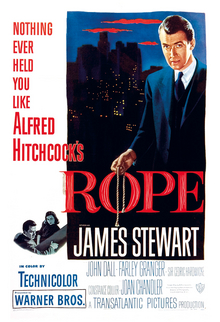
Long takes don't have to be all violence and space-floating, though. In fact, some of the more iconic long shots are during simple (albeit equally well-choreographed) sequences. Alfred Hitchcock's 1948 thriller Rope took place in real time and was edited to appear as one extremely long take, even though it was made up of only 10 separate shots. One of the bi
ggest reasons that filmmakers use long takes is to provide exactly this sense of real time, whether to create suspense or to add an extra element of realism to a film. Cutting from shot to shot can sometimes take away these elements and can create a less fluid experience. 

One man who makes statements with long takes is Louis C.K. Going into the fourth season of his TV series 'Louie', FX has allowed him even more freedom in regards to his creative process, and he certainly took advantage of it. Forrest Wickman, a staff writer for Slate, went so far as to call Louie "the most cinematic show on TV." (read the whole article, which I'll elaborate on further, here

C.K., for whatever reason, loves long takes. In fact, the third episode of the most recent season ended with a shot that lasted an incredible seven and a half minutes. This isn't HBO. This isn't even an hour long drama we're talking about. This a low budget comedy on FX. A seven and a half minute shot equates to almost a full act of the story, which means that almost the whole thing is bookended by commercials. That's a big chunk of TV. The shot in question is nothing particularly special. No fights, no guns, no exploding space stations, just Louie doing what he does best: going on an awkward date and the raw, brutally honest, and beautiful conversation that ensues. People love to throw around the phrase "it's like nothing else on television," but this is literally like nothing else you will find on television, let alone in any hollywood films. 

Louis - the real Louis, not the character - uses these long takes to create an atmosphere of real, honest, everyday life. It can be awkward, sure, but it can also be close and familial (see the living room scene with Louie's two daughters and then-girlfriend Amia), odd and unexpected (a model drives up to Louie and tells him to get in her car), and beautiful and special (Louie's daughter plays the violin). C.K. has proven himself to not only be one of the funniest comedians alive today, but also one of the most adept directors and showrunners on television. Not to mention the most cinematic. 

Sunday, October 2, 2011

Justice for Interns

As students who are studying media, we’ve all heard that famous line when that defines and explains how Hollywood and the entertainment industry work – “It’s not what you know, but who you know.”

We all receive the same advice over and over again from professors, colleagues, supervisors and people from the industry itself (I know I have!), including the following reality of the way it all works:

1. In Hollywood, you start at the bottom and work your way up. This is applicable to any particular of pre-production, production, or post-production aspect that you’d like to be a part of.
2. Your degree (or lack thereof) means nothing if you’ve got the talent.
3. Network, network, network! – because it’s all about who you know.
4. Intern as much as possible so that you can meet people, and gain experience to know what it is that you like and more importantly - what you don’t like.

The list continues on and on, but I’d like to elaborate on the last item on the list: internships. Internships are one of the best ways for students to step foot into the world of Hollywood. Through internships we get to witness firsthand the inner workings of a company—what they do, how they do it and if you’re lucky enough, you get to assist in that process firsthand. Internships provide students with a (sometimes) overwhelming dose of the world they’d like to one day be a part of.

Unfortunately, not all internships are great.

That’s something I had to learn the hard way after having a wonderful experience at E! Entertainment via NBCUniversal and an incredibly awful experience at a small production company owned by an A-List star that I will refrain from naming. Of course, anyone who has been an intern before knows that for every time you get to do something cool like sit in on a casting session or a pitch, you have to do a dozen mundane tasks such as grabbing coffee and lunch, or cleaning up the kitchen. It is a reality of the industry, one that has been acknowledged, accepted and ignored for a long time—until now.

Two unpaid interns who worked on the set of the movie “Black Swan” are suing the production company—Fox Searchlight for having been taken advantage of. The two interns, Eric Glatt and Alex Footman are asking for pay as well as an injunction on the company to make sure that future interns are treated properly. Although this may not be the first lawsuit interns have filed-it certainly is one that is getting highly publicized.


After discussing the lawsuit with several friends—all of whom also had internships in Los Angeles and beyond at companies such as Paramount, NBCUniversal, Warner Music Group and even the FBI (yes, really—the FBI!) we came to the conclusion that even though the two interns are putting their future careers in the industry at stake, it is something that will hopefully better internships in the future.

Here’s the deal: unpaid internships are supposed to be educational and have to meet the very specific requirements of the law. I’ve heard many friends, and even people who have had especially crappy internships criticize Eric Glatt and Alex Footman for being “babies” and claim that they should just “suck it up.”

My question is: why should they have to?

I’d like to remind each and every single reader out there than when you have an unpaid internship—one that is legally handled through your academic institution, you are paying your tuition money to work a certain amount of hours, depending on how many credits you are paying for. Here at Ithaca College, the current cost for a single credit is $1,175. For all of you going to L.A. in the future, you will be required to have a 6-credit internship. That means that you will be paying $7,050 for whatever internship you manage to get. For those of you who are lucky, that will mean reading scripts and writing coverage, attending shoots, sitting in on casting sessions, editing footage and meeting celebrities.

But sadly, for many of you that will not be the case. You will be stuck grabbing lunch orders, fetching coffee, taking out trash and counting down the hours until you get to leave your crummy dimly lit cubicle and exit the premises.

Both experiences cost the same amount of money—but which one is actually worth it?

We have to remember that these two guys—Eric and Alex are doing what many of us don’t have the courage or means to do, which is stand up for themselves and their peers and demand better internship standards. Although there is no way to tell how the lawsuit is going to end up, we can assume that companies that have internship programs are double-checking to make sure that their interns are benefitting from their time there. Perhaps there will finally be justice for interns.

Only time will tell.

Monday, September 19, 2011

Nine comes after 8 1/2


After reading chapter 9, Federico Fellini's 8 1/2, a light went off in my head like I have read or seen something like this before. I couldn't figure it out for a while, so i called my dad back at home and read some of the plot points and characters to him that the chapter described. He told me it sounded a lot like the movie Nine. So i did some research to find out that I did in fact
see the movie, and that 8 1/2 did intact have an influence on the 2009 hit movie.

Reading further into the chapter, the author kept using the term "double mirror construction," and what that refereed to was how the movie was portrayed. Unlike Hollywood films where each scene leads into the next and you can make connections, this new style of cinema took the audience into the mind of how a human really thinks, and put that on the screen. From dreams and emotions, to thoughts and ideas, you never knew what was coming and what was what. In one scene, Guido Anselmi, the director in the movie (not of the movie) would be doing something and the screen would radically change to what he was thinking of in his head. Whether it was a problem with his life, or something he didn't like in the film. Nin
e did similar cinema style, creating images of the on the screen to what the character was thinking.

As crazy as it seems, I can also relate 8 1/2 to a recent film called Inception. Both movies have similar themes finding true personal happiness in a difficult, fragmented life. In one, Guido Anselmi is trying to create the perfect film through all of his mishaps and life problems, and in the other Dominic Cobb (Leonardo DiCaprio) is trying to go through mazes and his life problems to get back to his kids. All of these movies are considered to be "second time movies" because you have to watch them twice to really understand what is going on.

If anyone has any comments or something to add, please do

steve kinslow