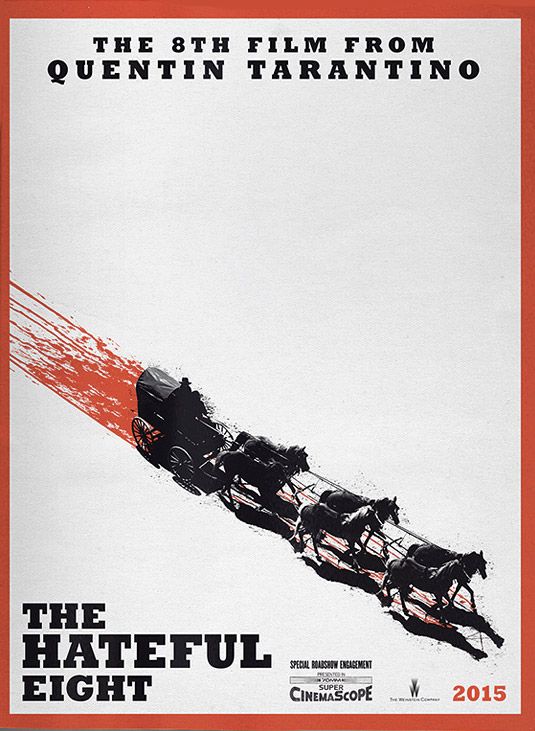
So it's that time of year again. Time for family, holidays, good food and presents. However, it's also time for some interesting movies. Now everyone's been clamoring about the new Star Wars, but personally, I have my eyes set on a different movie. The Hateful Eight is the, coincidently or not, eighth movie from famous director Quentin Tarantino. He's made some of the most commercially and critically successful movies ever, such as Pulp Fiction, Inglorious Basterds, and most recently, Django Unchained. He has been known for his sharp writing, over the top violence and meticulous attention to detail that's garnered him such a loving following over the years.
The movie, set to star actors like Samuel L. Jackson, Walter Goggins, Tim Roth among others. Many faces in the cast will look familiar to people who have seen a Tarantino film before. Anyway, the movie is about eight different people who, against their will, get trapped in a building and have to spend a few nights with each other, and this isn't any happy sleepover. No one trusts anyone and tensions are bound to be high.
One choice Tarantino made for the film which is really interesting is he made the decision to shoot using 70mm film, which isn't seen too often these days, and is certainly worth checking out one of the 70mm versions, because it will contain 6 addition minutes of film as well as usage of different takes. The total run time for the 70mm version is 3 hours and 2 minutes, and it's likely jam packed with everything that makes his movies so enjoyable. The movie releases on Christmas day, and I recommend making plans to go see, not necessarily on Christmas. And don't forget to go with someone you trust.
Recently the movie Brooklyn came out, based on the book by author Colm Tóibín. You may remember the book as that thing you got over the summer before freshmen year and never read....well I read it. I read it because I like to read, and you know what? It wasn't that bad! Until you got to the ending and then it was just plain terrible. It tricked me into thinking it wasn't a shitty book, but oh...it was a shitty book. On the popular website A.V. Club they gave Brooklyn (the movie) an A-! An A- is a pretty good grade for a movie on A.V. Club, and the author just spoons it loads of praise, it's actually sickening to read. Will I see the movie now? Probably not. Is it really as good as they say? Could vert well be. The reason I bring this all up is because I wanted talk briefly about the sin in Hollywood of turing books into movies. And that may not apply to Brooklyn, but just seeing it brings this idea to mind.
Today (and yesterday) in a world of 100% unoriginal ideas it has come to the attention of Hollywood scriptwriters everywhere that the easiest way to make a quick buck is to make an "adaptation" of a movie. The stories already written, tried and tested, so why the hell not?
You've heard the term "Oh well the movie wasn't as good as the book" in every way possible and at this point it comes across as arrogant to the process of filmmaking and storytelling. That's because it's unfair to do so; movies and books are different and shouldn't be compared to one another. My quarrel isn't with the fact that the books are usually better than the movies, which they are, my quarrel is in the fact that today adaptations have become the staple of Hollywood cinema to the point where I just have to say "Hollywood, take a break."
I think there's a lot of good adaptation that will (and have) come out this year, The Reverant, Me, Earl, and the Dying Girl, but there;'s also been a lot of bad. And my biggest pete peeve is when they take a short book and make it into three movie to take the poor suckers money who goes to see them. I would love to go into a case study about this but I'm honestly just exhausted of thinking sbout the state of Hollywood Cinema today so I'll quit while I still have some form of judgement about me. Not my finest blog post, but not my worst.
When learning the basics of composition it seems that above all else we're told to keep our object of interest away from the center of the frame. I've been told by various professors, YouTubers, and film books that these kinds of shots are boring to look at, visually unappealing, and overall can reduce the quality of a film. While in certain circumstances I admit that a symmetrical shot can come across as bland, I strongly believe that when done right these kinds of shot's can ut across a wealth of visual information.
Take for instance the work of Wes Anderson:
Though he may currently be the poster boy for symmetrical shots, I can think of very little instances in which the symmetry of the shot didn't add in some what to the content of the film. These kinds of shots don't take me out of the film, but rather draw me in to it's world and atmosphere. It's very rare that a serious drama would never design a shot that's as cloying twee as some of the examples posted above, but at the same time i don't think a lot of comedy films would benefit from the harsh lighting a lot of drama's benefit from.
It's all a matter of design really. If you feel that a shot would benefit from being arranged in a certain way, I really couldn't care less about what a book or professor might have to say.
Danger 5 is an Australian comedy series that is absolutely hysterical. Every aspect of the show makes me laugh. The actors, the set, the script, even the lighting. It is all over the top and over done.
This show is no Breaking Bad when it comes to looks. Everything in the show is done to look cheap and corny. While I understand that this is an approach that most people would hate I think that the show can be views as a good learning tool for students studying film. The show capitalized on low budget... to the extreme. The establishing shows are almost always hand made models, and this is a very cheap way to give a show a very interesting feel. It doesn't work if everything in the film is meant to be taken seriously but not all film needs to be so serious.
Danger 5 is still fun to watch even though it doesn't have crazy animation and locations, and I think that this is something that everyone can learn from. Also its available on Netflix... so check it out
Kung Fury is by far my favorite piece of cinematic work that I have seen since Interstellar. It is nothing like Interstellar, in fact it is quite the opposite. The creator David Sandberg wrote, directed and stared in this epic clusterfuck of a short film.
Kung Fury is set in 1985 on the streets of Miami. A bunch of ridiculous evens start happening, such as arcade game machines coming to life and killing people as well as Hitler coming to continental America. All in all Kung Fury it is just a crazy film shot to be a satire on 1980s films with a bunch of ridiculous jokes. That being said, I have never laughed so hard in my life.
The entire film is filled with jokes. There is literally never a serious moment in the film from start to finish and while this may seem like a bad thing, it is truly beautiful.
While being totally unbelievable in both plot line and in appearance, I would've believed that I would hate it, however It truly amused me. It is not a deep piece, or very an expensive piece but I can say with all honesty that If you are looking to watch something you have never seen anything like before, and laugh while watching that you should watch tis movie.
"It must always be remembered that the primary aim of pictures is to provide entertainment. To entertain people, one must first capture their interest." - Alfred Hitchcock
The name, Alfred Hitchcock, has sort of become a cliche, which is ironic because his filmmaking broke so many cliches by changing visual storytelling, specifically for psychological thrillers. Hitchcock, born in 1899, progressed filmmaking and influenced future films.
One piece of advice he said was, "Make your audience suffer, but give them pleasure. The same pleasure they have when they wake up from a nightmare." For example, Rear Window shows the danger early but uses the entirety of the film to build suspense. It makes the audience uncomfortable as they imagine the characters getting caught or witnessing a murder. It's not until the end when Hitchcock manages a somewhat sweet ending by wrapping up all the characters. Miss Lonelyheart finds a man, the dancer's love comes home, and the couple who's dog died has a new one. Lisa, played by Grace Kelly, reads a travel magazine next to Jeff, played by Jimmy Stewart, who now has two broken legs instead of one. The audience goes through a tremendous amount of suffering and suspense in order to enjoy this somewhat happy ending.
Hitchcock implemented and created many different techniques to portray emotion and make the audience feel something. His stylistic close ups on facial expressions helps convey the characters' strong emotions. Hitchcock is also famous for his point of view shots he used to create suspense. Second-unit cameraman, Irmin Roberts, created the dolly zoom, or "Vertigo Effect," which is used in Vertigo. Watch the scene below:
Once sound was used in films, dialogue started being used really heavily. But Alfred Hitchcock defined cinema as a visual medium. He believed dialogue should only be used when the visuals can't communicate an idea. He says, "sometimes you find that a film is looked at solely for its content without any regard to the style or manner in which the story is told." He wanted to use the camera every chance he gets to reveal the story with visuals and objects.
In the contemporary age of Hollywood, where Michael Bay's average shot length is a measly 3 seconds and the general average is only a second or two longer, it's really refreshing to see a film or TV show that has an appreciation for the long take. Obviously, Alfonso Cuaron is the first director that comes to mind - at least in this day and age - for his incredibly long takes in both Children of Men and the more recent Gravity (7 mins and 17 minutes, respectively). Also headline-worthy was Cary Fukunaga's elaborately choreographed 6 minute True Detective shot, featuring Matthew McConaughey bursting through houses and just generally kicking ass in one of the coolest TV scenes of the year.
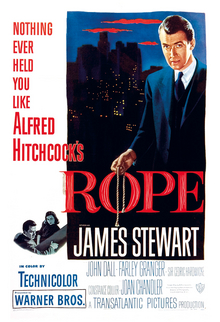
Long takes don't have to be all violence and space-floating, though. In fact, some of the more iconic long shots are during simple (albeit equally well-choreographed) sequences. Alfred Hitchcock's 1948 thriller Rope took place in real time and was edited to appear as one extremely long take, even though it was made up of only 10 separate shots. One of the bi
ggest reasons that filmmakers use long takes is to provide exactly this sense of real time, whether to create suspense or to add an extra element of realism to a film. Cutting from shot to shot can sometimes take away these elements and can create a less fluid experience.
One man who makes statements with long takes is Louis C.K. Going into the fourth season of his TV series 'Louie', FX has allowed him even more freedom in regards to his creative process, and he certainly took advantage of it. Forrest Wickman, a staff writer for Slate, went so far as to call Louie "the most cinematic show on TV." (read the whole article, which I'll elaborate on further, here)
C.K., for whatever reason, loves long takes. In fact, the third episode of the most recent season ended with a shot that lasted an incredible seven and a half minutes. This isn't HBO. This isn't even an hour long drama we're talking about. This a low budget comedy on FX. A seven and a half minute shot equates to almost a full act of the story, which means that almost the whole thing is bookended by commercials. That's a big chunk of TV. The shot in question is nothing particularly special. No fights, no guns, no exploding space stations, just Louie doing what he does best: going on an awkward date and the raw, brutally honest, and beautiful conversation that ensues. People love to throw around the phrase "it's like nothing else on television," but this is literally like nothing else you will find on television, let alone in any hollywood films.
Louis - the real Louis, not the character - uses these long takes to create an atmosphere of real, honest, everyday life. It can be awkward, sure, but it can also be close and familial (see the living room scene with Louie's two daughters and then-girlfriend Amia), odd and unexpected (a model drives up to Louie and tells him to get in her car), and beautiful and special (Louie's daughter plays the violin). C.K. has proven himself to not only be one of the funniest comedians alive today, but also one of the most adept directors and showrunners on television. Not to mention the most cinematic.
Whenever I am writing a script I always try and take advantage of film as a medium, and that is visuals. Writers too often try and come up with lengthy dialogue to tell the story, however when you do this you may find yourself being redundant and putting in unnecessary dialogue that has no real point to it . While dialogue is a very useful story telling technique, another way to tell the story is by letting the footage do the talking for you. As the saying goes "a picture is worth a thousand words" and this has never been more true in film. Typically we shoot at 24 frames a second, thats 24 individual pictures, I'll let you do the math. Using just the image and perhaps a soundtrack and natural sound allows the viewer to understand your story while at the same time have their own take to what is going on.
The trailer above is to the new movie "All is Lost"directed by J.C. Chandor and starring Robert Redford. Robert Redford is actually the only actor in the film. This film was covered in this month's edition of American Cinematographer and goes into the production process. There are only a few lines of dialogue and the screen play was only 31 pages long. In the article it talks about how that the camera man was never more then 10 feet away from the actor. This alone makes you feel like you are right there beside the character as well as makes the viewer feel like the character is trapped. The director said that if he were to get shots of the boat far away as establishing shots that it would give the feeling of hope for the character when in reality he is trapped and there really is no hope. Due to the lack of dialogue you don't really know who this character is, he could be murderer for all we know, but thats what is so great about the movie. You are able to almost become the character and shape him any way you want as a viewer.
Without even have seen this movie yet I am almost certain it is up for a lot of rewards for the sole reason of it going against the grain. This is so unusual for a feature film to have little to no dialogue and from the trailer it looks like it has been done well. This movie is on the top of my list to see and I can't wait.
As the digital age progresses many icons of our past are being left behind, including drive-in movie theaters. Since 1933, drive in theaters have been a staple of American Past-time for youth and adults alike. It is no secret that movie theaters, especially drive ins, have not been doing so well due to the economy and the rise in pirated movies. All theaters are being forced to switch to a new kind of digital projector if they want to be able to play current movies at a high quality. This means spending tens of thousands, possibly even hundreds of thousands of dollars on a single projector in order for the theater to still function. With less than 375 drive in theaters in America left, this has become a real concern of many movie fanatics. Honda (yes the car company) decided to do something about it.
I have only ever been to 1 drive in during my lifetime so far. I was on a family vacation to Wisconsin when I was in 8th or 9th grade (don't ask me why my family chose to go to Wisconsin...) and one thing my mom planned for the trip was a stop at a drive-in movie theater. We saw a double feature, first was Journey to the Center of the Earth, and after that was The Dark Knight. Despite how awful Journey to the Center of the Earth was, the drive-in movie theater proved to be one of the least shitty parts of my shitty family vacation. It was honestly an experience I remember to this day, and one I would not wish to forget. There is something about the atmosphere of a drive in that changes the movie-going experience. There is more of a sense of community and family. I hope that I get the opportunity to return to another drive-in during the near future.
So far Honda has donated 5 projectors to drive-in movie theaters across America and helped raise enough money for 4 more. They are urging for you to help however you can, whether it be a monetary donation, visiting a drive-in or even spreading the word. More information can be found at http://projectdrivein.com/.
For anyone interested in attending a drive in movie theater, the closest one to Ithaca is in Elmira, and about an hour away from school.
This skating video presented by Red Bull House Media 2013 is simply a work of art. Directed by Nicholas Schrunk, "Red Bull Perspective" is an impressive collection of footage that can literally teach you certain cinematic elements that could be used on a film of your own. A behind the scenes look at the making of the this video offers insight to all kinds of out of the box shots which with time, patience and the right equipment can improve the entire end product of any film. The use of anamorphic lenses gives the audience a wider perspective of view which adds to the cinematic quality of the film. Additionally the use of a phantom camera shooting up to 4,000 frames per second creates a realtime shot with slow motion action. The team also used cable cams to provide an up close and personal view of the skater as the are hitting their set therefore giving the audience a point of view which brings them along for the ride. Lastly I would like to mention how throughout the video the production team talks about the many variables that make up just one shot, rarely do action sport videos breakdown cinematic elements in such detail. Overall it is refreshing to see such unique genres of work accompanied with knowledgable production teams to capture the essence of cinema.
After reading chapter 9, Federico Fellini's 8 1/2, a light went off in my head like I have read or seen something like this before. I couldn't figure it out for a while, so i called my dad back at home and read some of the plot points and characters to him that the chapter described. He told me it sounded a lot like the movie Nine. So i did some research to find out that I did in fact see the movie, and that 8 1/2 did intact have an influence on the 2009 hit movie.
Reading further into the chapter, the author kept using the term "double mirror construction," and what that refereed to was how the movie was portrayed. Unlike Hollywood films where each scene leads into the next and you can make connections, this new style of cinema took the audience into the mind of how a human really thinks, and put that on the screen. From dreams and emotions, to thoughts and ideas, you never knew what was coming and what was what. In one scene, Guido Anselmi, the director in the movie (not of the movie) would be doing something and the screen would radically change to what he was thinking of in his head. Whether it was a problem with his life, or something he didn't like in the film. Nin
e did similar cinema style, creating images of the on the screen to what the character was thinking.
As crazy as it seems, I can also relate 8 1/2to a recent film called Inception. Both movies have similar themes finding true personal happiness in a difficult, fragmented life. In one, Guido Anselmi is trying to create the perfect film through all of his mishaps and life problems, and in the other Dominic Cobb (Leonardo DiCaprio) is trying to go through mazes and his life problems to get back to his kids. All of these movies are considered to be "second time movies" because you have to watch them twice to really understand what is going on.
If anyone has any comments or something to add, please do
Welcome everyone!. The following project structure is intended to provide you with a methodology to be both specific and help you track the progress and meet your milestones. Since individual projects vary widely some points might not apply. However, you can use it as a roadmap to define/clarify your deliverables and go back to it frequently and methodically.
It has four distinct phases:
DISCOVERY
This phase helps you understand the big picture and the opportunity to achieve the main goals of your project; to take an idea from conception to completion in the most effective manner.
Brainstorming, sketch models, scenarios, analysis and feasibility assessments.
Define the requirements, scope, timeline, budget (your time and resources) and benchmarks for the project.
Requirements of Analysis:
Prioritize and validate requirements based on quality(1) and strategic factors
Determine success criteria and metrics
Define a preliminary list of production requirements.
Synthesis:
Produce a final script with the discovery result.
Develop a high-level implementation plan. (storyboard)
Present a timeline and a budget estimate.
DESIGN
During this phase, create the look and feel of the solution (style). Develop the story requirements, the creative components, the technical design and infrastructure that supports the project.
Creative Design:
Storyline and character creation
Script
Storyboard
Art Direction
Audio Design
Production Design
Technical Design:
Equipment requirements
Set/backgrounds/location/plates
Lighting diagrams
Special efx design
Models, costumes and makeup
PRE-PRODUCTION
Develop and integrate all the creative, technical and information components.
Creative Production:
Location Scouting
Casting
Rehearsals
Graphics, 3D video/audio production needs
Technical integration
Technical Production:
Set design
Lighting
Cinematography
Sound
System testing
Problem resolution
DEPLOYMENT
Demonstrate the solution after all final specifications and testing results.
Live environment:
Projection
Audience Test performance and feedback
Implement promotion/communication strategies
Showtime!
That's all folks!
1-Quality: the true nature of things, the peculiar and essential character