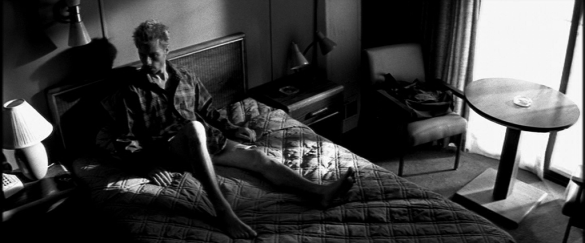
8 ½ is a film about “director’s block” and tells the story of Guido Anselmi, a film director, who during the filming of his latest film, suddenly loses inspiration and worries he will not be able to finish and fail. One of the first “rules” Fellini “broke” was the non-linear story. The linear plot is constantly interrupted with Guido’s dreams, fantasies, and childhood memories that are triggered by present problems. This helps create a world of fantasy and makes it clear to the audience that this film is not about life but the make believe world of film. When first reading about this it reminded me of Christopher Nolan’s film Memento. That film is about Leonard Shelby who has anterograde amnesia searching for the killer of his wife. The film’s events are told in two separate narratives. One is told in chronological order in black and white and the other is told in color in reverse chronological order. As each sequence begins the audience is unaware of the preceding events just like the main character. Finally at the end the film’s narratives converge and everything makes a lot more sense. Memento in comparison seems a lot easier to understand and follow than 8 ½ and since I was confused during Memento I can’t even comprehend my level of confusion if I watched 8 ½.

Another “rule” 8 ½ breaks is with editing. For example objects in the background and the orientation of people in the room move from shot to shot. This disrupts the viewer’s illusion of “reality” because in real life these kinds of things would not happen. However it makes perfect sense in the film because it helps capture the disoriented process of recalling memories, which the main character is doing. Try it yourself. It is hard to pinpoint the exact location of people and objects when recalling memories. In other words “rules” are meant to be broken but only with good reasons like Fellini had.

Like Memento, 8 ½ reminded me of a lot of other movies and television shows I have seen. First it reminded me of Six Feet Under when sometimes Fellini creates dream sequences or fantasies that are not really happening. Six Feet Under would use this method all the time to show what was really going on in their characters’ heads. Overall the plot of the film reminds me of two movies; Adaptation and Tropic Thunder. Adaptation is a Charlie Kaufman film about Charlie Kaufman’s difficult struggle to adapt The Orchid Thief novel into a film. It turns out it is based on upon his actual struggle when hired to write the film’s screenplay. Tropic Thunder is about a bunch of prima donna actors who are making a Vietnam War film based on the fictional novel Tropic Thunder. When their director becomes frustrated he decides to skip the script and drop them into the middle of the jungle to survive real action and danger. In the end the making of the film becomes the actual film in the film’s reality and is a worldwide smash! Sound familiar? Between these four movies and shows it is clear to see that Fellini’s movie paved the way for future strange and creative projects. It can take just one person to change the way we think and Fellini was definitely one for many people.
In an industry where Showtime and HBO television series get all of the spotlight (with good reason), sometimes we forget how to appreciate all of the “bad” television there is out there. More specifically, I am talking about soap operas. Yes, you read correctly.
Now, I am not an avid soap opera watcher, in fact, I think I may have seen only one episode of General Hospital and that was because James Franco was on it—but I must admit that over the summer, I became obsessed with a Spanish soap, una novella called “La Casa de al Lado.”
This is not an entry about the differences between Spanish and English soap operas, but rather about soap operas themselves. With so much fantastic television out there, soap operas get the short end of the stick and don’t get as much recognition—particularly by us students who are preparing to enter this industry or some variation of it. I believe it’s important to take a close look at soap operas and see why sometimes they’re so good, and sometimes why they’re just so darn awful.
Here is what stands out to me:
1. One of the best things about soap operas, in fact the most admirable—is the short amount of time that it takes to put on the production of one episode. Usually, it’s one day per one episode. Now that is just crazy! When you think about it in context, it is quite impressive. After all, how long does it take us to shoot a scene that is merely five minutes?
This creates an atmosphere of constant pressure because of the lack of time. This is the reason that a lot of soap operas aren't that visually exciting or impressive. A lot of their scenes are shot once, using three cameras so the lighting has to be able to work for all three angles simultaneously. Also as a result of the quick production time, the settings aren't always as believable as they could be if it were a production on a larger budget. Take a look below at the hospital scene and awful car crash in La Casa de al Lado.
2. The actors on soaps of course may not be the most groundbreaking actors to ever have been on television, but, they are very good at what they do. Since soaps have such a short production time, the actors are usually in the position of having to memorize their lines in an incredibly short amount of time-sometimes a day before the actual episode or scene is shot. This presents a huge challenge to the actors and it is highly respectable that they take their craft so seriously. After all, how many times do we hear of “serious” actors in Hollywood showing up to sets and not having their lines memorized?
Also, soaps feature up and coming actors quite frequently, usually giving a completely new actor their first role. Many times, great actors have had their start acting in a soap opera. Some examples include: Demi Moore who worked on General Hospital, Meg Ryan (As the World Turns), Christopher Reeve (Love of Life) and Susan Sarandon (A World Apart) – all of these actors have had successful careers after their initial soap-spot. They are just a few of many.
3. The best aspect of soap operas in my opinion is the writing (yes, I really did just write that.) Now, let me explain myself. When I say writing, I am well aware that there is far better writing on television than what ends up on One Life to Live, but that’s not my point. Soap opera have absolutely no limitations. None whatsoever. There is nothing impossible within the realms of a soap opera. Characters can die and come back from the dead because in fact, they were never really dead at all. Characters have shady pasts and can end up being evil even when they’ve been pretending to be good. It must be pretty fun to work in a writers room for a soap opera. Anything you suggest or think of can actually happen.
Granted, not much of it might logically make sense but that’s why it’s fun—it’s creative.
Like I mentioned before, I do not watch soap operas, however, I think it’s important to take a look at the shows that we truly admire and the kind of series that we don’t because we can learn a lot from both. Soap operas are extremely popular all over the world, with even their own award shows (Daytime Emmys). They last for years, even decades so even if it’s not something that you ever want to get into, it’s still interesting to know their production process.

First for those who have not seen the film, Inception is a 2010 film written, directed and co-produced by Christopher Nolan one of my favorite directors who has done movies like The Dark Knight and Memento. It was also nominated for a Best Picture Oscar. Leonardo DiCaprio stars and plays Dom Cobb, a specialized thief. Instead of robbing, banks he steals ideas from the unconscious minds while they are asleep and dreaming. This is called extraction. Cobb has been on the run and unable to go home to America to visit his children because he is wanted for his wife's murder. Cobb is offered a chance to go home and have his old life back if he could perform the impossible task of inception; the planting of an idea into someone's subconscious. That is Inception in a nutshell. It is a lot more complex and a definite watch for anyone who loves science fiction, action or heist movies.
The music from Inception is just beyond epic. Hans Zimmer, who has worked on movies like The Lion King, The Dark Knight, and Rango, completed the score. Now the score is described as a very electronic score but the coolest part about Zimmer's Academy Award nominated score involves Charles Dumont's 1956 song "Non, je ne regrette rien." In the movie this song is used as a "kick" to wake up them up. To know they are running out of time in the dream the song softly starts as headphones are placed on the dreamer's ears. The music builds and then they are awakened. 
Two final points, one small and one large, I want to bring up involve the story and the script, which was nominated for an Academy Award for Best Original Screenplay. Let's start small first. Nolan was so detailed when writing the script that some of the character names are allusions. Ellen Page's character Ariadne is an "architect" who creates the various dreamscapes, which are designed like mazes. The name alludes to a princess in a Greek myth who aided by the hero Theseus by giving him a sword and a ball of string to help him navigate the labyrinth, which imprisoned the Minotaur. Ariadne in the movie aids the hero Cobb and the rest of the characters on how to navigate the dream mazes.
The other point I must bring up when talking about Inception is the ending. The ambiguous and controversial ending involves a spinning top wobbling. For the characters in the movie they each have a totem that allows them to find out if they are dreaming or in the real world. For Cobb if the top stays spinning he is dreaming but the ending fails to show if the top falls or not because of the abrupt cut. In other words the audience is unsure if the final sequence of the film is reality or just another dream. While many of speculated and even came up with theories involving Cobb only wears his wedding ring during dreams and that is your clue to look for, Nolan has denied this. When I first saw the movie I was a little confused and looked for clues to find out what happened but after my second viewing I realized how it doesn't matter what happened. Whether he is dreaming or not, Cobb is not looking at the top for the answer but is looking at his kids. If he doesn't care, neither should we. Nolan has backed this in interviews but the audience is free to believe whatever they want. Maybe they should sleep on it and dream their own ending to this wild movie.


Will this show survive without their MVP?

Besides from great storytelling and acting, done especially well by Emmy nominated actor Michael C. Hall who plays Dexter, the production team makes some interesting and great aesthetic choices. First off the color of red is everywhere. Dexter will drink red wine and eat red meat. Streetlights behind Dexter’s head will often be red. Red, obviously, is supposed to signify blood, which Dexter sees a lot of. Another example is what they do to show the different sides of Dexter. When Dexter is the good, average Miami citizen upbeat Latin music plays against the sunny Miami city. The colors are bright and the world just seems happy. However when Dexter is acting as his “dark passenger” the lighting becomes chiaroscuro. There is a sharp contrast between light and dark (which is a metaphor for the sharp contrast between his two sides). Soft and creepy music also plays as Dexter slowly lurks in the dark.
Harry Morgan, a cop and Dexter’s dead adoptive father, will interfere with Dexter’s life and remind him about the code they set up so he will not get caught. Whenever Dexter sees him the scene gets a little blurry and the lighting becomes brighter, especially around Harry. This could be interpreted like Harry is Dexter’s guardian angel, a mystical figure coming back to help Dexter when he needs it the most.
One of the greatest aesthetic pieces of Dexter is seen every week in the opening credits, which is Dexter’s morning routine. There are many close ups and extreme close ups that show Dexter getting ready for the day. All of these show his precision and his eye for details. It is also edited in a unique way. First it is edited into “choppy” segments (pun intended) and like a horror movie the killer is not revealed until the end (Dexter is finally visible in the last few seconds of the video). These shots, especially in extreme close ups, also look very scary and brutal. For example when he tightens the lace on his shoe or cuts into a piece of meat, it looks like he is strangling someone or cutting into a body. It’s practically his killing cycle! The audience will definitely know what they are getting themselves into as they watch these credits! Finally despite all of these scary images his morning routine is very similar to ours and is supposed to show no matter how crazy or demented Dexter is, he is still human. He shaves, flosses his teeth, and locks the door to his house as he leaves just as we all do every morning. In a way he is just like all of us (except he finds very different ways to use his free time).
For more information on Dexter, check out it's Showtime website. The new (sixth) season premiere is October 2nd!
I just didn't want to be disappointed with the representation of people of color in film...again.
For as often as I have watched movies and TV I have noticed the pattern that appears when it comes to the portrayal of particular races. Generally speaking (and please not that I am saying generally, meaning often and not all the time!) stereotypes are attached to the character of color. Think about it for a moment. Really. Just sit back, take a breath and try to remember when you saw a television show or a movie that featured, or guest-starred or had a cameo played by a Black actor. How about a Latina? A Native-American? Asian? A person from the Middle-East? Now how did these characters dress? How did they speak? What role did they have within the film? Did they have an accent?
Mind you, I don't watch every movie that comes out nor do I keep up with every television show but I think of Eva Longoria on "Desperate Housewives". I think of Mindy Kaling in "The Office." I think of Sandra Oh and Chandra Wilson on "Grey's Anatomy." I think of Nelsan Ellis in "True Blood."Most of the characters that these actors play have a personality and story lines that don’t necessarily revolve around their ethnic background or color of their skin. Their race isn’t their only story lines which sometimes dictates the entire character. For example, how many Black men do you see on television that are lawyers or doctors on television? Think about that in comparison to how many you see as criminals and drug dealers. How many are even reoccurring characters? That’s a big gap, right?
Plenty of studies have been done analyzing the number of roles that people of color have in the media, as well as the stereotypes that they fall into. This topic is of particular importance to me because as a Latina who is studying television-production and who hopes to one day have a career in the media, it is overwhelming the lack of representation that minorities have in the media and even more so the way we are presented once we actually have a part. In a study conducted on the 2001-2002 Prime Time television shows (Latinos on Prime Time), it showed that Latinos accounted for ONLY 2% of characters that were reoccurring. This was out of 3, 172 characters that were examined.
Perhaps this isn’t of any concern to my fellow peers, but it is definitely a concern to me.
It's easy to watch anything and laugh and cry and feel for the characters that we are watching. It is entertainment - that's what it's there for, right? But as each and every one of us in this class are not just watching entertainment - we are studying it, admiring it, creating it and hoping that one day we get to put our work out there in the world. I say that we begin to critically analyze it as well. Let's take a look at how people of all races are portrayed as well as genders, and characters of particular ages and from different countries.
After all, media isn’t just about entertainment. It’s an incredibly large industry with many powers and functions. Sure, it can be used to make people laugh…but it can also be used to provoke thought, challenge norms and create change.