Friday, October 17, 2014

Underwater Filming: Part 3


A couple weeks ago I wrote a few blogs on underwater filming. I have keep up with researching this awesome topic. Here are a few more tips that will help you improve your underwater filming.

Hold Still
Avoid shaky movements. Sounds easy, right? After all, your camera is surrounded by water and should be nice and stable. While it's true that most underwater footage isn't prone to the kind of rapid shake that handheld cameras usually produce topside, any amount of wobble can be extremely distracting to your viewers. Hold the housing as close to your body as possible to help stabilize it, or use a tripod (see tip #3!).
Make sure you keep the camera steady on your subject for long enough to get a good, usable shot. Count to 10 in your head once you've got the subject in frame and don't re-adjust where you're pointing the camera or change the zoom during that time. A 60-second shot full of slight moves, shakes, or zooming isn't really a 60-second usable shot, and it's surprisingly easy to sabotage yourself by thinking you've been "on" something long enough when you never have more than a few steady seconds at once!

Move Around a Little
Videos are more interesting if they contain a variety of shots. So along with all your nice, steady, still clips, you probably want to have a few taken while moving.
Practice panning the camera by twisting at the waist to aim the camera all the way to one side, hitting record, and then slowly unraveling yourself back to the other side (don't try to turn your whole body using your fins as this will introduce more shaking).
Each kick of your fins makes the camera wobble for a moment, so try panning over or past your subject by frog-kicking. If you get a strong enough start, you can film a nice long, stable shot while coasting after each kick.


Use a Tripod
It's almost impossible to hold the camera completely steady, you can get rid of that last trace of shakiness by using an underwater tripod. Several manufactures make mounts for different housing, and tripod legs to suit your diving style and price range.
Using a tripod will kick your macro footage up to the next level. It's also surprisingly useful when shooting wide angle. Extend one of the legs out to one side and use it as a handle to give your housing a wider, more stable platform. Or, extend a leg toward your own body to use as a monopod that braces against your chest.
You can also leave your tripod set up on your subject and swim away - fish are much friendlier to cameras that don't have divers behind them.


Follow the Action
When shooting a moving subject, keep it in frame and with plenty of "headroom" - just like shooting stills, you want to make it look like your subject still has room to move.
You can't follow any critter forever, though, and if you try you wind up with a wobbly shot trying to "catch up" with it. After you've captured some amount of motion, hold the camera still and let the subject swim out of frame to "end" the shot gracefully.


Keep Rolling
Tape and memory cards are cheap - go ahead and take lots of footage! Some cameras take a moment to get rolling after you hit "record," and that usually turns out to be the moment with all the action. If something cool is hanging around in the area, I just leave the camera recording, but put my hand over the lens so I can easily see later that there's nothing "here".
Of course, the flip side of this is that you're going to have way, WAY more footage than anyone should ever be forced to watch. Keep in mind that the more footage you take, the more editing will be required. Some videographers truly enjoy the editing process, but those who don't often learn to be better "in-camera editors," only hitting the record button once they've got their shot all lined up and ready to go.

Get a Variety of Shots
When it's time to edit your video together later, you'll want to have a variety of shots to choose from. In particular, you want to try to get wide (establishing), medium, and close up shots of your subject whenever possible.
Try shooting your subjects from different angles, with different lighting. Take your time and give yourself lots of options for later.
Don't forget the shots that will help glue the story together: divers gearing up or entering and exiting the water, wide angle shots showing the overall appearance of the dive site, empty shots of blue water or diver bubbles that can be useful while running credits, etc.

White Balance
Get familiar with your camera's white balance functions. If you're shooting macro with lights, you can probably just leave it on 'auto.' But if you're using ambient light, even with a red filter, manual white balance is going to be your friend.
Manual white balance normally entails pointing the camera at something white (or close to white) and hitting a button, or an annoying series of buttons. Sand usually works, though in some locations the sand has too much red or yellow in it to make a good white card. Dive slates can work, but may need to be held at a bit of a distance and slanted so they aren't glaringly reflective. If all else fails, point straight up towards the sun (or make your buddy wear white fins).
It's often tempting to stop fiddling with white balance and just "fix it in post." But trust me: fixing it in the camera will look much better!
Ambient light and red filter; manual white balance.


Know When to Use Lights and Filters
Here are my rules of thumb - with the caveat that your mileage may vary based on your camera's performance in different lighting situations:
Wide-angle, 45' or shallower: Use a red filter and ambient light. Manual white balance whenever you change depth or the lighting changes.
Wide-angle, deeper than 45': if shooting something close, turn on your lights (extended above and to the sides of the housing to cut down on backscatter) and remove the red filter. If you're trying to shoot something larger than the area illuminated by your lights, you may just have to settle for having extremely blue footage. Putting the red filter on may help you white balance, but at depth it also cuts out way too much light and leads to grainy footage.
Macro: lights on, no red filter. Experiment with different light locations. I usually put one light right next to the lens aiming directly at the critter, and use the other light to backfill some of the shadows from the side or above.


Check Your Footage
Those tiny little screens on video cameras help you figure out where to aim, and hopefully tip you off if you're terribly out of focus or badly white-balanced. But to really get a good look at your footage, you need to look at it on a big screen.
Often I've taken what I thought was great footage - only to play it back on my HDTV at home and discover there's a bit of dust on the inside of the lens that mucked up the autofocus. If you're traveling and go days without really looking at your footage, you can miss things that ruin days of footage, so it's worth it to take the time and make sure you're getting the results you want at full resolution!

David Fincher: The Don'ts to Filmmaking


“Everything seems really simple on paper until you take a camera out of the box.”
                                                                                                                       -David Fincher


   Every filmmaker has their list of dos and don’ts and David Fincher is no exception. Producer and director of countless films such as Seven, Fight Club, and this year’s highly anticipated Gone Girl, he has honed a skill that has arguable been very influential.
   And if you want to understand his craft, you need to ask yourself this: what does David Fincher not do? To put it simply, there are three things he does not do: handheld shots, close-ups, and camera movement. But it’s not a matter of casting these aside, but using them when the times calls for it.
   In terms of handheld operation, Fincher is notorious for having as little to one shot not placed on a tripod or Steadicam. The reason for this is the way he wants the camera to act in any given scene. Camera shake (the most well-known trait of handheld) puts the audience in the scene with the character but a smoothly gliding shot drags us out of the scene. Normally, most filmmakers want to avoid this as they don’t want their audience to become separated from the story they’re trying to tell. But to David Fincher, this is exactly what he wants. He wants the camera to be this omniscient character. It forces you to really look at everything that’s happening on screen. Without the camera shake, you’re eye has nowhere to look but at the action. It’s subtle but a very powerful technique when executed properly.
   Close-ups are similarly a need-by basic sort of deal. Excessive close-ups will distract an audience and can potentially exclude too much for to hold their attention. Yet, having only a few close-ups in any given film is a crafty way to tell the audience that they need to look at something. It’s similar to grabbing a person by the face and physically shoving their attention at an object. It’s the equivalent of shouting, “you need to see this!” It’s a subtle way to tell an audience that what’s happening on screen is about to impact the movie in huge way.
    And the last don’t on this list, may seem like the strangest. It’s all about camera movement, or the lack thereof. David Fincher, if he can help it, likes to keep his camera in one place. This allows the scene to play out as it might be viewed realistically from a person on the outside (as he sets the camera up to be in the first rule).  This adds to the idea that what we’re seeing on screen is important and all of our attention needs to be focused on that specific thing. The lack of movement forces our eye, much like the lack of camera shake, to really look at what’s happening.
   All three of these techniques end up creating  the same thing: a movie we can’t force ourselves to look away from. They’re subtle, their powerful, and they’re not something to be overlooked. As Fincher said, “people will say ‘there are a million ways to shoot a scene,’ but I don’t think so. I think there’s two, maybe. And the other one is wrong.”

An Effective PSA

There are some really bad PSA’s out there but there are also some really good ones. A PSA's goal is to persuade an audience to take a specific action or adopt a particular viewpoint on a cause or social issue. 

What I think makes a bad PSA:
  • It's not realistic
  • The storyline is exaggerated
  • It tells the story poorly
  • It drags on for more than 60 seconds
  • Instead of wanting to take action after watching it the audience is just annoyed

What I think makes a great PSA:
  • It is empathetic and gives a sense of caring about a problem 
  • It builds trust with their audience
  • It tells a story
  • It holds your interest
  • It gets to the point in 30 to 60 seconds
  • It makes you want to do something
  • It actually gets the public to take action after watching it

One of my favorite PSA's:

CBS Launches Online Streaming Service

That's right, you heard me. CBS is the first broadcast network to create a stand-alone streaming option for viewers.

It's been a good week for television fans. On Wednesday, HBO announced that their streaming service will be available to people without their pay-TV subscription starting 2015. On Thursday, CBS announced CBS All Access, a new streaming device for $5.99 a month that includes current and previous programming. That's right, kids. You no longer have an excuse to not watch The Good Wife.

“CBS All Access is another key step in the company’s long-standing strategy of monetizing our local and national content in the ways that viewers want it,” CBS President and CEO Leslie Moonves said in a statement. “This new subscription service will deliver the most of CBS to our biggest fans while being additive to the overall ecosystem. Across the board, we continue to capitalize on technological advances that help consumers engage with our world-class programming, and we look forward to serving our viewers in this new and exciting way.”

This is huge, because CBS is the largest broadcast network. The Big Bang Theory, one of CBS's programs, was the most watched television show of last season, and had more than 18 million tune in for the Season 8 premiere last month. CBS All Access will also include special programming, like the Grammy Awards, the Academy of Country Music Awards, and the Victoria’s Secret Fashion Show. There will be ads for current programming, although commercials will run between 9-12 minutes, as opposed to the 12-16 minutes of advertisement on television. Another big plus is that previous programming, like Twin Peaks (which seriously all of you need to watch if you haven't already), will not have advertisements.

My only complaint is that CBS All Access will not include the NFL games. Hopefully they add those one day. Speaking of adding onto the service, CBS All Access will initially only be available in major cities, including New York City and Los Angeles, of course. The network, however, said it plans to expand.

Skateboarding tool repurposed to help find locations

Another post about skateboarding! Kind of...

The other day in class, instead of doing my work, I was doing skateboard related things on my computer. More specifically looking for more hills to skate down. Arturo walked up behind me, and instead of criticizing me for not doing my work, he was interested in the website I was using. Its called "findhills.com" and its pretty simple to use. Its a topographic version of Google Maps,  and you can find the slope between two points on a road by simply clicking them. It will give you a detailed breakdown of the elevation, elevation change, average grade, steepest grade, ect.


And it also incorporates Google Earth and street view, so you can see your location more realistically while still at your computer. 


After I showed Arturo findhills.com he told me that I should write my next blog post about it. Originally I was super skeptical, because it really doesn't seem that useful in a location scout application. And truth is, its not. If I'm attempting to find locations I'm never going to use findhills first. There are few reasons to use it over Google Maps. But, that one time where you do need a location on a hill, its an amazing tool. So overall, don't use it, unless you need it. 

Thursday, October 16, 2014

Writing for TV Vs. Writing for Film

If you're like me and want to be a screenwriter (which apparently applies to like, half of our class) you might assume that all scripts are more or less the same: just throw something decent in celtx and boom. Script. Film, Tv, whatever, a script is a script. However, as I'm learning very quickly in my writing for series television class, there are some major differences between writing a film (short or feature) and writing for a weekly television show. Here are just a few.

1. Television writers are more likely to get/keep jobs.
Yay jobs!

Not to say that people who write TV shows are better at their jobs than those who choose to write films; it's simply a matter of numbers. While film scripts are typically written by only one or two people as a kind of freelance project, TV scripts are made by - almost always - staff writers. Staff writers collaborate on scripts to keep episodes of any given TV show consistent with that show's tone and brand. Simply put, there are more positions available to write for TV than to write for film. To find out a bit more about the various positions and hierarchy of a television writing team, check out the Writer's Guild of America's official overview here.

2. Characters develop differently...if at all.

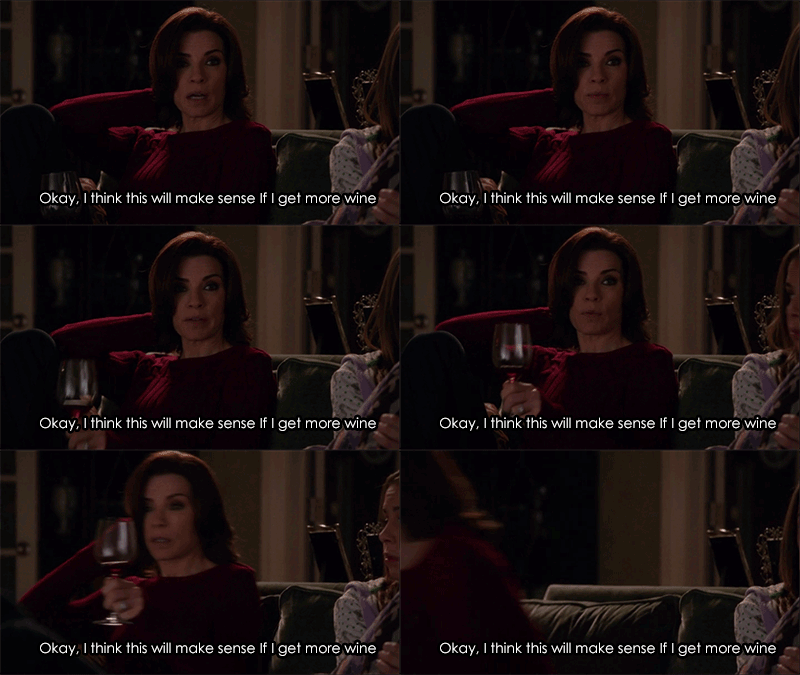
Ja feel, Alicia.
In any good film, the main character will undergo some kind of change as they progress from point A to point B. A movie with a static character is kind of just a boring movie. Television, however, is more or less the exact opposite. Apart from certain cable dramas (cough cough Breaking Bad), people watch TV shows for consistency. If Michael Scott suddenly realized that he was a gigantic doofus and wanted to change his ways halfway through season 3, there never would have been a season 4. As weird as it sounds, we want to know what we're getting into before we watch a show. I watch the Good Wife because it's an intensely dramatic show about lawyers; even though major, major changes occur during its fifth season, I continue to watch it because it's characters are consistent and awesome. It's perfectly fine to reveal new traits and things about your characters as a show goes on, but they should always have the same basic characteristics that made your viewers want to watch your show in the first place.

3. TV is faster and there's way more of it.

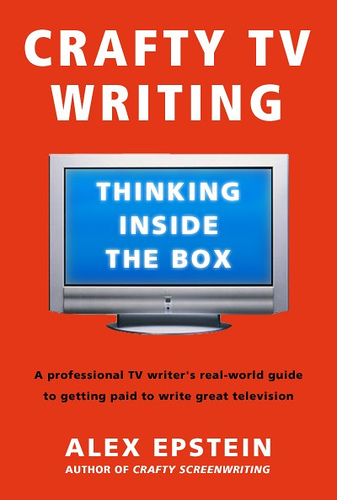
Whereas a feature film writer can take months (or even years!) to write a first draft of a commissioned screenplay, a television writer typically has to churn out a script that's ready for production in 5-7 days. That's less than a week to go from concept to breakdown to outline to rough draft to shooting draft, with a few extra drafts thrown in there somewhere for good measure. And don't even think of missing deadlines. Alex Epstein details the entire process in section taken from his book, Crafty Screen Writing, which can be read here. The upside to this tight production schedule, however, is that television writers are some of the most powerful people in the industry. Unlike film writers - who are typically never on set and practically thrown away after they've turned in a decent draft - television writers are often the producers and showrunners of their own productions. All of this basically just means that the actors shouldn't piss off the writers, since they could literally kill off your character at any moment.

While both television and film have their pros and cons, it almost goes without saying that writing for TV is the more difficult of the two. But if you are up to the challenge and can somehow not consistently get chronic writers block, it also may be the more rewarding.

Monday, October 13, 2014

Director of Photography-ing(?) FOR DUMMIES

Oh hello there. Didn't see you there. No, don't go! As long as I have you here, we have a very important matter to discuss. For centuries (or at least for a little while), there has been a daunting question on people's minds. What exactly does a Director of Photography (or cinematographer) do for a film production? Hmph, that's certainly a tough question. Let's go to the expert to try to find an answer to this inquiry.
...

What's up, guys?! You know me. I'm that guy. From that thing. You know, that thing? No? Ah well, might as well just give you what you came here for. So you want to know what a director of photography does, huh? Well you're in luck! It's time for this week's "...FOR DUMMIES!"


Like quite a few other crew positions (Producer, Director, etc.) the director of photography's (or DP for short) job stretches out over all three stages of production: preproduction, production, and postproduction. They really don't get any sleep, but who needs sleep?! Let me break it down for you.

Obviously, we start with preproduction. Duh. The DP begins his/her job with discussing the director's vision for the overall film as well as scene by scene. Based on what the director is looking for, the DP determines what exactly is needed for each scene, and, following that, hires a camera crew and organizes and purchases any equipment and supplies that will be needed. When deciding what's needed for each scene, the DP works with many other departments--including sound and lighting--to coordinate production needs. In summary, the DP uses his preproduction time very wisely. He pretty much plans out every shot and gets any and all the tools he'll need to acquire these shots.

After many months of planning, the DP's job moves into production. The most essential thing the DP must do during this step of the process is to coordinate the crew while working closely with the director to make sure every scene and shot is set up to match the director's vision. If the director doesn't get what they want, may Hitchcock have mercy on your soul. Here's where the difficult stuff comes in. For each and every shot, the DP must decide on: the best combination of cameras (oh yeah, filters and lenses, too), the placement of the cameras, what the lighting should look like, AND when the best time would be to shoot. On particularly large films, the DP often oversees several cinematographers who supervise different camera set-ups. He often ALSO manages the photography budget, so the DP is kind of like a part-time production accountant.

Finally we come to postproduction (yeah right, we're not done yet). The first step of the third step of the three-step film production process begins with the DP working with the processing lab to make sure the film retains the color and the mood that he and the director were aiming for. If this part of the process gets screwed up, then a big chunk of all the hard work and planning goes right down the drain. The DP also reviews dailies as well as cuts of the film throughout the editing process. It's important for the DP to participate as a critical eye throughout postproduction.

Alongside the film director, the director of photography has some of the most creative control of the entire crew. They decide what we see and how we're going to see it. Often times, the DP is the person who makes a good film into a film that we'll never forget...

Or they can be the person who absolutely ruins it. Either way, they're really important.

Friday, October 10, 2014

My Rode Reel: A Competition of Shorts

    Making a film for a festival is intimidating. For me, I didn't know where to start. And unfortunately, this meant that I ended up trapping myself into a corner. What I did was go backwards. I started with the question: what would a film festival want? And while it's not a bad thing to ask yourself, it shouldn't be the reason you decide to write anything. Because then your writing isn't yours, it's what you think other people want it to be.
    And then there was the issue of "ten minutes." Ten minutes was the hypothetical limit. To me, that was not nearly enough time to express a whole story. But I suppose that's why it makes the perfect challenge. Ten minutes. Ten minutes to tell an entire story. To the unexperienced, that seems impossible. To the foolish, that seems too easy. But to the truly skilled, that was just enough.
   My Rode Reel was a competition set up in partnership with the Rode microphone company. The rules dictated a short film, that had to use one of their branded mics, and a behind the scenes video. They had nine winners, all who received an insanely decked out cinema package. The categories stood as: Judges' choice, People's choice, Behind the Scenes, Cinematography, Soundtrack, Documentary,  Sound Design, Non-English, and Location. The film above is the Judge's pick.
   But the reason I point any of this out is because of the content that came out from this challenge. Hundreds of entries popped up from all around the world: all of which told a story in under ten minutes. Just when you thought you saw something you were positive would win, another video pushed its way to the front.
    And that why you should check out these films from the website. Because these are people who can tell a story. It doesn't take a lot to add things, but it takes a lot to know what needs to scrapped. The above movie, The Tale of Benjamin Sawyer is a perfect example of this practice. While it's not perfect, and relies heavily on exposition to get its story through the backstory (something arguably needed), it shows that even five minutes can begin and end and entire story. The behind the scenes themselves show just the process that its director, Ronnie Bingaman, had to go through to do this. And his is not the only film that should be looked at. All of the winner's have a remarkable twist on storytelling that begs to ask the question: if they can do it, can you? And hopefully that answer is yes.
   Te minutes used to seem like too little. But regardless of whether our stories go beyond or below, it's a limit that shouldn't be looked at lightly. Ten minutes is more than enough to tell a story. If anything, it's an art.

Five of the Many Reasons You Should Be Watching Shameless

For those of you who somehow missed it, my favorite television show of all time is Showtime's Shameless, followed by CBS's The Good Wife. My personal tagline for the show is, "The best show you're not watching." But let's get into what makes Shameless an overwhelmingly under-appreciated television drama. Here are just five of the oh so many reasons you should start watching tonight:

1) Its seamless integration of social commentary into every episode

The entire show is social commentary for poor, dysfunctional families and the way our country handles these situations. After all, Shameless takes place in the South Side of Chicago, or a world of dysfunctional families, where parents are expected to fuck up either children. Their social commentary goes deeper into specific story lines of episodes.

2) The best written gay couple on television

One of the six children in the Gallagher family is Ian Gallagher, who was touted as a “unique” gay character on television from the start. And while it’s true that Ian is a bit more rough and tumble than your usual gay stereotype, he’s still a fairly sensitive boy. But there’s nothing sensitive about the Mickey character, a horrifyingly violent young thug who was as likely to punch Ian as he was to kiss him. Just last season, Mickey delivered this heart-breaking beat down.


These are scared, oppressed boys who often kiss through broken faces. They defy stereotypes and do not signal their sexuality with limp wrists or theatrical gestures. Both revel in their masculinity and seem more interested in throwing a punch than picking out flower arrangements. If for no other reason, watch Shameless for the most radical portrait of homosexuality. #TeamMilkovich

3) It handles its multiple, simultaneous, intersecting storylines masterfully

It's style of storytelling is unlike anything else on television right now. Unlike the more streamlined programs that follow careful A-story/B-story/C-story structures, it's, well, kind of a mess. The threads of the story get tangled easily. Though its frentic structure may seem untidy at first glance, it's one of the things viewers who stick with it come to love most. The frenzied, overlapping plotlines mirror and represent its characters' own hectic lifestyles.

4) The ensemble is full of incredible characters, played by incredible actors

Sex, violence, addiction, and depravity are the show’s rallying cry. But somewhere in the cracks, Shameless has built a cast of believable, sympathetic, dirt-poor characters struggling to escape circumstance, genetics, and self-destructive behavior. Every character is on point in every scene. Of course, the actors who play the gay couple, Noel Fisher and Cameron Monaghan, have grown beautifully into their roles. However, Fiona Gallagher, portrayed by Emmy Rossum, and Lip Gallagher, portrayed by Jeremy White, are two of televisions great heroines and heroes. Oh, and Bill Macy. If Shameless had no other redeeming qualities besides seeing William H. Macy playing the alcoholic mess that is Frank Gallagher, it would still be worth recommending. This is undeniably one of the best performances on television right now.

5) The show's themes

No, I don't mean their theme song. Although, their title sequence is one of my favorites...

 
Shameless is a very complex show that focuses on the human condition. As I said before, sex, violence, addiction, and depravity are the show’s rallying cry. And although the Gallagher’s are extremely poor, they stick together as a family and overcome struggles.

In short, watch Shameless. You won't regret it.

Let's Get Into a Film Festival.

You’ve finally finished that short you’ve been slaving over for a year now. You’ve re-scripted, re-shot, edited, edited again, and edited some more. Your film’s been color-graded, sound designed, and reviewed by all of your family and friends. You’ve put more blood, sweat, and tears into this movie than you even thought you had but it was all worth it because now, your film is festival-ready. 

Congrats! But that doesn’t mean you get to put away your box of tissues. On the contrary, you’re about to see your perfect film get rejected from festival after festival. However, there are some things you can do to possibly lessen the blows. But first— what are the benefits of entering a film festival? 

The Benefits:


The Bathroom Situation:
Film festivals (especially *Majors) provide the best opportunity for an aspiring filmmaker to rub shoulders with high-profile people. Everyone goes to the big festivals which means you never know who you’re peeing next to. 


You Get to Expose Yourself:
Although the Internet can open the doors for your film to be seen, film festivals are a great way to get audience feedback from real, “film people. ” This exposure can also lead distributers to buy your film, which is a lovely, lovely thing. Any buzz about your film is good buzz, and it never hurts to be able to say that your film got into a festival. You may even get your own article!


Potential Opportunity for Ice Cream:

The cool thing about winning an award at a film festival is that you win an award at a film festival. Depending on the caliber of the festival, winning an award could jump-start your career and make your name known in the filmmaking community. You can put it on your resume, and best of all, your parents will be so proud of you that they’ll probably take you out for ice-cream or something. Yum!


Now that I’ve hopefully renewed your excitement for film festivals, you’re ready to start sending your short around. Maybe. A short that may be new and exciting to your family friends may not be "festival” material in the eyes of the festival judges. Senior programmer at the Sundance film festival, David Courier, describes the sheer mass of applicants entered into Sundance alone:  


“Last year, we received overall, close to 13,000 submissions including shorts and fictions. Of those 13,000, close to 8,000 were shorts. The rests were features. Of those features, I'd say about 1800 or close to 2,000 were documentaries. Of those, we show 41 feature films." -- Courier 


You would imagine that based on the magnitude of films being submitted into the festival, there must be a lot of different evaluators. That, or they don’t actually watch the films all the way through. Courier responds to tis concern as well, 

“We have eight feature programmers, a whole separate set of shorts programmers and about 35 screeners who are the first eyes on most of those films. They are all people who have terrific jobs in the industry and who want to do this also. We pay them. They rate the films. They write coverage and they grade the film on a 1-5 basis with 5 being the best. One of our programmers covers all of the 1s and 2s to make sure the screeners didn't miss something -- or that possibly, it was an experimental film and it was meant to have burnt footage. The rest of us cover the 3s, 4s and 5s….Every film gets watched in its entirety. They have to watch the entire film even if they think it's the worst thing they've ever seen in their life." -- Courier

Eight people watch 13,000 films. Every year. These people have seen everything. In every panel discussion, interview, or Q&A with film festival screeners they offer the same advice:

Your Film Should Be:

Something different. This goes without saying. If you don’t stand out, you’re going to rejected. Every time. That means don’t open your film with an alarm clock. Don’t be cliche. Going beyond just getting into a film festival, if you have interesting or exciting content, you’ll accumulate more buzz. The more buzz about your film, the more likely distributers or big execs will hear about it. And well, that’s the dream isn’t it? 

Some advice specifically for short films:
If your short is 5 minutes, don’t have a 2 minute opening credit sequence. Do you really want the audience to be distracted by a weird font for half of your movie? Just don’t. You also want to avoid making a short any longer than 10 minutes. If you can’t tell the story completely in 10 minutes, make it a feature. Have you ever noticed how uncomfortable a 20 - 30 minute film is to watch? People are either praying for it to end for the entirety of the last 10 minutes, or completely thrown off and feel it ends abruptly. 


If it’s a short, make it short.  However, if your 10 minute is going to compete with features, then every shot NEEDS to be perfect. Check out any short film that’s won an award at a Major festival. You can pause the film at any point and it looks like a piece of art. If you can’t do that with your film, re-shoot it. Seriously. Also make sure you’ve covered your 3 As. Actors, audio, and art design. If your film doesn’t get into a festival, chances are you’ve either made something uninspired, or you’ve messed up one of the A’s. I’d go more in-depth about audio, actors, and art design but then you’d be reading a novel and not a blog post so I’ll try to abstain. Just make something great. Festival’s are expensive, don’t waste your money on rejection letters. 

Speaking of money…

Help Us We’re Poor: 

You may have noticed that I’ve been leaving subtle hints about the increased monetary expenditures you’ll be making if you decide to send enter the festival circuit. $50 is the average cost of submitting your film to a festival. That’s not too bad right? It’s not, depending on the number of festivals you “Apply” for. Much like when applying to college, you are paying for the reviewee’s time, so you won’t get that money back even if your film isn’t accepted. Money is just one of the reasons why it’s important to do your research about the types of festivals and which ones would be a good fit for your film. I”ll go more in depth about the types of festivals soon. Unfortunately, applying for festivals is the least of your worries. God forbid you actually get ACCEPTED into one! You’ll need money for travel expenses, hotels, money for schmoozing at the bars with distributers, etc. Furthermore, many festivals with lower submission costs make you cough up an additional fee when you’re accepted. Here’s a doc that you may find useful while budgeting for film festivals. Long story short, production is simply one aspect of the film-spending business. Hopefully by now you realize the importance of long-term budgeting, and are particularly cautious not to spend your entire savings on props and location. It’s great to have a great film, but it’s unlikely to get the exposure it deserves if you can’t afford the festivals.

All the Flavors of Festivals:

As I’ve already mentioned, researching the types of festivals to find the  film festivals are divided into categories based on the number of acquisition executives that attend. Major and mini major film festivals charge submission fees, (boo), but they also give you a chance to schmooze with some really important people in the filmmaking industry from all around the world. It is here that your film has it’s best chance of being seen by a wealthy distributor. 

Majors: Major film festivals are the ones you hear being thrown around most often; Cannes, Toronto, Sundance, Berlin, Rotterdam and Venice are the most famous  Major festivals. Most of these are foreign film festivals, although Sundance is dominated by American cinematographers and has become a sort of “launching pad” for Hollywood Films. 

Mini-majors: Mini-major festivals are also excellent festivals to launch your films, and vie with the majors for industry and celebrity turnout. Festivals such as SXSW, Locarno, San Sebastian, Raindance, Tribeca and Karlovy Vary have hundreds of celebrities and paparazzi attending and can be a useful springboard to getting your film noticed. Also, if you have a really “indie” looking film, you might want to look into the Raindance festival which often shows very, “cinematic” pieces. 

City Festivals: Many cities host their own festivals that predominately attract the people within the surrounding territory. You’re less likely to run into any especially important film people, but city festivals still provide great exposure for your film.

Genre Film Festivals: Certain film festivals cater to specific genres. If you make a horror film you would probably make Sitges your number one choice. London has the London Sci Fi and Fright Fest. While fewer acquisition executives attend genre festivals, those that do are there because they are interested in that genre. in marketing speak, these buyers are pre-qualified.In human speak, you’re chances of selling that script is more likely than ever. 

What's the Point?

At a certain point during the 4 hour Prerequisites shoot last night (in which we forced Canon to dress up as a clown and pull 3 takes worth of colored paper out of his mouth), I paused for a moment and asked myself what I was doing there. Why would I voluntarily put myself in the position of organizing, directing, and otherwise running a six-episode ICTV production when I was already taking 16 credits worth of classes? What kind of masochistic, deranged person would do that to themselves? And, come to think of it, why did I want to be a part of the film/TV industry in the first place? Everyone that I've talked to, all the advice that I've been given up to this point, has all more or less warned me about the difficult and relentless pace of Hollywood. It sounds, to be blunt, fucking awful.

So then I got into a little bit of a funk, barraging myself with self-criticisms and convincing myself that my show, which I've spent a good 9 months on, would turn out to be a piece of shit, with a cast and crew who hates me for wasting their time and who will never voluntarily work with me again. 

This post is not about Bob's Burgers.
It was kind of a dark place. 

That, in turn, lead me to ask this question: does film matter? Is the source of 90% of my stress something that I should be stressing about at all? I could be studying medicine right now, or physics, or literally anything else that would allow me to contribute to the world more than I already am. I watch episodes of Bob's Burgers and call that "studying." So. What's the point of it all?

I'd love to say that I have a definitive answer to that question, but that's not really the case. However, since a purely whiny blog post would kind of suck, I did a little googling and found a really cool collection of quotes about why film matters. And it was actually pretty inspiring. The full study/article can be found here. (It's got lots of pictures, it's definitely worth a read) 

The study is basically a collection of interviews with prolific filmmakers giving their opinions on why film actually matters. The answers range from the inevitably annoying (film is art, and like, without art, what are we really) to the thought provoking (my favorite quote being "as long as we continue to enjoy the peculiar sensation of gathering with a bunch of strangers in a darkened theatre, film will still matter.")

The biggest thing this article reminded me of, however, was that film is entertainment, and human beings actually yearn to be entertained. It's a form of escapism: as Gabriel Solomons says, "film matters because it has the power to connect us to a world outside of our own, even if the only traveling we do is from our sofa." Film, like any good novel or piece of artwork, allows us to escape from our every day lives and just be entertained. There's no effort, no immense amount of concentration required. Films can do something as simple as make us laugh or fascinate us visually, or they can present us with ideas and concepts that stick with us for the rest of our lives. A good film will do all of these things simultaneously.


So maybe this whole post was for my own self-satisfying benefit, but long story short, that's why film matters. If you ever find yourself in my position, desperate for some sense that what you're doing is actually somewhat important, don't give up hope. Take a deep breath, step off-set for a minute (or a week) and have faith that what you're doing matters. Movies are always there for you when you need a break, and hey: someone's gotta make them. 

Book Lighting

Book lighting refers to a technique of manipulating light to create a nice, soft, bounce light.


Position your light at a 45 degree angle to a bounce source so that your subject is lit primarily from the bounce. Add a layer of diffusion in between your subject and the bounce. The farther your diffusion is from the bounce, the softer the light will be on the subject, and likewise, the closer your diffusion is to the bounce source, the harder the light will be (but it will still be a soft light). This makes the bounce the primary source of light, with no light from the actual fixture reaching your subject.


This technique can be achieved very easily with equipment accessible to all of us. 


Use a powerful light (1K or 2K both available from PPECS) and then as the bounce source either use a reflector, bounce card, or muslin (available at any fabric store), and then diffuse it through a diffusion gel (cheap online, or ask around, I'm sure someone you know has one you could borrow). Good luck!

How To Make The Perfect Sundance Film


That's right, by the time you finish reading this article you will be ready to dominate the Sundance scene.

Okay, not exactly. But Ted Hope (CEO of Fandor and author of Hope for Film) has shared his advice on how he got his films into Sundance.... all twenty-three of them. Not only that, but his films have won the Grand Jury prizes three times. That's the big kahuna of prizes at Sundance.

He even understands our modern short attention span and broke down his advice into 10 easy to follow steps. For extra measure, I've added pictures to extend your attention.

1. The protagonist


Center the story around an everyday person, someone the audience can identify with (not a wealthy or an evil type).


2. The plot


The protagonist needs to go through a serious arc, suffer hardship, and then come to some understanding that the audience didn’t expect.


3. Be bold


Show risk-taking in the filmmaking. Make it feel like it may all fall apart, but then save it at the last moment: People should say, “It’s bold.”


4. Be disciplined


If you can’t be bold, be disciplined. If it doesn’t fit the form, cut it out.


5. Own your aesthetic


Embrace, even flaunt, your aesthetic and the limits of your aesthetic. Don’t be ashamed of your limitations. Own your choices.


6. Engage bigger issues


The story has to be bigger than the movie itself and should deal with issues of either class conflict, gender conflict, sexual conflict, or other political issues. How do you comment on the world at large while still examining the minute and particular?

7. Cast


You need to cast a few stars or soon-to-be stars, so it should be an ensemble piece that covers generational conflict. You have the old-name actor you’re bringing back and the up-and-comer whom no one had seen yet, along with actors who can move from TV into feature films.

8. Shock value


It needs some moment of audacity, the kind of thing that people will talk about and that might even shock the uninitiated.

9. The right mix


Have a sense of humor about great tragedy— or find the tragedy in the hilarious. Embrace the cocktail; make it at least feel fresh.

10. Leave them wanting more


Shorter is better; 90 minutes is the new 120 (today, 80 is the new 90). No one ever says, "I wish it had been longer" when they leave the theater.


The following was an excerpt from Hope's new book, "Hope For Film: From the Frontline of the Independent Cinema Revolutions", also featured in a blog post on nofilmschool.com. I found this post particularly interesting and insightful, and hopefully you find it helpful too as you write your new Sundance film :)

Thursday, October 9, 2014

Under The Skin.

In 2000 Michel Farber published a novel titled Under The Skin. The novel followed an alien named Isserley who is sent from to earth to harvest human meat, a delicacy on her home planet. The novel was a commentary on big business and factory farming. In 2014 Jonathan Glazer directed the film adaptation of the novel, though the film is vastly different from the novel.

Glazer takes the novel's plot and ideas and strips them down to a minimalistic visually and audibly beautiful and haunting piece of cinema. The alien, now unnamed is portrayed by Scarlett Johansson. She spends the film silently driving through Scotland picking up men and bringing them back to her lair. I use the term lair because there is no other word to describe where she, like a venus fly trap, entices and traps the men she has picked up. An endless black void that the alien walks on while her pray slowly sink into seemingly unaware, seemingly hypnotized by the seductive creature they have encountered. 


Once they have sunk below the void's pitch black surface we see a haunting scene of what happens next.

The film is largely dialogue free and what little dialogue is in the film is delivered in thick scottish accents. This makes what is being said very difficult to understand. With this, we the audience feel similar to the alien, a stranger in a strange land, trying to understand and make out what is going on. 

Under the Skin is dominated by hauntingly beautiful and breathtaking visuals. From the endless black void where the alien takes her prey to bustling inner city Scotland, and later in the story, the more rural Scottish farmlands each shot is beautifully crafted in a manner that draws you in. 

One of the most interesting aspects of the film is the fact that very few of the men the alien picks up where actors. Many of them were simply people on the street, who upon getting into the van, where  they would be told what was going on and the lengths that they would have to go to if they chose to be in the film. This gives the film a for realistic feel to it and the interactions, as a result are more natural and human than they would have been had the scenes been cast and scripted. The van that Johansson drove around in was outfitted with multiple hidden cameras to capture these encounters. 

Mica Levi's haunting score complements the equally strong visuals that dominate the film. Levi's score, much like the film, is very minimal but incredibly haunting. Levi uses a simple recurrent simple drum beat accompanied by some of the creepiest strings ever heard. Check them out.

The film stays away from the more satirical tone of the novel, focusing much more on identity and sexuality.  The film is not for everyone but those who want to be taken on a haunting visual journey should check out what lies under the skin.